
How a Global Biogas Project Contractor Delivers USR Process Systems End-to-End
Choosing the right Biogas Project Contractor is the single decision that determines whether a project finishes on schedule, passes commissioning, and still performs in year ten. Policy support across the EU, US, and China has made biogas bankable-but bankability depends on execution. The USR Process (Upflow Solids Reactor) has become the process of choice for high-solids organic wastewater, and delivering it reliably requires a contractor who controls design, manufacturing, construction, and after-sales service under one roof. That is precisely the model Center Enamel operates.
Global Policy Framework: Why Biogas Projects Are Now Financeable
Global biogas policy has evolved from a purely waste treatment orientation to a core component of energy strategy and climate action. The EU, through the Renewable Gas Directive and REPowerEU Plan, has set mandatory targets for biomethane production growth and uses the Carbon Border Adjustment Mechanism to incentivize member states to improve organic waste treatment rates, incorporating biogas into the green hydrogen certification system.
The US, under relevant energy legislation, provides multiple incentives such as production tax credits and investment tax credits for biogas and biomethane projects, and includes biogas in the Renewable Fuel Standard system. China has incorporated biogas into its rural revitalization strategy and the "Rural Energy Revolution" priority development catalog, updated national standards for automotive biomethane, and promotes the integration of biomethane into urban gas pipeline networks.
The global policy framework is shifting from fiscal subsidy-driven to carbon market-driven and quota-mandatory approaches, with more countries incorporating biogas into their Nationally Determined Contributions. For developers selecting a Biogas Project Contractor, this shift means the contractor must deliver not only treatment performance but also documentation supporting carbon credits, grid injection standards, and long-term regulatory compliance.
Regional Policy Drivers for Biogas Projects
| Region | Key Policy Instrument | Core Incentive | Contractor Implication |
| EU | Renewable Gas Directive, REPowerEU, CBAM | Mandatory biomethane targets; green hydrogen certification | Grid injection quality; digestate carbon accounting |
| US | Energy legislation, RFS | Production and investment tax credits | RIN market revenue; vehicle fuel pathway |
| China | Rural Energy Revolution catalog, national biomethane standards | Rural revitalization; pipeline network access | Automotive biomethane; county-level distributed projects |
USR Reaction Process: How High-Solids Organic Waste Becomes Biogas
High-solids organic wastewater, after simple pretreatment to remove large debris, is uniformly fed into the reactor through the bottom distribution system. The upward flow drives solid substrates and anaerobic sludge to slowly rise and thoroughly mix. In the sealed anaerobic environment, microorganisms sequentially hydrolyze/acidify and then methanogenically ferment, degrading macromolecular organic pollutants and generating biogas and treated water.
Without complex separation structures, gentle hydraulic disturbance prevents clogging. The mixed liquor rises to the upper portion of the reactor where natural gas-liquid-solid separation occurs. Biogas is collected, effluent overflows, and solid sludge and unreacted substrate settle back to the lower reaction zone for continued reaction, with a small amount of aged sludge periodically discharged-continuous stable operation.
This simplified internal architecture is what allows a Biogas Project Contractor to deploy the USR Process in remote, high-solids agricultural settings where conventional three-phase separators would clog within months.
USR Process Reaction Stages
| Stage | Location in Reactor | Function | Output |
| Pretreatment | Upstream | Remove large debris | Uniform feedstock |
| Bottom distribution | Lower zone | Even feeding; upflow initiation | Mixed substrate-sludge contact |
| Hydrolysis/Acidification | Reaction zone | Break down macromolecules | Soluble organics, VFAs |
| Methanogenesis | Reaction zone | Convert organics to methane | Biogas + treated water |
| Gas-liquid-solid separation | Upper portion | Natural separation without internals | Biogas collected; effluent overflow |
| Sludge return | Lower reaction zone | Settle and return active sludge | Continued reaction; minimal discharge |
Biogas Plant Digestate Standardized Treatment Solutions
Treatment focuses on nitrogen and phosphorus removal, desalination, and polishing-suitable for the unique water quality of low organics, high nutrients. The mainstream approach is "pretreatment + biological nitrogen removal + advanced polishing."
Pretreatment is minimal, only simple filtration to remove trace suspended solids-no complex solid-liquid separation or organic degradation steps required. The main stage uses AO or A²O multistage biological nitrogen removal processes to target high ammonia nitrogen, total nitrogen, and total phosphorus-addressing the core eutrophication issue. For high-salinity digestate, coagulation/sedimentation and membrane treatment for desalination ensure effluent compliance.
The entire process requires no high-intensity organic degradation units, with simplified flow, stable operation, strong shock load resistance, convenient O&M, and suitability for the stable single-component digestate. This is the downstream half of every USR Process deployment-and the part most often underestimated by a Biogas Project Contractor during design.
Digestate Treatment Train and Design Rationale
| Stage | Process | Target Parameter | Design Note |
| Pretreatment | Simple filtration | Trace suspended solids | No complex separation needed |
| Main biological stage | AO / A²O multistage | Ammonia nitrogen, TN, TP | Addresses eutrophication core issue |
| Desalination | Coagulation/sedimentation + membrane | High salinity | Ensures effluent compliance |
| Polishing | Advanced treatment | Residual nutrients | Stable, single-component influent |
Ghana Municipal Domestic Wastewater Treatment Project
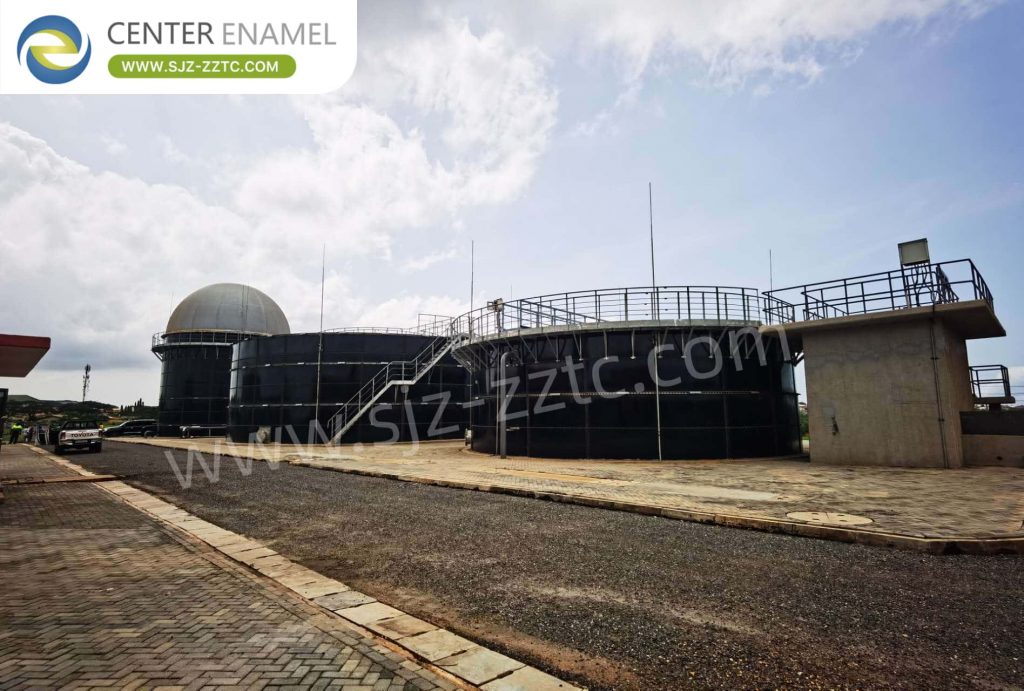
Completed installation in 2021, the Ghana project treats 1,800 m³/day of municipal wastewater using UBF anaerobic + A²/O nitrogen/phosphorus removal mature processes. It is equipped with multiple Center Enamel GFS tanks including 1 UBF anaerobic reactor, 1 secondary clarifier, and 2 internal/external double-layer A²/O biological tanks.
Influent has high COD, BOD, suspended solids, and nitrogen/phosphorus concentrations-after full treatment, effluent parameters are significantly reduced with pH stable at 6.5–9.0, fully meeting local environmental discharge standards. Corrosion-resistant, conveniently assembled GFS tanks efficiently solve urban domestic wastewater pollution while balancing treatment effectiveness and O&M economics-a mature municipal wastewater case in Africa, delivered by Center Enamel as Biogas Project Contractor and tank manufacturer.
Ghana Project Technical Specifications
| Parameter | Specification |
| Location | Ghana |
| Completion Year | 2021 |
| Treatment Capacity | 1,800 m³/day |
| Process Train | UBF Anaerobic + A²/O Nitrogen/Phosphorus Removal |
| GFS Tank Components | 1 UBF Anaerobic Reactor, 1 Secondary Clarifier, 2 A²/O Biological Tanks |
| Effluent pH Range | 6.5–9.0 |
| Application | Municipal Domestic Wastewater Treatment |
Center Enamel's Smart Manufacturing Base Scale
Center Enamel's core intelligent manufacturing base is located in Hebei Province, China, covering a total area of over 150,000 m², with Phase I mature manufacturing facility and Phase II high-end environmental equipment industrial park-dual-base synergy ensures stable production capacity.
The base includes dedicated R&D office buildings, proprietary material laboratories, and finished product testing centers, with full-process quality control systems meeting ISO, NSF, CE, and other international standards. The facility operates to green manufacturing standards, certified as a Provincial Green Factory-balancing efficient production with energy conservation and emission reduction. The company has 6 marketing service centers across China, establishing a nationwide production-sales network ensuring stable global order delivery.
The base is adjacent to expressway networks and major logistics hubs, with complete container shipping capabilities-supporting simultaneous large-scale tank projects globally. The base employs over 500 staff, with multiple parallel automated production lines-facility scale and production capacity firmly placing it among the global top tier of GFS tank equipment manufacturers.
Center Enamel is the only company globally integrating proprietary enamel frit R&D, self-manufactured tanks, and EPC general contracting-full-process self-control from solution design, equipment production, cross-border logistics, overseas construction, to post-construction O&M-significantly reducing client coordination and time costs. For any developer evaluating a Biogas Project Contractor, this vertical integration removes the interface risk that delays most USR Process projects.
Manufacturing and Integration Capability at a Glance
| Metric | Figure / Status |
| Base Area | 150,000+ m² |
| Facility Structure | Phase I manufacturing + Phase II environmental equipment park |
| Certifications | ISO, NSF, CE; Provincial Green Factory |
| Marketing Service Centers | 6 across China |
| Staff | 500+ |
| Production Lines | Multiple parallel automated lines |
| Integration Scope | Enamel frit R&D → tank manufacturing → EPC contracting → O&M |
| Logistics | Expressway access; full container shipping capability |
Gas Holder: Independent Double-Membrane Biogas Storage
Center Enamel's Gas Holder (independent double-membrane biogas holder) is a ground-mounted biogas storage device installed independently from the fermentation tank. It adopts a double-layer high-strength membrane structure, with the inner membrane forming the gas storage cavity and the outer membrane forming the protective shell. Continuous aeration between the inner and outer membranes maintains constant positive pressure, ensuring stable sealing of the gas storage cavity.
The Gas Holder is installed separately from the fermentation tank and connected via biogas transmission pipelines. Biogas produced from the fermentation tank is sent to the holder for storage after desulfurization and dehydration, then pressure-regulated and stably delivered to end-use equipment, enabling separated management of biogas production, storage, and utilization.
The gasholder volume can be customized from tens to thousands of cubic meters to meet storage and peak-shaving requirements for different production rates and consumption cycles. The Gas Holder is equipped with a comprehensive safety control system, including biogas leak detection, inner membrane overpressure protection, emergency flare stack, and lightning protection grounding, ensuring full operational safety. The membrane material uses high-strength PVDF outer membrane and biogas-corrosion-resistant inner membrane, with a service life of over 15 years. Maintenance is simple, requiring only periodic checks of membrane integrity and aeration system operation, with significantly lower lifecycle maintenance costs than steel gasholders.
Gas Holder Specifications
| Parameter | Specification |
| Type | Independent double-membrane biogas holder |
| Structure | Inner gas storage membrane + outer protective membrane |
| Pressure Control | Continuous aeration; constant positive pressure |
| Volume Range | Tens to thousands of m³ (customizable) |
| Safety Systems | Leak detection, overpressure protection, emergency flare, lightning grounding |
| Membrane Material | High-strength PVDF outer; biogas-corrosion-resistant inner |
| Service Life | 15+ years |
| Maintenance | Periodic membrane integrity and aeration checks |
Frequently Asked Questions
Q1: What should I look for in a Biogas Project Contractor?
A: Look for vertical integration-in-house tank manufacturing, process design, and construction crews. A contractor who outsources tanks or anaerobic internals creates interface risk. Center Enamel controls enamel frit R&D, GFS Tank production, USR Process design, and overseas installation under one contract.
Q2: Why is the USR Process preferred for high-solids biogas projects?
A: The USR Process tolerates high suspended solids, resists clogging without three-phase separators, and operates on flocculent sludge without granulation. This makes it reliable for livestock manure and agricultural wastewater where feedstock quality fluctuates and O&M resources are limited.
Q3: How does Center Enamel support projects after commissioning?
A: We provide 24/7 remote diagnostics, process parameter adjustment, tank anti-corrosion maintenance guidance, and dispatched on-site support for inspection, annual service, and refurbishment-plus long-term operational data tracking to optimize performance across the project lifecycle.
Let's Build Your Biogas Project Together
Choosing the right contractor is the difference between a plant that runs and a plant that lasts. Contact Center Enamel today for a free feedstock assessment and a tailored USR Process design built on our own GFS Tanks - one contract, one guarantee.
1,000+ biogas projects. 100+ countries. Talk to our engineers now and get your Biogas Project Contractor proposal and USR Process budget estimate within 48 hours.