
How We Handle High-Solids Organic Wastewater with the USR Process and Full-Chain EPC Delivery
High-solids organic wastewater is among the most difficult streams in agricultural and environmental engineering. Conventional anaerobic systems clog, wash out sludge, and react unevenly when solids loads rise. Center Enamel solves this with two complementary strengths: the USR Process, a reactor engineered specifically for high-suspended-solids wastewater, and full-chain EPC Contractor capability that carries a project from design through manufacturing, logistics, construction, and long-term operation.
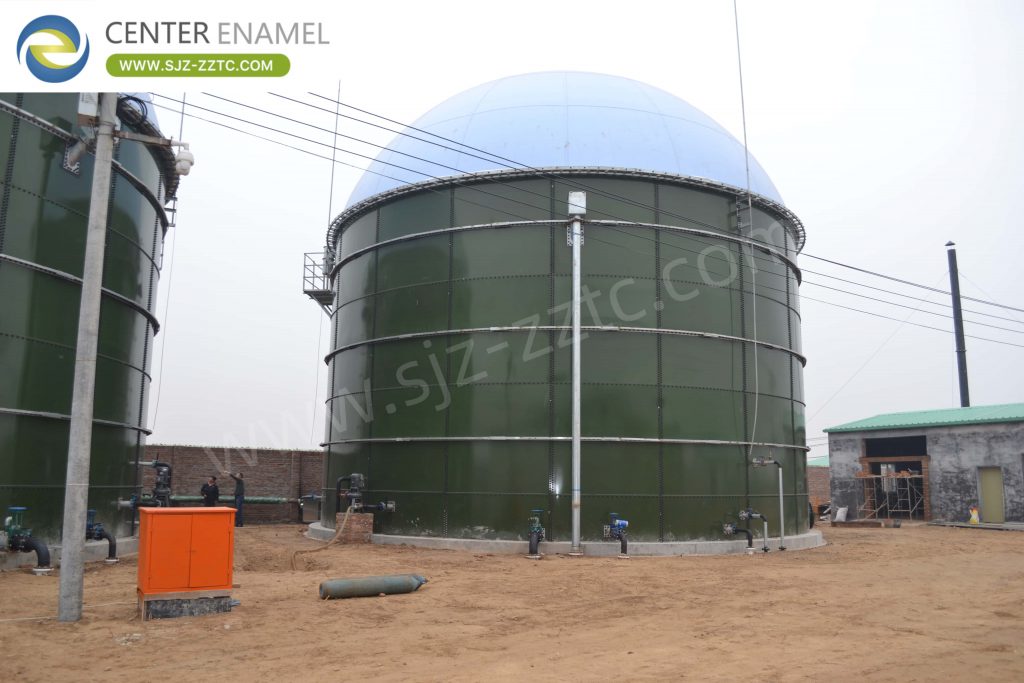
Together, they allow farms and industrial clients to treat the toughest organic wastewater reliably while recovering biogas as a clean energy asset. This article explores the regional context, the USR reaction mechanism, the water quality challenges involved, a proven reference project, and the manufacturing and delivery infrastructure that makes it all possible.
Regional Progress in Livestock Manure Management
Global livestock inventories such as swine remain stable, but the maturity of manure treatment varies widely by region. The US has developed technical models represented by integrated crop-livestock systems with on-field application and Comprehensive Nutrient Management Plans. Denmark, the Netherlands, and others have developed centralized biogas projects with digestate application systems. China's large-scale farms still have considerable room for improvement in supporting biogas project coverage, and digestate resource utilization rates lag behind advanced European levels.
Greenhouse gas emissions from livestock account for a significant proportion of total global anthropogenic emissions, making manure management a critical battleground for agricultural carbon reduction. Latin American countries started later in manure management but are accelerating relevant infrastructure development. Across every market, the same technical requirement emerges: a process that can handle high-solids organic wastewater without constant failure. This is where the USR Process and an experienced EPC Contractor become decisive.
The USR Reaction Process-How High-Solids Wastewater Is Treated Step by Step
The USR Process is best understood as a sequence of controlled biological stages. High-solids organic wastewater, after simple pretreatment to remove large debris, is uniformly fed into the reactor through the bottom distribution system. The upward flow drives solid substrates and anaerobic sludge to slowly rise and thoroughly mix.
In the sealed anaerobic environment, microorganisms sequentially hydrolyze and acidify, then methanogenically ferment, degrading macromolecular organic pollutants and generating biogas and treated water. Without complex separation structures, gentle hydraulic disturbance prevents clogging. The mixed liquor rises to the upper portion of the reactor where natural gas-liquid-solid separation occurs. Biogas is collected, effluent overflows, and solid sludge and unreacted substrate settle back to the lower reaction zone for continued reaction, with a small amount of aged sludge periodically discharged-enabling continuous stable operation.
This design is what allows the USR Process to tolerate suspended solids levels that would choke conventional reactors, and it is a core reason clients select Center Enamel as their EPC Contractor for agricultural wastewater projects.
Water Quality Characteristics-The "Four Highs" That Define the Challenge
Understanding the USR Process begins with understanding the influent it must handle. Livestock wastewater is a typical high-concentration organic wastewater with "four highs"-high COD, high ammonia nitrogen, high total phosphorus, and high suspended solids-creating a very high pollution load. COD can exceed 8,000 mg/L, with high turbidity and suspended solids. Nitrogen and phosphorus levels far exceed discharge standards, being the primary cause of eutrophication.
The wastewater is rich in manure, feed residues, and metabolic waste, readily turning black and odorous. Water quality fluctuates significantly with production cycles, seasons, and washing frequency. Aquaculture wastewater has lower pollutant concentrations but significant nitrogen and phosphorus accumulation issues, causing algal blooms and water quality deterioration with long-term discharge. These characteristics-high solids, high variability, high corrosivity-define why the USR Process, delivered by a capable EPC Contractor, is the appropriate technical answer.
Proven Performance-The Bangladesh Poultry Farm Reference Project
The effectiveness of this approach is demonstrated by a benchmark installation in Southeast Asia. The Bangladesh Large-Scale Poultry Farm Manure Resource Recovery Project targets local poultry farm manure resource recovery with daily treatment of 47 tons.
Influent COD, BOD, and SS measure as high as 50,000 mg/L, 25,000 mg/L, and 50,000 mg/L. After CSTR + UASB anaerobic treatment, all three parameters are reduced to below 200 mg/L, 100 mg/L, and 100 mg/L-effluent compliant with local environmental discharge standards. The project produces approximately 4,900 m³ of biogas daily. Each cubic meter of biogas can generate 2 kWh of electricity, with daily power generation of 9,800 kWh-simultaneously achieving pollutant reduction and clean energy recovery. This is a benchmark project for livestock waste recycling in Southeast Asia.
Table 1: Bangladesh Poultry Farm Manure Recovery Project-Performance Results
| Parameter | Influent Concentration | After Anaerobic Treatment | Removal Rate |
| COD | 50,000 mg/L | Below 200 mg/L | >99.6% |
| BOD | 25,000 mg/L | Below 100 mg/L | >99.6% |
| SS | 50,000 mg/L | Below 100 mg/L | >99.8% |
| Daily Treatment Capacity | 47 tons poultry manure | - | - |
| Biogas Production | 4,900 m³/day | - | - |
| Power Generation | 9,800 kWh/day | - | 2 kWh per m³ biogas |
Smart Manufacturing Scale Behind Every USR Process Installation
Delivering reliable high-solids treatment at scale requires manufacturing depth. Center Enamel is located in Hebei Province, China, covering a total area of over 150,000 m², with a mature Phase I manufacturing facility and a Phase II high-end environmental equipment industrial park-dual-base synergy ensures stable production capacity.
The base includes dedicated R&D office buildings, proprietary material laboratories, and finished product testing centers, with full-process quality control systems meeting ISO, NSF, CE, and other international standards. The facility operates to green manufacturing standards, certified as a Provincial Green Factory-balancing efficient production with energy conservation and emission reduction. The company has 6 marketing service centers across China, establishing a nationwide production-sales network ensuring stable global order delivery. The base is adjacent to expressway networks and major logistics hubs, with complete container shipping capabilities-supporting simultaneous large-scale tank projects globally. The base employs over 500 staff, with multiple parallel automated production lines-facility scale and production capacity firmly placing it among the global top tier of GFS tank equipment manufacturers. This capacity underpins every USR Process system Center Enamel delivers as an EPC Contractor.
Full-Industry-Chain Integrated Delivery Capability
Manufacturing scale alone is not enough-integration is what shortens timelines and reduces risk. Center Enamel is the only company globally integrating proprietary enamel frit R&D, self-manufactured tanks, and EPC general contracting-full-process self-control from solution design, equipment production, cross-border logistics, overseas construction, to post-construction O&M-significantly reducing client coordination and time costs.
For clients, this means a single accountable EPC Contractor managing every stage rather than multiple vendors with fragmented responsibilities. The result is faster delivery, clearer quality control, and fewer interface failures-critical advantages when deploying USR Process systems in remote or international locations.
Aluminum Geodesic Dome Roof-Engineered Covering for Demanding Sites
Completing the system is a roof designed for long-term performance. The Aluminum Geodesic Dome Roof, independently developed by Center Enamel, is manufactured using high-strength aluminum alloy plates through integral stamping. It features a triangular grid spherical self-supporting structure, enabling large-span full coverage without internal support columns.
Made of aluminum alloy, the roof offers excellent weather resistance and corrosion resistance, capable of long-term protection against acid rain, salt spray, and UV radiation, suitable for various extreme outdoor climate conditions. The structural design complies with international AWWA D108 standards, with aluminum plate thickness, rib cross-sections, and joint connections all verified by finite element stress analysis, ensuring wind and snow load resistance that meets building code requirements across different global regions.
The weight is only one-third to one-half of a steel roof with the same span, significantly reducing the load on the tank top and allowing direct installation without tank wall reinforcement. The roof provides superior overall sealing performance, with double sealing between panels using specialized sealant strips and mechanical interlocking, enabling both airtight gas storage and enclosed odor control, suitable for biogas collection and storage, wastewater tank odor control, and drinking water contamination prevention. The support-column-free design does not interfere with the installation and operation of internal equipment such as mixers and water distributors. The aluminum material does not support microbial growth, requiring no anti-corrosion maintenance over long-term use, resulting in low total life-cycle costs.
Table 2: Manufacturing, Delivery, and Roof Capabilities at a Glance
| Capability Area | Specification | Client Benefit |
| Manufacturing Base | 150,000+ m², dual-phase | Stable large-scale production |
| Quality Standards | ISO, NSF, CE certified | Global compliance |
| Green Certification | Provincial Green Factory | Sustainable production |
| Marketing Centers | 6 across China | Nationwide order support |
| Logistics | Expressway and container shipping access | Simultaneous global projects |
| Workforce | 500+ staff, multiple automated lines | Top-tier GFS tank capacity |
| Integration | Enamel R&D + manufacturing + EPC | Single-point accountability |
| Roof Standard | AWWA D108, finite element verified | Code compliance worldwide |
| Roof Weight | 1/3 to 1/2 of steel roof | Reduced structural load |
Whether your challenge is livestock manure, agricultural organic waste, or another high-solids stream, Center Enamel offers the USR Process expertise and full-chain EPC Contractor capability to deliver results. Contact our engineering team today to discuss your wastewater characteristics and receive a tailored treatment design. Let us show you how our manufacturing scale, integrated delivery model, and proven process technology have supported projects across 100+ countries.
Frequently Asked Questions
What makes the USR Process suitable for high-solids organic wastewater?
USR uses upflow hydraulics to mix solids and sludge without complex separators, preventing clogging and sludge washout. It tolerates very high influent suspended solids and operates stably with flocculent sludge-no granular sludge cultivation required.
What does an EPC Contractor handle in a wastewater project?
An EPC Contractor manages engineering, procurement, and construction as one integrated contract. Center Enamel controls design, enamel frit R&D, tank manufacturing, cross-border logistics, overseas installation, and post-construction O&M.
How does Center Enamel ensure quality across global projects?
Our 150,000 m² manufacturing base operates under ISO, NSF, and CE quality systems with dedicated material laboratories and testing centers, supported by 500+ staff and automated production lines.