
Helping Dairy Plants Treat High-Strength Wastewater with Anaerobic Technologies and GFS Tanks
Dairy processing generates wastewater throughout the production of liquid milk, milk powder, cheese, yogurt, cream, and other dairy products. From raw milk reception and pasteurization to fermentation, separation, filling, and equipment cleaning, each stage contributes wastewater with different flow rates and pollutant concentrations. In particular, Clean-in-Place (CIP) operations can produce intermittent discharges with high organic loads, making wastewater management more challenging for dairy facilities.
For dairy plants, treating this wastewater requires more than a conventional storage tank or a single biological process. High concentrations of proteins, fats, lactose, and other biodegradable organic matter can place significant demands on treatment systems. Flow and water quality may also fluctuate during production changes and cleaning cycles.
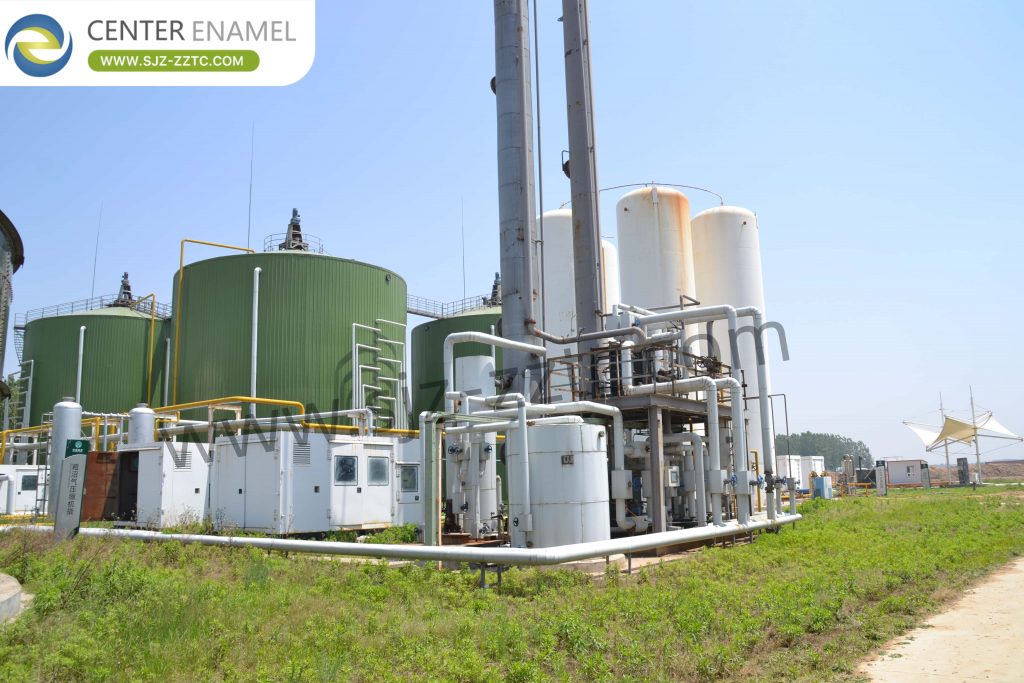
Center Enamel supports industrial wastewater projects with Anaerobic Technologies and GFS Tanks, helping customers develop treatment infrastructure suited to high-strength organic wastewater. By combining appropriate reactor selection, corrosion-resistant tank systems, and project installation capabilities, dairy plants can build more stable treatment processes while making better use of available land and potential energy resources.
Where Dairy Wastewater Comes From
Dairy wastewater is generated across almost every stage of production. Its composition depends on the products being manufactured, cleaning schedules, and the amount of water used in processing. Understanding these sources helps engineers determine the appropriate pretreatment and anaerobic treatment configuration.
| Production stage | Main wastewater sources | Typical characteristics |
| Raw milk reception and storage | Pipeline and tank washing | Milk residues, proteins, fats |
| Pasteurization and UHT | Equipment cleaning and cooling water | Organic residues, variable temperature |
| Separation and homogenization | Centrifuge and separator washing | Cream residues, fats and oils |
| Yogurt and cheese production | Fermentation tank and equipment cleaning | Lactose, proteins, cultures, whey residues |
| Milk powder production | Spray dryer and pipeline washing | Concentrated milk powder residues |
| Filling and packaging | Filling equipment and pipe cleaning | Product residues and cleaning wastewater |
| CIP and floor cleaning | Intermittent cleaning and washdown | Fluctuating pH, organic concentration, and flow |
Medium and large dairy plants may discharge hundreds or thousands of tons of wastewater daily, according to the supplied source material. CIP wastewater is particularly important because it is often discharged intermittently and can create sudden changes in flow and water quality.
Consequently, an effective treatment system should include suitable equalization and pretreatment before selecting the main biological process.
Choosing the Right Anaerobic Technologies
Anaerobic treatment uses microorganisms to break down biodegradable organic pollutants without oxygen. It can reduce the organic load of industrial wastewater while producing biogas that may be collected and used as an energy resource.
Different Anaerobic Technologies are designed for different wastewater conditions. The main selection factors include organic concentration, suspended solids, viscosity, flow rate, and the need for internal mixing.
IC Process for High-Strength Liquid Wastewater
The Internal Circulation (IC) reactor is a third-generation high-efficiency anaerobic technology developed from the UASB process. Its key feature is a built-in gas-lift circulation system that drives wastewater and sludge movement without requiring external return pumps.
The reactor generally consists of a lower main reaction zone and an upper polishing zone. Biogas generated during digestion drives internal hydraulic circulation, increasing upflow velocity and improving contact between microorganisms and organic matter.
The IC Process is particularly suitable for high-concentration, high-flow soluble industrial wastewater. For dairy facilities, it may be considered after effective removal of excessive fats, oils, and suspended solids.
Other Anaerobic Options
Not all dairy wastewater is suitable for high-rate IC treatment. Where wastewater contains higher suspended solids or requires more intensive mixing, other technologies may be more appropriate.
CSTR: Continuous Stirred Tank Reactors use mechanical mixing to maintain contact between microorganisms and organic matter. They can be considered for wastewater with higher solids content.
UASB: Upflow Anaerobic Sludge Blanket reactors use granular anaerobic sludge to degrade soluble organic pollutants.
EGSB: Expanded Granular Sludge Bed reactors use higher upflow velocities to improve contact between wastewater and granular sludge.
| Anaerobic technology | Main characteristic | Potential application |
| IC | Gas-lift internal circulation and compact configuration | High-strength, high-flow soluble wastewater |
| UASB | Granular sludge-based anaerobic treatment | Soluble organic wastewater |
| EGSB | Expanded sludge bed and enhanced contact | High-strength wastewater requiring efficient mass transfer |
| CSTR | Mechanical mixing throughout the reactor | Wastewater with higher suspended solids |
The final technology should be selected through wastewater analysis and engineering evaluation. In particular, high-solids or high-viscosity streams should not be directed into an IC reactor without confirming their suitability.
GFS Tanks: Durable Infrastructure for Anaerobic Treatment
The performance of an anaerobic treatment system depends not only on biological technology but also on the durability of its reactor structure. Wastewater, organic acids, and biogas-related corrosive conditions place demanding requirements on tank materials.
Center Enamel's GFS Tanks combine steel structural strength with a glass-enamel coating fused to the steel surface. The resulting protective layer is designed for demanding wastewater and biogas applications.
Key advantages include:
Corrosion resistance: The glass coating provides a protective barrier against corrosive wastewater and process conditions.
Long service life: Center Enamel's supplied material reports that its proprietary double-sided, double-layer enameling technology supports a GFS tank anti-corrosion service life exceeding 30 years.
Modular installation: Prefabricated panels are assembled on site, supporting efficient construction and flexible project delivery.
Customized dimensions: Tank height and diameter can be configured to suit available land and process capacity.
Expansion flexibility: Modular construction makes future layout adjustments easier than with fixed monolithic structures.
Center Enamel also reports developing more than 200 anti-corrosion enamel formulations, allowing coating selection to be adapted to different storage media and operating environments. Actual coating specifications and service-life expectations should be confirmed against the project conditions.
Flexible Tank Layouts for Modern Dairy Facilities
Land availability is an important consideration when expanding or upgrading a dairy wastewater treatment plant. Conventional poured concrete tanks have fixed dimensions once constructed, which can limit layout changes and future expansion.
By comparison, GFS Tanks offer greater flexibility in capacity and configuration. Their height and diameter can be adjusted to fit different site conditions, including narrow or irregularly shaped industrial plots.
According to the supplied company material, Center Enamel offers customized tank capacities ranging from dozens of cubic meters to 50,000 m³. Enamel color options can also help align tank appearance with surrounding industrial facilities.
This modular approach can support phased construction, improve space planning, and provide more flexibility when treatment capacity needs to increase.
Roof Solutions for Different Tank Applications
Tank roof selection should match the stored medium and operating conditions. Center Enamel offers different roof solutions for different applications.
Its FRP Roof Cover is designed for atmospheric-pressure storage tanks that do not require airtight gas containment. Available in flat and dome configurations, it is lightweight, resistant to moisture and mild chemical corrosion, and suitable for applications such as firewater storage, agricultural water storage, and temporary wastewater storage.
However, the FRP roof is not recommended for anaerobic fermentation tanks requiring biogas collection or pressurized gas containment. Those applications require an appropriately engineered gas-tight roof or dedicated gas storage system.
Choosing the correct cover at the design stage helps avoid mismatches between tank structure, process requirements, and gas management.
Global Construction and Technical Support
A successful wastewater project requires more than equipment manufacturing. Installation quality, construction coordination, and technical support all influence long-term system reliability.
Center Enamel has established domestic and international construction teams, with regular practical training in GFS tank installation and overseas construction standards. Regional teams can support multiple domestic projects, while international installation teams are prepared to work under different local construction requirements.
After installation, technical support may include tank inspections, process commissioning assistance, maintenance guidance, and operational troubleshooting.
This combination of manufacturing and construction resources helps Center Enamel support projects in different geographical environments, from remote sites to industrial facilities with demanding installation standards.
Build a More Efficient Dairy Wastewater Treatment System
Treating high-strength dairy wastewater requires the right combination of pretreatment, biological processes, durable tanks, and project execution. No single technology is suitable for every wastewater stream, so process selection must reflect actual influent characteristics and treatment objectives.
Center Enamel combines Anaerobic Technologies with customized GFS Tanks to support industrial wastewater and biogas applications. From IC reactors for suitable soluble wastewater to CSTR systems for higher-solids conditions, the company can help customers evaluate equipment and infrastructure options for their projects.
Whether you are constructing a new dairy wastewater treatment facility or upgrading an existing plant, contact Center Enamel to discuss your wastewater characteristics, tank requirements, and project configuration.
Looking for reliable GFS Tanks and anaerobic treatment solutions? Get in touch with our team to explore a customized system designed around your plant's operating conditions and long-term treatment needs.
Frequently Asked Questions
Which anaerobic technology is suitable for dairy wastewater?
The choice depends on wastewater composition. IC, UASB, and EGSB can treat suitable high-strength soluble wastewater after effective pretreatment. CSTR may be more appropriate when suspended solids are relatively high and intensive mixing is required.
Why are GFS Tanks used in anaerobic treatment?
GFS Tanks combine steel strength with a corrosion-resistant glass coating. Their modular construction supports customized dimensions, on-site assembly, and flexible plant layouts. They can be used as reactor vessels or storage tanks when properly engineered for the application.
Can FRP roofs be used on anaerobic digesters?
Standard FRP Roof Covers are intended for atmospheric-pressure tanks without gas-tightness requirements. They are not recommended for biogas-producing anaerobic digesters. These applications require a suitable gas-tight roof or dedicated gas storage solution.