
High-COD & High-Salinity Wastewater? Anaerobic Solutions That Cut Footprint and Costs
High-concentration organic wastewater is one of the most persistent challenges in industrial environmental engineering. Solving it requires more than a single reactor-it demands a fully integrated Anaerobic Solutions approach that combines proven process design, corrosion-resistant equipment, and long-term service capability. Center Enamel delivers exactly that, with the IC Process at the core of our anaerobic portfolio and GFS tanks engineered to withstand the most aggressive wastewater conditions worldwide.
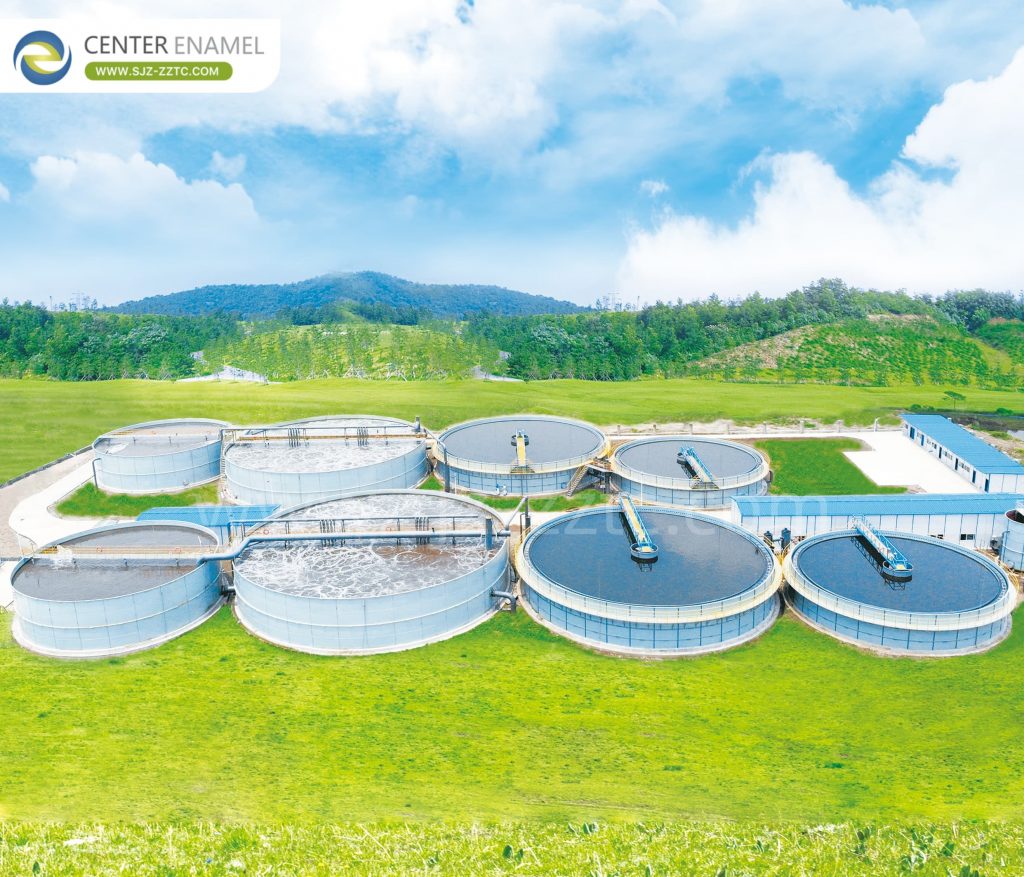
Market Landscape: Where Anaerobic Solutions Are Heading
The competitive landscape shows divergence, with leading companies building integrated service capabilities through technical integration and capital operations, and industry concentration gradually increasing. Chinese companies continue to consolidate their advantages in mid-tier equipment exports. International giants target high-end customers and complex industrial wastewater markets, while local players occupy the mid-to-low-end and industrial park centralized treatment markets with service responsiveness and cost advantages.
In the anaerobic process segment, UASB, EGSB, and IC anaerobic reactors-with advantages of high loading rates, small footprints, and stable operation-are widely used in high-concentration organic wastewater pretreatment in food processing, pharmaceutical fermentation, alcohol brewing, chemical, and other industries. These reactors use steel tank shells, and their corrosion resistance and gas-tightness directly determine long-term operational stability. This is precisely why the application value of glass-fused-to-steel tanks in such scenarios is increasingly prominent, and why Center Enamel builds its Anaerobic Solutions around them.
GFS Tanks Built for Compact, Intensive Plant Layouts
GFS tanks offer flexible customization of size and appearance, with higher land utilization rates-ideally suited for modern compact plant layouts, with significant advantages over fixed poured concrete tanks.
Concrete tanks cannot alter volume or shape after pouring. Their heavy bases occupy large areas, making placement difficult on narrow or irregular plots, and their rough, uniform appearance cannot match modern facility aesthetic requirements.
GFS tank volume can be precisely customized as needed, with capacities ranging from dozens of cubic meters to 50,000 cubic meters freely selectable. Tank height and diameter can be flexibly combined to fit narrow or irregularly shaped plots, effectively saving plant land occupation. Enamel color customization is also supported, achieving visual harmony with plant buildings and environmental facilities.
During later plant expansion, GFS tanks can be directly adjusted in layout and expanded; concrete tanks, being monolithic structures, must be demolished and rebuilt-offering far less flexibility in land resource utilization. This aligns well with the intensive construction and aesthetic operation and maintenance needs of industrial parks.
GFS Tanks vs. Concrete Tanks
| Parameter | GFS Tanks | Concrete Tanks |
| Volume Flexibility | Customizable after design | Fixed once poured |
| Capacity Range | Dozens to 50,000 m³ | Limited by structure |
| Footprint Efficiency | High, fits irregular plots | Low, heavy base |
| Expansion | Adjustable and expandable | Demolish and rebuild |
| Appearance | Custom enamel colors | Rough, uniform finish |
| Construction Time | Short, modular | Long curing period |
IC Process Supporting Equipment
Core equipment is the GFS tank with built-in gas-lift internal circulation system and upper/lower three-phase separators-key components for autonomous circulation and sludge-water separation. Bottom precision distribution system and pressure-regulating feed device ensure uniform stable influent.
Supporting equipment includes influent lift pumps, equalization tanks, and flow meters for precise influent control. Top high-efficiency biogas collection, desulfurization, dehydration, and storage integrated equipment. High-precision online monitoring equipment for real-time temperature, pH, COD, and level monitoring.
Bottom and mid-section dedicated sludge discharge pipes and recirculation control devices eliminate the need for external return pumps in internal circulation. The complete system is highly integrated, with no excess external equipment, compact structure, and high automation-making it a practical, deployable embodiment of modern Anaerobic Solutions.
IC Process System Components
| Component | Function |
| GFS Tank with Gas-Lift Internal Circulation | Core reactor body; autonomous circulation |
| Upper/Lower Three-Phase Separators | Sludge-water separation |
| Bottom Precision Distribution System | Uniform, stable influent |
| Pressure-Regulating Feed Device | Influent control |
| Biogas Collection, Desulfurization, Dehydration, Storage | Biogas handling |
| Online Monitoring (Temp, pH, COD, Level) | Real-time process control |
| Sludge Discharge Pipes & Recirculation Control | No external return pumps needed |
Pharmaceutical Wastewater: Standardized Treatment Solutions
Pharmaceutical wastewater cannot rely on a single process for compliance. It requires a combined treatment train of "pretreatment + anaerobic digestion + aerobic treatment + advanced treatment."
Pretreatment uses coagulation/sedimentation, DAF, advanced oxidation, and desalination processes to remove macromolecular organics, suspended impurities, and toxic/inhibitory substances-reducing biological toxicity and improving biodegradability. The main stage uses IC/CSTR anaerobic plus A/O coupled processes to target high-concentration organic pollutants. End-stage Fenton oxidation, activated carbon adsorption, and UF/RO advanced treatment remove residual recalcitrant pollutants and salts.
The full treatment train is lengthy, equipment complex, and operation and control demanding. Chemical and energy consumption run high, and toxic sludge hazardous waste disposal costs are substantial-requiring strict O&M expertise and equipment corrosion resistance. For this reason, tanks preferentially use Center Enamel GFS tanks to withstand high-salinity, highly corrosive wastewater, ensuring the Anaerobic Solutions perform reliably over the full asset life.
Global Integrated Standardized Service System
Leveraging regional sales centers in China and overseas local agent networks, Center Enamel has established a complete after-sales service loop covering all markets. The system provides four core service pillars: a 24/7 rapid response mechanism, on-site domestic and overseas installation services, full-project-cycle after-sales support, and long-term warranty protection-forming a complete service chain from preliminary site survey, mid-term construction management, to long-term inspection and maintenance.
The entire system is uniformly adapted to both domestic and international project service standards, coordinating personnel scheduling, material support, and on-site coordination for simultaneous projects across multiple regions-significantly reducing customer multi-party coordination costs and ensuring efficient domestic and overseas project delivery.
Comprehensive International Certifications
Center Enamel holds CE, NSF, WRAS, ISO9001, BSCI, ASME, and other global certifications-fully clearing EU, North American, Southeast Asian, and African project tendering barriers. These credentials provide critical hard advantages for large overseas project bidding and reinforce the credibility of our Anaerobic Solutions and IC Process deployments worldwide.
FRP Roof Cover Solution for Atmospheric Storage
FRP Roof is a general-purpose economical roof for atmospheric pressure storage tanks without air-tightness requirements. It is suitable for drinking water storage, agricultural irrigation water, firewater reserve, and general production wastewater temporary storage. It is available in two styles-flat and dome-allowing flexible selection based on tank specifications and site aesthetic requirements.
The roof is integrally molded from resin and fiberglass: lightweight, with natural water resistance and mild acid/alkali corrosion resistance. It will not rust or rot in long-term humid environments, eliminating the frequent anti-corrosion maintenance required for metal roofs. The dome style features excellent drainage performance due to its curved structure, resisting water accumulation, dust buildup, snow load, and strong winds. The flat style facilitates the installation of maintenance walkways, level gauges, and vents on top, making inspection and operation convenient.
The product is fully insulated with no risk of galvanic corrosion, will not contaminate drinking water quality, and meets environmental standards for domestic water storage. The modular design with low individual component weight allows for simple on-site hoisting and assembly, offering high construction efficiency and affordable procurement and installation costs.
It is only suitable for atmospheric pressure water storage tanks without biogas collection or pressurization requirements, and is not recommended for anaerobic fermentation gas-producing conditions. It is widely used in rural agricultural water storage tanks, industrial park firewater tanks, waterworks buffer tanks, and small to medium-sized domestic wastewater temporary storage facilities-making it a cost-effective general-purpose roof choice for conventional water storage applications.
Roof Solution Comparison
| Feature | FRP Roof | Aluminum Geodesic Dome Roof |
| Primary Use | Atmospheric water storage | Biogas collection, odor control |
| Styles | Flat, Dome | Geodesic dome |
| Corrosion Resistance | Mild acid/alkali | High, weather resistant |
| Sealing | Not airtight | Airtight, double sealed |
| Biogas Collection | Not suitable | Yes |
| Maintenance | Low | Virtually none |
Frequently Asked Questions
Q1: What are Anaerobic Solutions, and when should they be used?
Anaerobic Solutions use microorganisms to degrade organic pollutants without oxygen. They suit high-concentration, high-flow soluble organic wastewater-including food, brewery, pharmaceutical, and chemical streams.
Q2: What makes the IC Process different from traditional anaerobic reactors?
The IC Process uses built-in gas-lift internal circulation, requiring no external return pumps. It offers higher loading rates, stronger shock-load tolerance, and a footprint about one-third of traditional systems.
Q3: Why are GFS tanks used with the IC Process?
GFS tanks resist pH 1–14, high salinity, and microbial corrosion, with a 30+ year service life. They provide the gas-tightness and durability that IC Process stability depends on.
Let's Design the Right Anaerobic Solution for Your Site
Every high-strength wastewater stream behaves differently-and so should the solution. Share your effluent profile with Center Enamel, and our engineers will recommend the right IC Process configuration, tank specification, and supporting equipment for your project.
From feasibility study through commissioning and long-term O&M support, we deliver complete Anaerobic Solutions backed by 30,000+ global projects. Reach out today to discuss your next project.