
How Center Enamel Delivers High-Efficiency Livestock Wastewater Treatment for Farms Worldwide
The global livestock industry faces mounting pressure to manage manure and wastewater responsibly. With regulatory frameworks tightening across the US, EU, and Asia-and with operators seeking to recover energy and nutrients rather than treat waste as a pure cost-the demand for integrated Livestock Wastewater Treatment Project solutions has never been greater. Center Enamel addresses this challenge through a comprehensive approach built around Anaerobic Digestion, combining proprietary Glass-Fused-to-Steel tank technology with proven biological processes to convert farm effluent into biogas, compliant discharge, and reusable by-products.
The Global Shift Toward Full-Process Nutrient and Wastewater Management
The regulatory landscape for livestock manure is undergoing fundamental transformation. The United States, through Comprehensive Nutrient Management Plans, now mandates a whole-farm approach rather than end-of-pipe fixes. The European Union's Nitrates Directive imposes strict limits on manure application, with Germany and the Netherlands deploying tax instruments to enforce nitrogen and phosphorus recovery targets. Denmark has pioneered distinctive livestock regulation combined with ecological compensation mechanisms. Meanwhile, the Netherlands links manure treatment directly to phosphate quotas-creating direct economic incentives for farms to adopt advanced treatment technologies. China has likewise issued a series of environmental regulations that now comprehensively govern pollution from large-scale livestock operations.
These converging policy pressures share a common thread: the expectation that livestock wastewater is no longer discharged untreated. Instead, farms are increasingly required to demonstrate measurable nutrient recovery, pathogen reduction, and where feasible, energy recovery. This regulatory shift has elevated the Livestock Wastewater Treatment Project from a compliance burden to a strategic infrastructure investment.
Understanding the Challenge-What Makes Livestock Wastewater So Difficult to Treat?
Livestock wastewater originates from large-scale poultry, livestock, and aquaculture operations. It is generated primarily during farming operations and facility cleaning, with the dominant component being wash water from pig, cattle, and poultry housing, manure and urine seepage, and facility washdown-all rich in livestock metabolic residues. Aquaculture wastewater contributes periodically from pond water exchange and cleaning, carrying feed residues and metabolic waste.
What makes this effluent uniquely challenging is its concentration. COD, BOD, and suspended solids routinely measure in the tens of thousands of milligrams per liter. Pathogenic organisms are present at concentrations that pose public health risks if not properly treated. Nitrogen and phosphorus levels contribute to eutrophication when discharged. And unlike municipal wastewater, flow rates and pollutant loads fluctuate dramatically with production cycles, feeding schedules, and cleaning routines.
Small-scale farmers often lack adequate collection facilities, resulting in direct discharge to land and water. Large-scale farms typically have collection systems for centralized treatment, but water production still varies considerably with production cycles and cleaning frequency. Effectively managing this variability requires a treatment approach that is both robust and flexible-a design philosophy that underpins Center Enamel's Livestock Wastewater Treatment Project solutions.
The USR and CSTR Processes-Engineered for High-Solids Agricultural Wastewater
Center Enamel's treatment philosophy begins with selecting the right anaerobic process for the specific characteristics of livestock wastewater. Two reactor configurations are particularly well-suited to this application.
The USR (Upflow Solids Reactor) is an upflow anaerobic process modified for high-suspended-solids, high-solids organic wastewater. It was specifically designed to solve the problems of clogging, sludge washout, and uneven reaction that plague traditional anaerobic processes when treating high-solids waste. The USR eliminates complex three-phase separators, simplifies internal structure, and relies on upflow hydraulics to promote thorough mixing of solid materials and anaerobic sludge. No strict granular sludge formation conditions are required-flocculent sludge can operate stably. The key feature is high solids tolerance and impurity resistance, making it a dedicated high-efficiency anaerobic process for livestock manure, agricultural organic waste, and high-solids livestock wastewater.
The CSTR (Continuous Stirred-Tank Reactor) serves as the industry default for high-solids feedstocks. It utilizes mechanical mixing to maintain a homogeneous environment, maximizing contact between microorganisms and organic matter. This ensures stable and high biogas yield even with thick, complex materials characteristic of concentrated pig or cattle manure. The CSTR's ability to handle viscous slurries without clogging makes it particularly valuable for farms where manure is collected as a thick slurry rather than flushed with large volumes of water.
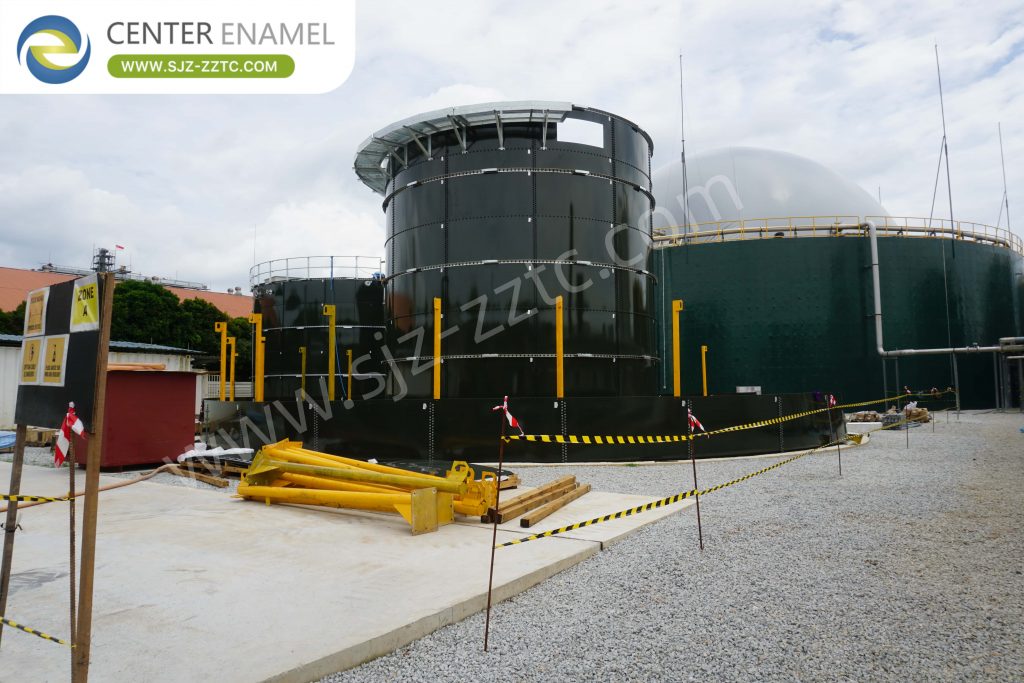
Both processes share a critical requirement: a containment vessel that can withstand the corrosive environment of actively digesting manure. Center Enamel's Glass-Fused-to-Steel (GFS) tanks meet this requirement through a proprietary manufacturing process. Enamel frit is fused to steel at temperatures exceeding 820°C, creating a vitrified glass coating that forms an inert, impermeable barrier against organic acids, ammonia, and hydrogen sulfide-the corrosive agents that shorten the life of concrete or ordinary steel tanks.
From Wastewater to Energy-The Biogas Advantage of Anaerobic Digestion
The economic case for treating livestock wastewater through Anaerobic Digestion rests on a simple principle: the organic matter that creates pollution also contains energy. By capturing this energy as biogas, farms can offset treatment costs and generate a revenue stream from what would otherwise be a disposal expense.
A reference project demonstrates the scale of what is achievable. The Bangladesh Large-Scale Poultry Farm Manure Resource Recovery Project processes 47 tons of poultry manure daily. Influent COD, BOD, and SS measure 50,000 mg/L, 25,000 mg/L, and 50,000 mg/L respectively. After CSTR + UASB anaerobic treatment, all three parameters drop below 200 mg/L, 100 mg/L, and 100 mg/L-effluent fully compliant with local environmental discharge standards.
The environmental performance tells only half the story. The same facility produces approximately 4,900 m³ of biogas daily. At a conversion rate of 2 kWh per cubic meter, daily power generation reaches 9,800 kWh-enough to meaningfully offset farm energy consumption or feed into the grid. This dual outcome of pollutant reduction and clean energy recovery has established the project as a benchmark for livestock waste recycling in Southeast Asia.
The biogas also carries value as a thermal resource. Combined heat and power units convert biogas into both electricity and usable heat, which can be directed toward barn heating, water heating, or process needs. Excess heat or power can sometimes be exported, further improving project economics.
Material Technology That Extends Digester Life Beyond Conventional Systems
Anaerobic digestion environments are among the most aggressive in industrial wastewater treatment. The combination of organic acids, ammonia, hydrogen sulfide, and moisture creates conditions that rapidly degrade ordinary materials. Center Enamel has addressed this challenge through more than three decades of focused development in enamel anti-corrosion technology.
The company has independently developed over 200 anti-corrosion enamel formulations. Proprietary double-sided, double-layer enameling technology produces GFS tanks with an anti-corrosion service life exceeding 30 years-far surpassing concrete and ordinary equipment-and suitable for the most corrosive global wastewater and biogas fermentation conditions.
The manufacturing process itself is a quality control measure. Enamel frit is fired onto steel at 820°C to 930°C, bonding glass to steel at the molecular level. The result is a smooth, inert, non-porous surface that resists bio-fouling, simplifies cleaning, and maintains structural integrity under continuous exposure to aggressive digestate.
Single and Double Membrane Roofs-Optimizing Biogas Capture and Storage
The digester vessel is only part of the gas management equation. Equally important is the roof system that captures and contains the biogas. Center Enamel offers two proprietary airtight tank cover systems for anaerobic digestion and biogas storage projects, specifically developed for biogas collection and odor containment.
The single-layer membrane roof features a simple structure with economical cost, meeting basic biogas containment needs. It is an appropriate choice for projects where thermal insulation and load resistance are not critical design drivers.
The double-layer membrane roof consists of inner and outer corrosion-resistant membrane materials with pressurized air in the interlayer forming rigid support. This configuration provides outstanding thermal insulation that reduces biogas condensate formation inside the tank. It also delivers enhanced wind and snow load resistance, making it suitable for high-altitude and windy outdoor sites.
Both configurations use specialized aging-resistant and biogas-slurry-corrosion-resistant PVDF membrane. This material will not leak or degrade from long-term contact with biogas or hydrogen sulfide. The flexible structure accommodates tank settlement and slight deformation without cracking or gas leakage-an important consideration for large-diameter tanks subject to thermal cycling and soil movement.
The lightweight design eliminates heavy steel support trusses, significantly reducing the load on the tank and foundation and saving construction costs. The roof integrates biogas outlets, safety pressure relief valves, and access channels, fully enabling closed gas collection for anaerobic fermentation tanks. This recovers biogas for power generation and heating while blocking odor diffusion to meet environmental odor control requirements.
These systems are widely used in large-scale livestock biogas projects, municipal sludge anaerobic digestion, and food waste fermentation projects, compatible with large-volume GFS anaerobic tanks. Construction is fast and maintenance is simple, requiring only periodic membrane seal integrity checks, offering significant overall engineering advantages.
Center Enamel-Three Decades of Environmental Engineering Excellence
The technologies described above are not laboratory concepts. They are field-proven systems delivered by a company with deep expertise in the environmental infrastructure sector.
Center Enamel has been engaged in the environmental bolted storage equipment field for over 30 years. Starting with proprietary enamel anti-corrosion material technology, the company has gradually completed a full-industry-chain upgrade from a single tank manufacturer to a comprehensive environmental EPC service provider.
Throughout its 30+ year history, the company has been recognized as a National High-Tech Enterprise, National Specialized and Sophisticated "Little Giant," Manufacturing Single Champion, and Provincial Green Factory. It has successfully delivered over 30,000 environmental projects globally, establishing itself as a leading enterprise in the global GFS tank storage industry.
The company has fully integrated the entire chain from enamel frit R&D, intelligent environmental equipment manufacturing, to EPC project contracting. Every business breakthrough has been achieved through proprietary core anti-corrosion technology. For livestock operators considering a Livestock Wastewater Treatment Project, this vertical integration means a single point of accountability from design through commissioning.
Data Tables
Table 1: Bangladesh Poultry Farm Manure Recovery Project-Performance Summary
| Parameter | Influent Concentration | After CSTR + UASB Treatment | Removal/Outcome |
| COD | 50,000 mg/L | Below 200 mg/L | >99.6% removal |
| BOD | 25,000 mg/L | Below 100 mg/L | >99.6% removal |
| SS | 50,000 mg/L | Below 100 mg/L | >99.8% removal |
| Daily Treatment Capacity | 47 tons poultry manure | - | - |
| Biogas Production | 4,900 m³/day | - | - |
| Power Generation | 9,800 kWh/day | - | 2 kWh per m³ biogas |
Whether you are replacing aging lagoon systems, expanding an existing biogas facility, or planning a new greenfield development, our specialists are ready to help you evaluate the technical and economic feasibility of Anaerobic Digestion for your operation. Reach out to Center Enamel and discover why over 30,000 projects worldwide trust our GFS tank technology and EPC expertise.
Frequently Asked Questions
What makes livestock wastewater difficult to treat with conventional anaerobic systems?
High suspended solids cause clogging and sludge washout in traditional reactors. Center Enamel's USR and CSTR processes are specifically engineered for high-solids livestock wastewater, maintaining stable operation where conventional systems fail.
How does a Livestock Wastewater Treatment Project generate revenue?
Biogas production creates value through electricity generation, heat recovery, or biomethane upgrading. Nutrient-rich digestate can be recovered as fertilizer, offsetting treatment costs and creating additional income streams.
Why choose GFS tanks over concrete for anaerobic digesters?
GFS tanks offer superior corrosion resistance against hydrogen sulfide and organic acids, faster installation, lower maintenance, and a service life exceeding 30 years-typically at lower installed cost than site-built concrete alternatives.