
IC Reactor Solutions for High-Performance Industrial Wastewater Treatment Projects
High-strength organic wastewater demands more than conventional biology-it demands a reactor that circulates, degrades, and recovers energy with minimal intervention. The IC Reactor delivers exactly that, and when it is paired with durable glass-fused-to-steel containment, an Industrial Wastewater Treatment Project gains both efficiency and longevity. Center Enamel brings these elements together through integrated manufacturing, proven installation experience, and full-chain delivery.
A Market Shaped by Divergence and Concentration
The competitive landscape shows divergence, with leading companies building integrated service capabilities through technical integration and capital operations, and industry concentration gradually increasing. Chinese companies continue to consolidate their advantages in mid-tier equipment exports. International giants target high-end customers and complex industrial wastewater markets, while local players occupy the mid-to-low-end and industrial park centralized treatment markets with service responsiveness and cost advantages. In the anaerobic process segment, UASB, EGSB, and IC anaerobic reactors-with advantages of high loading rates, small footprints, and stable operation-are widely used in high-concentration organic wastewater pretreatment across food processing, pharmaceutical fermentation, alcohol brewing, chemical, and other industries. These reactors use steel tank shells, and their corrosion resistance and gas-tightness directly determine long-term operational stability. The application value of glass-fused-to-steel tanks in such scenarios is increasingly prominent, making containment choice inseparable from process performance in any serious Industrial Wastewater Treatment Project.
Inside the IC Reactor: Autonomous Internal Circulation
Pretreated high-strength organic wastewater enters the lower main reaction zone from the bottom, mixing with recirculated sludge-water mixture and rising rapidly. Anaerobic microorganisms efficiently degrade organic matter, producing large volumes of biogas. The gas-lift action of biogas carries the mixed liquor upward to the top gas-liquid separator, where biogas is collected. Degassed sludge-water mixture returns by gravity through downcomers to the reactor bottom, creating autonomous internal circulation that repeatedly enhances pollutant degradation. After multiple circulation cycles, the wastewater enters the upper polishing zone for further reaction and sludge-water separation. Remaining trace organics are fully degraded, sludge settles back to the lower reaction zone, treated effluent overflows from the top, and aged sludge is periodically discharged-fully autonomous circulation, efficient continuous operation. No external return pumps are required, which keeps the IC Reactor compact, energy-efficient, and highly automated.
What Makes Beverage Wastewater an Ideal Match
Beverage wastewater is defined by high COD, high sugar content, low suspended solids, slight acidity, and excellent biodegradability-with significant fluctuations. COD typically ranges from 3,000 to 20,000 mg/L, with high-concentration CIP cleaning wastewater peaking above 50,000 mg/L. Core pollutants are soluble sugars-sucrose, fructose, glucose-highly degradable organics, with BOD/COD typically 0.5 to 0.65, an industry-leading biodegradability ratio. Suspended solids remain low, primarily fruit pulp, tea residues, and fiber impurities. pH runs slightly acidic, with juice wastewater at 3–4 and carbonated beverage wastewater containing phosphoric acid. Color varies by beverage type, and temperature sits at a moderate 20–40°C. Water quality fluctuates intermittently with CIP cleaning cycles and product changeovers, alternating high-concentration CIP and low-concentration filling wastewater. Because sugars are the best anaerobic substrate, an IC Reactor converts this load into stable biogas with high COD removal-turning a disposal burden into recoverable energy.
GFS Tanks Fitted to Intensive Plant Layouts
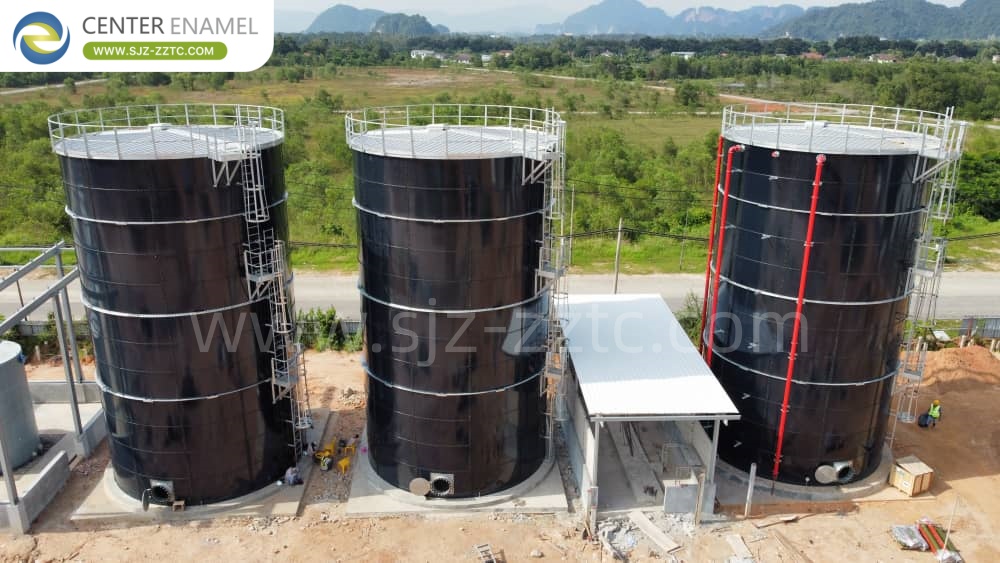
Equally important is where the equipment sits. GFS tanks offer flexible customization of size and appearance, with higher land utilization rates, ideally suited for modern compact plant layouts and significantly advantaged over fixed poured concrete tanks. Concrete tanks cannot alter volume or shape after pouring, with heavy bases occupying large areas, making placement difficult on narrow or irregular plots, and their rough, uniform appearance cannot match modern facility aesthetic requirements. GFS tank volume can be precisely customized as needed, with capacities ranging from dozens of cubic meters to 50,000 cubic meters freely selectable. Tank height and diameter can be flexibly combined to fit narrow or irregularly shaped plots, effectively saving plant land occupation. Enamel color customization is also supported, achieving visual harmony with plant buildings and environmental facilities. During later expansion, GFS tanks can be directly adjusted in layout and expanded; concrete tanks, being monolithic, must be demolished and rebuilt. This aligns well with the intensive construction and aesthetic operation needs of industrial parks-an important practical advantage in any Industrial Wastewater Treatment Project.
Over a Decade of Global Installation Experience
Unmatched global practical experience among domestic peers-over a decade covering multiple regions and all industry sectors.
| Milestone | Detail |
| 2009 | First overseas GFS tank installation-team dispatched to Niger, Africa for drinking water storage |
| 2015 | China's first GFS tank export and installation to the US, passing strict US acceptance standards |
| Applications | Livestock biogas, POME, municipal wastewater, drinking water storage |
| Regions Covered | Southeast Asia, Africa, the Americas |
| Site Expertise | Mountainous terrain, coastal salt spray, tropical heat, high-standard European/American conditions |
All installed projects have operated stably for many years, and construction has covered Southeast Asia, Africa, the Americas, and other regions-accumulating specialized solutions for complex sites and maturely addressing global special construction requirements.
Full-Chain Integrated Delivery
Center Enamel is the only company globally integrating proprietary enamel frit R&D, self-manufactured tanks, and EPC general contracting-full-process self-control from solution design, equipment production, cross-border logistics, overseas construction, to post-construction O&M-significantly reducing client coordination and time costs.
Roofing Choices for Every Storage Need
Not every tank in a project needs gas-tight anaerobic conditions. FRP Roof is a general-purpose economical roof for atmospheric pressure storage tanks without air-tightness requirements, suitable for drinking water storage, agricultural irrigation water, firewater reserve, and general production wastewater temporary storage. It is available in flat and dome styles, allowing flexible selection based on tank specifications and site aesthetic requirements. The roof is integrally molded from resin and fiberglass, lightweight, with natural water resistance and mild acid/alkali corrosion resistance. It will not rust or rot in long-term humid environments, eliminating the frequent anti-corrosion maintenance required for metal roofs. The dome style features excellent drainage performance due to its curved structure, resisting water accumulation, dust buildup, snow load, and strong winds.
The flat style facilitates installation of maintenance walkways, level gauges, and vents on top, making inspection and operation convenient. The product is fully insulated with no risk of galvanic corrosion, will not contaminate drinking water quality, and meets environmental standards for domestic water storage. Modular design with low component weight allows simple on-site hoisting and assembly, offering high construction efficiency and affordable procurement and installation costs. It is only suitable for atmospheric pressure water storage tanks without biogas collection or pressurization requirements, and is not recommended for anaerobic fermentation gas-producing conditions. It is widely used in rural agricultural water storage tanks, industrial park firewater tanks, waterworks buffer tanks, and small to medium-sized domestic wastewater temporary storage facilities-a cost-effective general-purpose roof for conventional water storage.
Frequently Asked Questions
Why choose an IC Reactor over UASB or EGSB?
The IC Reactor uses biogas-driven internal circulation for higher loading rates and a smaller footprint, with no external return pumps-ideal for land-constrained, high-strength projects.
Is an IC Reactor suitable for beverage wastewater?
Yes. Soluble sugars are an excellent anaerobic substrate, and IC reactors achieve high COD removal and stable biogas production despite intermittent CIP fluctuations.
Can GFS tanks be expanded later?
Yes. Volume and layout can be adjusted during expansion, while concrete tanks must be demolished and rebuilt.
Share your wastewater profile and site constraints, and our engineers will size the right IC Reactor configuration for you. Connect with Center Enamel today and turn your next industrial wastewater treatment project into a model of efficiency and reliability.