
How the USR Process Powers High-Solids Biogas Power Plant Projects
Building a Biogas Power Plant that runs on livestock manure, crop residue, or high-solids agricultural wastewater demands more than a standard anaerobic digester. Conventional processes clog, wash out sludge, and demand precise feedstock control-conditions rarely met on real farms or county-level projects. The USR Process (Upflow Solids Reactor) was engineered specifically to solve these problems, and when paired with GFS Tanks and airtight membrane roofs, it forms the backbone of a stable, profitable Biogas Power Plant.
Market and Industry Landscape: Why Anaerobic Digestion Is Consolidating Around Proven Technology
The global biogas industry competitive landscape shows divergence. Leading companies dominate major project market shares through the "EPC + Operation" integrated model, while small and medium-sized enterprises focus on county-level distributed projects and specialized equipment segments. China's biogas equipment exports continue to expand, with generator sets primarily flowing to emerging markets.
Business model innovation is accelerating, with carbon asset development becoming a standard feature of large projects, converting methane emission reductions into tradable carbon credits. Some countries have piloted digestate fertilizer carbon credit trading, encouraging the integration of digestate application to farmland with carbon accounting. The "biogas operation outsourcing" service model is emerging, improving operational efficiency of county-level projects through professional management.
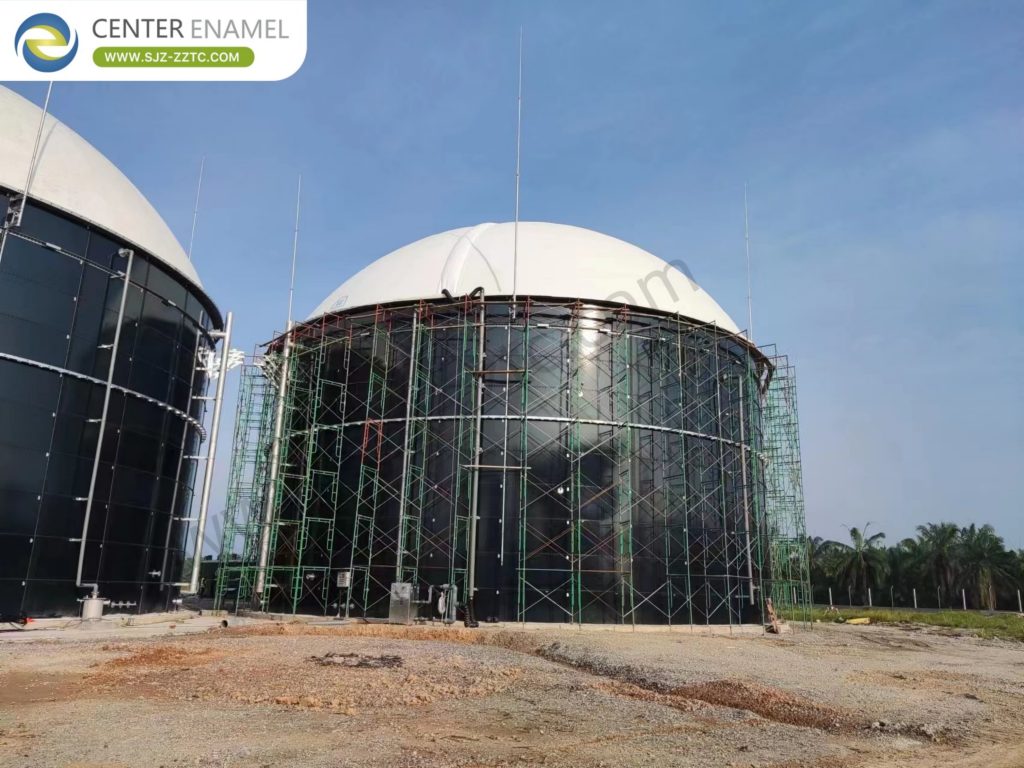
From a technology and equipment perspective, anaerobic digestion is the core process of biogas engineering. Glass-fused-to-steel (GFS) tanks, with their excellent sealing, corrosion resistance, and construction convenience, have become the mainstream choice for large anaerobic digestion tanks. Their modular design can be combined with membrane gas holders to form an integrated "fermentation + gas storage" solution, with penetration rates continuing to rise in new projects in biogas industry clusters. For any Biogas Power Plant developer, this convergence means technology selection-especially the choice between conventional digesters and the USR Process-directly determines project bankability.
Full-Process Factory Standardization: The GFS Tank Foundation for Every Biogas Power Plant
GFS tanks are fully factory-prefabricated to standardized specifications, with finished product quality stability far exceeding cast-in-place concrete tanks. All concrete tank processes are completed in the open air, with rebar tying, concrete pouring, and curing heavily influenced by worker skill, temperature, and rainfall. Wall thickness, density, and strength vary significantly between batches, with hidden defects like honeycombing, voids, and insufficient wall thickness common-quality cannot be uniformly controlled.
Center Enamel's GFS tank steel panels, seals, and reinforcement components are all mass-produced in automated factories. Steel stamping, high-temperature enameling, and dimensional cutting are all controlled by CNC equipment, with each panel's parameters and enamel thickness strictly following unified national standards. All components are uniformly packaged and transported to site, with assembly strictly following standardized construction drawings.
Full-process quality inspection from raw materials to finished components ensures highly consistent product performance parameters, completely eliminating the uncontrollable quality risks of on-site concrete construction. Every tank delivers stable, consistent performance-the structural guarantee that allows the USR Process to operate at design efficiency inside a Biogas Power Plant.
GFS Tanks vs. Concrete Tanks for Biogas Power Plant Digesters
| Dimension | GFS Tanks | Concrete Tanks |
| Quality Control | Factory-prefabricated; CNC-controlled parameters | On-site casting; dependent on labor and weather |
| Corrosion Resistance | Double-sided fused glass coating; resistant to H₂S, organic acids, high salinity | Requires anti-corrosion lining; prone to failure |
| Gas Tightness | Precision-bolted, gas-tight construction | Curing cracks common; methane leakage risk |
| Installation Timeline | Modular assembly; weeks vs. months | Cast-in-place; weather-dependent |
| Service Life | 30+ years with minimal maintenance | 15–20 years with lining upkeep |
USR Process Definition: The Anaerobic Technology Built for High-Solids Wastewater
USR, or Upflow Solids Reactor, is an upflow anaerobic process modified for high-suspended-solids, high-solids organic wastewater, specifically designed to solve problems of clogging, sludge washout, and uneven reaction common in traditional anaerobic processes for high-solids wastewater.
The USR Process eliminates complex three-phase separators, simplifies internal structure, and relies on upflow hydraulics to promote thorough mixing of solid materials and anaerobic sludge. No strict granular sludge formation conditions are required-flocculent sludge can operate stably. The key feature is high solids tolerance and impurity resistance, with very high influent suspended solids tolerance. It is a dedicated high-efficiency anaerobic process for livestock manure, agricultural organic waste, and high-solids livestock wastewater, specifically developed for agricultural and environmental applications-and it is the process of choice for any Biogas Power Plant handling these feedstocks.
USR Process vs. Conventional Anaerobic Processes
| Parameter | USR Process | Conventional Anaerobic Processes |
| Solids Tolerance | Very high; designed for high-suspended-solids streams | Limited; requires pre-settling or dilution |
| Clogging Risk | Minimal; no three-phase separator | High; separator and piping prone to blockage |
| Sludge Requirement | Flocculent sludge; no granulation needed | Often requires mature granular sludge |
| Start-Up Time | Fast; short acclimation period | Slow; extended sludge cultivation |
| Maintenance | Simple; no precision wear parts | Complex; separator and internals wear |
| Best Fit | Livestock manure, agricultural high-solids wastewater | Low-solids industrial streams |
Key Water Quality Characteristics in a Biogas Power Plant
Stable water quality, simple composition, with high ammonia nitrogen, high total phosphorus, high salinity, and low COD as core characteristics-prominent eutrophication concerns.
Through thorough anaerobic digestion, most macromolecular organics have been converted to methane and carbon dioxide, resulting in significantly reduced and stable COD with no easily decomposable pollutants. Nitrogen, phosphorus, and potassium nutrients are concentrated during fermentation, with ammonia nitrogen and total phosphorus far exceeding conventional discharge standards-these are the key control parameters. Moderate to high salinity with strong acid/base buffering, slightly alkaline. Clear, low-turbidity liquor with minimal odor, very low suspended solids. Moderate biodegradability, no major fluctuations, without the high pollution load characteristics of conventional organic wastewater.
These characteristics are precisely why the USR Process is specified for Biogas Power Plant digestate streams-the process tolerates the ammonia and salinity loads that destabilize conventional digesters.
Biogas Power Plant Wastewater Quality Profile
| Parameter | Characteristic | Implication |
| COD | Low and stable after digestion | No easily decomposable pollutants |
| Ammonia Nitrogen | High; exceeds discharge standards | Key control parameter |
| Total Phosphorus | High; eutrophication concern | Key control parameter |
| Salinity | Moderate to high; strong buffering | Requires corrosion-resistant tanks |
| pH | Slightly alkaline | Stable anaerobic conditions |
| Suspended Solids | Very low; clear liquor | Low post-treatment load |
| Biodegradability | Moderate; stable | Suitable for polishing treatment |
Center Enamel Professional Construction Team Manpower Reserve
Center Enamel has established its own domestic and international certified construction teams, with regular practical training on GFS tank installation and overseas construction standards for various countries.
Domestically, regional construction teams cover multiple zones, capable of simultaneously deploying multiple teams for large tank farm projects. Internationally, cross-border professional installation teams are equipped to various country construction standards-sufficient manpower reserves ensure uninterrupted construction delivery for remote African sites, high-standard European/American facilities, and other projects. This delivery capacity supports parallel Biogas Power Plant rollouts across multiple regions without schedule compromise.
Center Enamel Innovative Material Technology
Center Enamel has independently developed over 200 anti-corrosion enamel formulations, with proprietary double-sided double-layer enameling technology-GFS tank anti-corrosion service life exceeds 30 years-far surpassing concrete and ordinary equipment-suitable for global high-corrosion wastewater and biogas fermentation conditions.
This material capability is what allows USR Process reactors and Biogas Power Plant digesters to withstand the combined attack of hydrogen sulfide, organic acids, ammonia, and high salinity over decades of continuous operation.
Material Performance at a Glance
| Metric | Center Enamel GFS Tank |
| Enamel Formulations Developed | 200+ |
| Coating Technology | Proprietary double-sided, double-layer enameling |
| Anti-Corrosion Service Life | 30+ years |
| Resistance | Strong acids/alkalis, high salinity, microbial corrosion |
| Application | Wastewater, biogas fermentation, chemical storage |
Single and Double Membrane Roof for Biogas Storage
Single and Double Membrane Roofs are proprietary airtight tank cover systems for anaerobic digestion and biogas storage projects, specifically developed for biogas collection and odor containment, representing a benchmark lightweight sealing solution for fermentation tanks.
The single-layer membrane roof features a simple structure with economical cost, meeting basic biogas containment needs. The double-layer membrane roof consists of inner and outer corrosion-resistant membrane materials, with pressurized air in the interlayer forming rigid support, providing outstanding thermal insulation that reduces biogas condensate formation inside the tank, with enhanced wind and snow load resistance suitable for high-altitude and windy outdoor sites.
The membrane material is specialized aging-resistant and biogas-slurry-corrosion-resistant PVDF membrane, which will not leak or degrade from long-term contact with biogas or hydrogen sulfide. The flexible structure accommodates tank settlement and slight deformation without cracking or gas leakage. The lightweight design eliminates heavy steel support trusses, significantly reducing the load on the tank and foundation, saving construction costs.
The roof integrates biogas outlets, safety pressure relief valves, and access channels, fully enabling closed gas collection for anaerobic fermentation tanks, recovering biogas for power generation and heating while blocking odor diffusion to meet environmental odor control requirements. It is widely used in large-scale livestock biogas projects, municipal sludge anaerobic digestion, and food waste fermentation projects, compatible with large-volume glass-fused-to-steel anaerobic tanks, with fast construction and simple maintenance requiring only periodic membrane seal integrity checks, offering significant overall engineering advantages-and completing the gas-tight loop of a modern Biogas Power Plant.
Membrane Roof Options Compared
| Feature | Single-Layer Membrane Roof | Double-Layer Membrane Roof |
| Structure | Simple, single membrane | Inner + outer membrane with pressurized interlayer |
| Cost | Economical | Higher initial investment |
| Thermal Insulation | Basic | Outstanding; reduces condensate |
| Wind/Snow Load Resistance | Standard | Enhanced; suitable for high-altitude/windy sites |
| Biogas Containment | Basic needs | Full closed collection |
| Best Fit | Small to medium projects | Large livestock, municipal sludge, food waste projects |
Let's Design Your Biogas Power Plant Together
Your feedstock deserves a process built for it-not adapted to it. Contact us today for a free feedstock assessment and a tailored Biogas Power Plant design using the USR Process and our own GFS Tanks.
1,000+ biogas projects. 100+ countries. Talk to our engineers now and get your USR Process and GFS Tank budget estimate within 48 hours.
Frequently Asked Questions
Q1: What feedstock is the USR Process best suited for?
A: The USR Process is designed for high-solids organic wastewater-livestock manure, livestock soaking water, agricultural straw leachate, and slaughterhouse wastewater. It tolerates high suspended solids and impurities, making it ideal for farm-scale and county-level Biogas Power Plant projects where feedstock varies.
Q2: Why pair USR Process with GFS Tanks instead of concrete?
A: USR reactors operate under constant H₂S and organic acid attack. GFS Tanks resist this corrosion with a fused glass coating, maintain gas tightness through bolted construction, and allow individual panel replacement. Concrete cracks, leaks methane, and requires lining maintenance within 15 years.
Q3: How does the double membrane roof improve Biogas Power Plant performance?
A: It creates a gas-tight seal for biogas collection, insulates the digester to reduce condensate, resists wind and snow loads, and eliminates heavy steel trusses. This lowers foundation cost, recovers more biogas for power generation, and blocks odor diffusion for environmental compliance.