
How Center Enamel Delivers Efficient High-Solids Organic Wastewater Treatment for Livestock Farms
The livestock industry faces a persistent challenge rooted in the contradiction between decentralized waste generation and centralized treatment capacity. As farming operations intensify, manure volumes surge rapidly, yet supporting treatment infrastructure frequently fails to keep pace. Digestate resource utilization channels remain obstructed, while safety concerns over heavy metal and antibiotic residues constrain widespread farmland application.
At the enforcement level, farmers' environmental awareness varies considerably, and illegal discharges occur with troubling frequency. Policy-level subsidies and incentives often prove insufficient to drive voluntary compliance. Further complicating the economic picture, biogas grid connection difficulties and limited digestate transport radius compress the viability of resource recovery. These interconnected pressures demand treatment solutions that are adaptable, economically sound, and capable of operating reliably in distributed agricultural settings.
Why GFS Tanks Outperform Conventional Concrete for Modern Intensive Plant Layouts
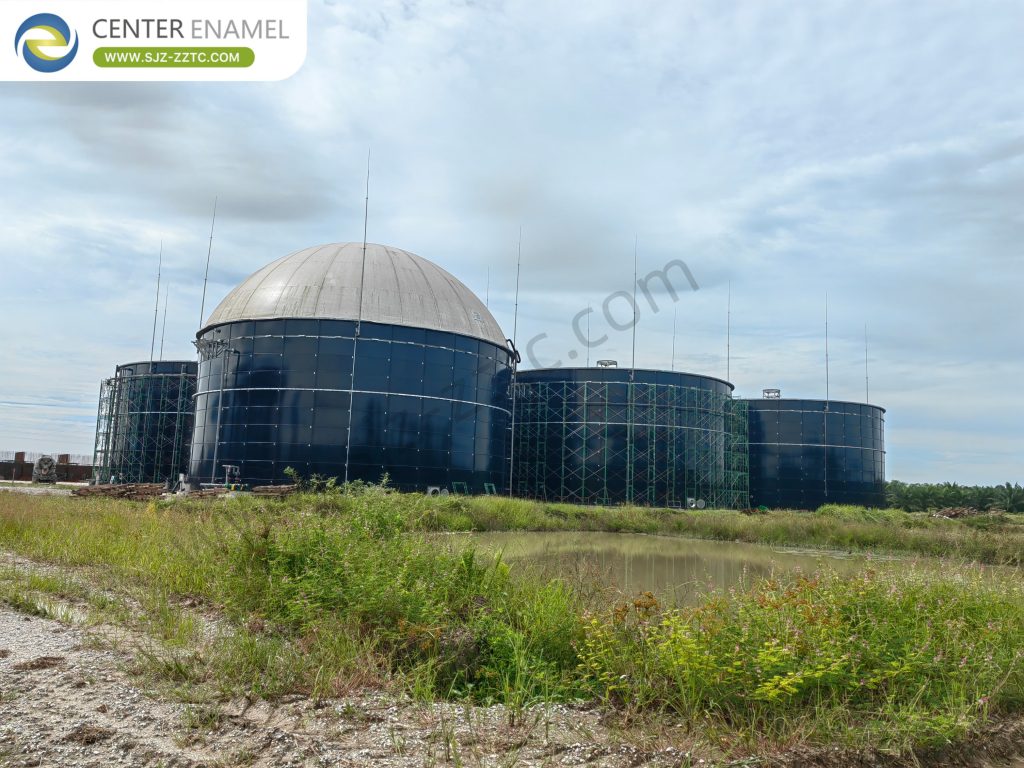
GFS Tanks offer flexible customization of both size and appearance, delivering higher land utilization rates that are ideally suited for modern compact plant configurations. This represents a significant advantage over fixed poured concrete tanks. Concrete structures cannot alter volume or shape after pouring, and their heavy bases occupy large areas, making placement difficult on narrow or irregular plots. Their rough, uniform appearance also fails to meet the aesthetic requirements of modern facilities. GFS Tanks, by contrast, allow precise volume customization with capacities ranging from dozens of cubic meters to 50,000 cubic meters freely selectable. Tank height and diameter can be flexibly combined to fit constrained or irregularly shaped plots, effectively minimizing plant land occupation. Enamel color customization is also supported, achieving visual harmony with plant buildings and environmental facilities. When later plant expansion becomes necessary, GFS Tanks can be directly adjusted in layout and expanded, whereas monolithic concrete tanks must be demolished and rebuilt-offering far less flexibility in land resource utilization. These characteristics align well with the intensive construction and aesthetic operation and maintenance needs of modern industrial parks.
USR Reactor Advantages for High-Solids Organic Wastewater Treatment
The USR Reactor brings distinct operational advantages to high-solids organic wastewater treatment. Its high solids tolerance, clog resistance, and strong adaptability make it perfectly suited for high-suspended-solids, high-impurity, high-solids organic wastewater streams. The equipment structure is extremely simple, with no precision wear parts, resulting in low capital investment, long service life, virtually no clogging failures, and extremely low subsequent maintenance costs. The USR Reactor places no strict requirements on sludge morphology-there is no need to cultivate mature granular sludge, as flocculent sludge can operate stably with fast start-up and a short sludge acclimation period for rapid commissioning. Gentle hydraulic disturbance results in low sludge washout and high sludge utilization, with stable organic pollutant degradation. Operation is simple with low automation requirements and high error tolerance, making the USR Reactor suitable for remote sites, farms, and other settings with limited O&M capabilities-outstanding stability and practicality advantages that directly address the operational realities of livestock manure treatment.
Environmental Toxicity Profile of Livestock Wastewater Pollutants
Livestock wastewater pollutants present no synthetic chemical toxicity and contain no hazardous substances, resulting in very low risk of acute or chronic toxicity. Pollution impacts are primarily biological and nutrient-related. All pollutants are natural organics from livestock metabolites and feed residues, with no inhibition of microbial activity and no toxicity to soil, water, or aquatic organisms. However, this wastewater is rich in nitrogen, phosphorus, and suspended impurities, and it carries E. coli, parasite eggs, and pathogens. Direct discharge without treatment rapidly causes eutrophication, black-odor conditions, mosquito breeding, and disease transmission. Long-term discharge causes soil compaction and elevated nutrient levels in groundwater-persistent ecological pollution, but without hazardous substance accumulation or carcinogenic/mutagenic risks. This profile means treatment strategies must target nutrient removal and pathogen inactivation rather than chemical detoxification, a distinction that shapes appropriate technology selection.
Bangladesh Large-Scale Poultry Farm Manure Resource Recovery Project
This project targets local poultry farm manure resource recovery with a daily treatment capacity of 47 tons. Influent COD, BOD, and SS concentrations reach as high as 50,000 mg/L, 25,000 mg/L, and 50,000 mg/L respectively. After CSTR + UASB anaerobic treatment, all three parameters are reduced to below 200 mg/L, 100 mg/L, and 100 mg/L-effluent compliant with local environmental discharge standards. The project produces approximately 4,900 m³ of biogas daily; each cubic meter of biogas can generate 2 kWh of electricity, yielding daily power generation of 9,800 kWh. This simultaneously achieves pollutant reduction and clean energy recovery, establishing it as a benchmark project for livestock waste recycling in Southeast Asia.
Table 1: Bangladesh Poultry Farm Manure Treatment Project Performance Data
| Parameter | Influent Concentration | Effluent Concentration | Treatment Performance |
| COD | 50,000 mg/L | < 200 mg/L | >99.6% removal |
| BOD | 25,000 mg/L | < 100 mg/L | >99.6% removal |
| SS | 50,000 mg/L | < 100 mg/L | >99.8% removal |
| Biogas Production | - | ~4,900 m³/day | - |
| Power Generation | - | 9,800 kWh/day | 2 kWh per m³ biogas |
Center Enamel's Research Capabilities and Global Certifications
Technology R&D constitutes Center Enamel's core competitive advantage. The company independently masters over 200 differentiated anti-corrosion enamel formulations, with full self-control over the enamel raw material chain, and holds nearly 100 invention and utility patents. Products have passed NSF, WRAS, ASME, BSCI, CE, ISO9001, and other global certifications. Company certifications and honors include National High-Tech Enterprise, National Specialized and Sophisticated "Little Giant," Hebei Manufacturing Single Champion, Provincial Smart Factory, and Provincial Green Factory, along with complete environmental engineering and special equipment manufacturing compliance qualifications. The company maintains long-term collaborative research with multiple universities through joint materials laboratories, continuously iterating anti-corrosion coatings and large bolted tank structural design technologies. This proprietary material technology barrier creates an irreplaceable competitive advantage, with product performance comparable to high-end imported European and American storage equipment.
Full-Process Standardized Installation Quality Control
Demonstrating high-standard installation quality through long-term stable global project performance, Center Enamel has established full-chain quality control standards across four dimensions: factory protection, on-site assembly construction, completion inspection, and long-term warranty-ensuring quality control for every GFS Tank. At the factory stage, all enameled panels, seals, and structural components receive rust-proof and moisture-proof independent packaging with dedicated protective supports, preventing damage during sea and land transport and avoiding enamel coating damage.
On-site construction strictly follows unified assembly process specifications, with panel-by-panel tightening and leak testing in layers, along with air-tightness and verticality testing after each tank section completion; dual-membrane covers and anaerobic piping undergo simultaneous pressure testing and acceptance. Differentiated quality acceptance standards are customized for different regions: EU/US projects follow stringent CE/NSF inspection criteria; Southeast Asian hot humid regions receive enhanced corrosion protection and sealing acceptance; remote African sites have additional foundation settlement re-inspection procedures. Upon project completion, complete construction inspection reports, pressure test records, and anti-corrosion appearance acceptance documents are issued, with full photo and video archives retained. Over 10,000 tanks delivered globally have operated long-term without large-scale leakage or structural deformation-preventing future O&M issues at source.
Global Project Delivery Performance
Center Enamel's track record spans over 10,000 total projects, including 2,000+ wastewater projects and 1,000+ biogas projects. Notable reference projects include the Yili Group Dairy Processing Plant industrial wastewater treatment project in Gansu Province, where the company handled design planning through handover, and a biogas project in Henan Province developed in coordination with China's National Development and Reform Commission, the Ministry of Ecology and Environment, and the Ministry of Agriculture and Rural Affairs. These projects demonstrate the company's capability as a professional one-stop solution provider for global waste-to-energy initiatives, with particular strength in the Asia-Pacific region's industrial wastewater treatment market where China has emerged as the largest market.
Table 2: Center Enamel Global Project Statistics
| Project Category | Quantity | Representative Projects |
| Total Projects | 10,000+ | Global installations |
| Wastewater Projects | 2,000+ | Yili Group Dairy Processing Plant (Gansu) |
| Biogas Projects | 1,000+ | Henan Province Biogas Project |
| Tanks Delivered | 10,000+ | Operating without large-scale leakage or deformation |
Ready to optimize your livestock manure treatment with proven GFS Tanks and USR Reactors? Contact Center Enamel today for a customized solution tailored to your farm's specific capacity and site conditions.
Explore our global project portfolio and discover why over 10,000 installations trust Center Enamel for reliable, long-term performance in organic wastewater treatment.
Frequently Asked Questions
Q1: What makes GFS Tanks suitable for livestock farm locations with limited space?
GFS Tanks offer flexible height and diameter combinations that fit narrow or irregular plots, with customizable volumes from dozens to 50,000 cubic meters. This maximizes land utilization compared to bulky concrete alternatives.
Q2: Why is the USR Reactor preferred for high-solids livestock wastewater?
The USR Reactor tolerates high suspended solids and impurities without clogging, requires no precision wear parts, and operates stably with flocculent sludge-eliminating the need for mature granular sludge cultivation and reducing maintenance costs significantly.
Q3: How does Center Enamel ensure installation quality across different regions?
Center Enamel applies region-specific acceptance standards: CE/NSF criteria for EU/US projects, enhanced corrosion protection for Southeast Asian humid climates, and additional foundation re-inspection for remote African sites, with full documentation retained.