
How Anaerobic Digestion and GFS Tanks Deliver Efficient Industrial Wastewater Treatment
The global industrial wastewater market is shifting decisively from project construction toward long-term operational management, and regional priorities now shape technology choices. The Asia-Pacific region, particularly China, has become the world's largest industrial wastewater treatment market, with the operation and maintenance service segment's contribution continuing to rise. The North American market focuses on upgrading existing facilities, while Europe emphasizes high-value-added resource recovery technologies.
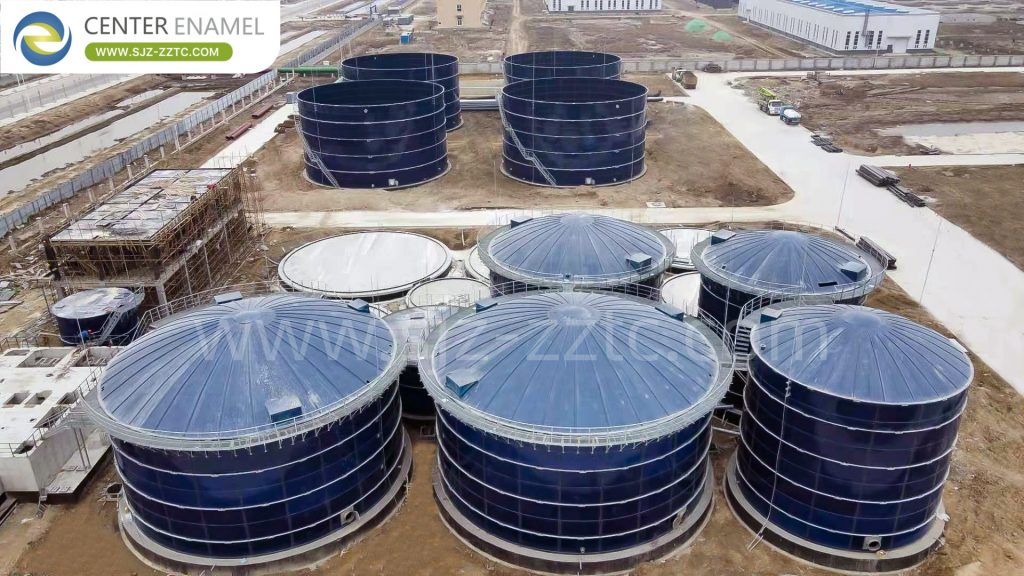
Wastewater from the new energy industry chain-lithium batteries, photovoltaics, and hydrogen-has become the most notable emerging growth area due to its complex composition and high treatment difficulty, generating significant demand for customized solutions. The maturity of third-party treatment models in industrial parks continues to improve, driving consolidation in the professional operation market. The Middle East has strong demand for advanced treatment and reuse due to water scarcity, while manufacturing transfer in Southeast Asia drives local facility construction demand. Across all these markets, two technologies keep proving their value: Anaerobic Digestion for high-strength organic streams, and GFS Tanks for durable, adaptable containment.
Inside the IC Reaction Process
At the heart of modern Anaerobic Digestion lies the Internal Circulation reactor. Pretreated high-strength organic wastewater enters the lower main reaction zone from the bottom, mixing with recirculated sludge-water mixture and rising rapidly. Anaerobic microorganisms efficiently degrade organic matter, producing large volumes of biogas. The gas-lift action of biogas carries the mixed liquor upward to the top gas-liquid separator where biogas is collected. Degassed sludge-water mixture returns by gravity through downcomers to the reactor bottom, creating autonomous internal circulation that repeatedly enhances pollutant degradation. After multiple circulation cycles, the wastewater enters the upper polishing zone for further reaction and sludge-water separation. Remaining trace organics are fully degraded, sludge settles back to the lower reaction zone, treated effluent overflows from the top, and aged sludge is periodically discharged-fully autonomous circulation, efficient continuous operation, and a clear illustration of why Anaerobic Digestion outperforms conventional alternatives.
Why GFS Tanks Suit Anaerobic Digestion Systems
Reliable Anaerobic Digestion depends on containment that can be built quickly and adapted as projects evolve-and this is where GFS Tanks excel. GFS Tanks are assembled on-site from prefabricated panels, with short construction periods and support for expansion, relocation, and reuse-advantages distinctly different from immovable concrete tanks. Concrete tank pouring requires formwork, rebar tying, pouring, and long curing periods, with a single tank construction taking months. Rain, snow, and low temperatures force work stoppages and delays. Once poured, they are permanent fixed structures that cannot be dismantled, expanded, or relocated-project relocation means complete abandonment.
GFS Tanks vs. Concrete Tanks
| Parameter | GFS Tanks | Concrete Tanks |
| Construction Time | About 1/3 of concrete | Months per tank |
| Weather Constraints | Workable in low temperature and light rain | Stoppages in rain, snow, cold |
| Expansion | Add panels to increase volume | Difficult and costly |
| Relocation & Reuse | Fully dismantlable and reusable | Permanent, cannot be moved |
| Best Fit | Short-term, phased, relocation projects | Fixed long-term sites |
GFS tank panels are all factory-prefabricated, transported to site, and directly assembled with simple procedures. Construction can proceed even in low-temperature, light-rain conditions, with installation time only one-third that of concrete tanks-construction schedules are controllable. For expansion, additional steel panels can be installed to increase volume; for plant relocation, tanks can be fully disassembled with panels transported to new sites for reassembly and reuse, significantly reducing material and construction costs for new construction and reconstruction. This makes GFS Tanks ideally suited for short-term environmental projects, phased expansion projects, and relocated construction projects.
Papermaking Wastewater: A Demanding Feed for Anaerobic Digestion
Papermaking streams represent one of the most demanding applications for Anaerobic Digestion. The key water quality characteristics include high suspended solids, high COD, high alkalinity, and large discharge volume-with suspended solids (fibers and fillers) being the most distinctive feature. Very high suspended solids, typically 1,000-5,000 mg/L, primarily consist of fiber fines, fillers such as calcium carbonate and talc, and colloidal substances. COD ranges widely: cooking black liquor can exceed 100,000 mg/L, while combined wastewater COD is approximately 1,500-5,000 mg/L. Cooking black liquor pH can exceed 13 (strongly alkaline). BOD/COD is approximately 0.3-0.45-moderate biodegradability, with lignin and cellulose being refractory. The wastewater is rich in lignin, hemicellulose, resin acids, tannins, and other plant extracts, contributing to moderate to high color (brown). Cooking and papermaking discharges occur at moderate to high temperatures of 40-60°C. Large mills discharge tens of thousands of tons daily, with relatively stable water quality despite production process variations.
A Decade of Global Installation Experience
Handling such demanding streams requires field-proven execution. Center Enamel holds unmatched global practical experience among domestic peers-over a decade covering multiple regions and all industry sectors. In 2009, Center Enamel completed the first overseas GFS tank installation, sending a team to Niger, Africa for drinking water storage tank installation. In 2015, it broke industry ground with China's first GFS tank export and installation to the US, passing strict US acceptance standards. All installed projects have operated stably for many years, covering livestock biogas, POME, municipal wastewater, and drinking water storage applications. Construction has covered Southeast Asia, Africa, the Americas, and other regions-accumulating specialized solutions for complex sites including mountainous terrain, coastal salt spray, tropical high temperatures, and high-standard European and American facility conditions, maturely addressing global special construction requirements.
Center Enamel Global Installation Milestones
| Year / Metric | Milestone | Significance |
| 2009 | First overseas GFS tank installation (Niger, Africa) | Entry into international project delivery |
| 2015 | First GFS tank export and installation to the US | Passed strict US acceptance standards |
| Coverage | Southeast Asia, Africa, the Americas | Solutions for mountains, salt spray, tropics |
| Applications | Livestock biogas, POME, municipal wastewater, drinking water | Cross-sector operational track record |
Integrated Delivery from a Single Source
What ties these capabilities together is full-industry-chain integration. Center Enamel is the only company globally integrating proprietary enamel frit R&D, self-manufactured tanks, and EPC general contracting-full-process self-control from solution design, equipment production, cross-border logistics, overseas construction, to post-construction O&M-significantly reducing client coordination and time costs. This means the same team accountable for Anaerobic Digestion performance also controls the quality of every GFS Tank panel that contains it.
Advanced Roofing for Gas and Odor Control
Completing the containment system, the Aluminum Geodesic Dome Roof independently developed by Center Enamel is manufactured using high-strength aluminum alloy plates through integral stamping. It features a triangular grid spherical self-supporting structure, enabling large-span full coverage without internal support columns. Made of aluminum alloy, the roof offers excellent weather resistance and corrosion resistance, capable of long-term protection against acid rain, salt spray, and UV radiation, suitable for various extreme outdoor climate conditions.
The structural design complies with international AWWA D108 standards, with aluminum plate thickness, rib cross-sections, and joint connections all verified by finite element stress analysis, ensuring wind and snow load resistance that meets building code requirements across different global regions. The weight of the Aluminum Geodesic Dome Roof is only one-third to one-half of a steel roof with the same span, significantly reducing the load on the tank top and allowing direct installation without tank wall reinforcement. The roof provides superior overall sealing performance, with double sealing between panels using specialized sealant strips and mechanical interlocking, enabling both airtight gas storage and enclosed odor control-suitable for biogas collection and storage, wastewater tank odor control, and drinking water contamination prevention. The support-column-free design does not interfere with the installation and operation of internal equipment such as mixers and water distributors. The aluminum material does not support microbial growth, requiring no anti-corrosion maintenance over long-term use, resulting in low total life-cycle costs.
Frequently Asked Questions
How does Anaerobic Digestion handle papermaking wastewater?
It degrades high-COD black liquor and combined effluent while producing biogas, provided suspended solids are pre-treated and pH is balanced before reactor entry.
Why choose GFS Tanks for anaerobic reactors?
Factory-prefabricated panels cut installation to about one-third of concrete time and allow future expansion, relocation, and reuse.
What global experience backs these systems?
Center Enamel has delivered GFS Tanks since 2009 across Africa, the Americas, and Southeast Asia, including a landmark 2015 US installation.
Send us your wastewater analysis and site conditions, and our engineers will size the right Anaerobic Digestion and GFS Tanks configuration for your project. Reach out to Center Enamel today to turn your high-strength effluent into a stable, resource-recovering treatment asset.