
How Biogas Project Contractors and GFS Tanks Turn Industrial Wastewater into Clean Energy?
Industrial wastewater treatment has long been defined by the "three highs"-high difficulty, high cost, and high energy consumption. Wastewater streams from new energy, chemical, and pharmaceutical industries contain complex compositions with numerous characteristic pollutants that traditional treatment processes struggle to remove effectively. While Chinese manufacturers maintain significant price advantages in the mid-to-low-end equipment segment, the industry faces continuous technological upgrade pressure from increasingly stringent emission standards, alongside new requirements for digitalization and low-carbon transformation. These challenges demand innovative solutions that combine robust infrastructure with proven biological processes. This is where the synergy between high-performance GFS tanks, the efficient UASB process, and experienced Biogas Project Contractor capabilities becomes critical for delivering sustainable, cost-effective industrial wastewater treatment.
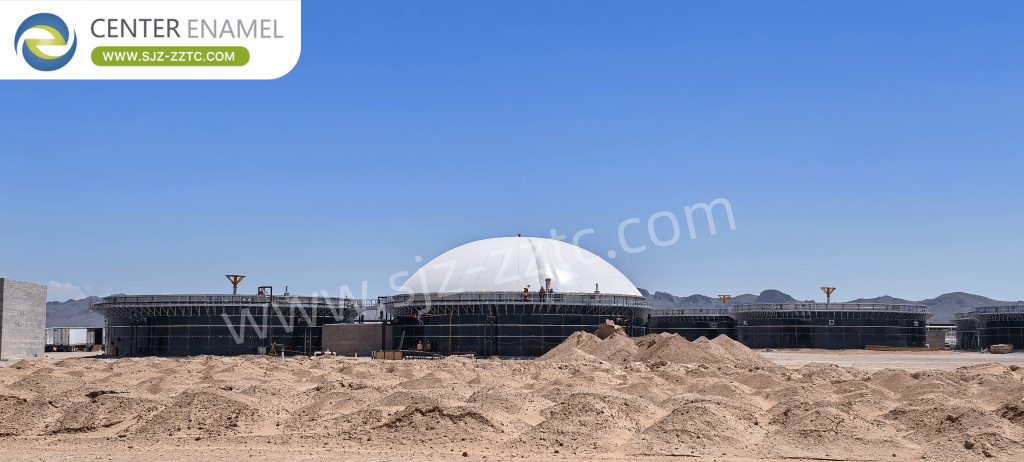
GFS Tanks: The Foundation for Reliable Industrial Wastewater Treatment
At the heart of any successful industrial wastewater treatment or biogas project lies the storage and reaction infrastructure. Center Enamel has independently developed over 200 specialized enamel frit formulations and supporting patents, enabling the customization of anti-corrosion enamel based on specific customer storage media. This adaptability makes GFS tanks comprehensively superior to traditional concrete tanks, which use a single material and are only suitable for neutral clean water storage. When storing corrosive materials such as livestock manure, palm oil mill effluent, chemical wastewater, food waste digestate, or high-salinity wastewater, concrete tanks require additional anti-corrosion linings that are prone to failure, preventing long-term stable operation and cannot adapt to alternating high and low concentration storage conditions.
This material limitation directly impacts the viability of anaerobic treatment systems. GFS tanks can be specifically formulated with specialized enamels resistant to strong acids, strong alkalis, high organic content, and high salinity, allowing a single tank to switch between multiple wastewater and fermentation feedstock storage requirements. The universal applicability across biogas anaerobic digestion, municipal wastewater, livestock farming, food processing, and industrial water treatment scenarios eliminates the need to rebuild tanks for media changes, perfectly meeting the needs of diversified, multi-condition environmental protection projects. For any Biogas Project Contractor, this versatility translates into reduced capital expenditure and faster project deployment.
The UASB Process: Proven Anaerobic Technology for High-Strength Wastewater
While robust tank infrastructure provides the physical containment, the biological treatment process determines overall system efficiency. The UASB (Upflow Anaerobic Sludge Blanket) process represents a benchmark mainstream technology for medium-to-high concentration soluble organic wastewater treatment. After pretreatment through screens and equalization tanks to remove impurities and balance water quality and flow, wastewater is uniformly fed into the reactor through the bottom distribution system. The wastewater rises at a constant rate through the high-concentration granular sludge bed at the bottom, where anaerobic microorganisms rapidly degrade most organic matter, converting it into biogas, clean water, and a small amount of sludge.
The UASB process requires no mechanical mixing or media carriers, relying on the upward flow of wastewater to suspend and expand granular sludge within the reactor, forming a stable sludge bed layer. Gentle hydraulic mixing maintains sludge suspension, expanding microbial contact area. Remaining pollutants continue to degrade in the mid-section suspended sludge layer, with the mixed liquor finally entering the top three-phase separator for gas, solid, and liquid separation. Biogas is collected upward for utilization, sludge settles back to the reaction zone, treated effluent overflows from the top, and aged sludge is periodically discharged-enabling fully automated continuous operation. This inherent efficiency makes the UASB Process a preferred choice for industrial facilities seeking to minimize energy consumption while maximizing organic removal.
Industry-Specific Applications: Brewery Wastewater
The practical application of these technologies becomes evident when examining specific industry challenges. Brewery wastewater exhibits high concentration, high suspended solids, high color, slightly acidic pH, and excellent biodegradability-with significant fluctuations. COD typically ranges from 5,000 to 25,000 mg/L, with high-strength spent mash and still bottoms peaking at hundreds of thousands of mg/L. Suspended solids can reach up to 40,000 mg/L, with thick turbid liquor and stable slightly acidic pH of 3-5.
Pollutants are primarily natural organics from grain fermentation-starches, reducing sugars, proteins, alcohols-with no synthetic toxic substances, resulting in a BOD/COD ratio that can reach 0.5-0.6, representing industry-leading biodegradability. However, significant fluctuations with production batches and seasonal capacity, combined with susceptibility to secondary fermentation and odor if left standing, demand treatment systems that can handle variable loads. Here, the combination of corrosion-resistant GFS tanks and the robust UASB Process delivers consistent performance where traditional systems often fail, reinforcing the value proposition for any Biogas Project Contractor serving the beverage industry.
Proven Performance: Indonesia Palm Oil Biogas Upgrade Project
The real-world effectiveness of integrated GFS tank and anaerobic treatment solutions is demonstrated by the Indonesia Palm Oil Biogas Upgrade Project, commissioned in 2013 as the core anaerobic digestion reactor for the POME treatment station. The project utilized three GFS tanks in two sizes: 17.58 m diameter × 8.4 m height and 16.82 m diameter × 7.2 m height. These tanks serve as the core anaerobic reaction equipment specifically designed for high-organic palm oil production wastewater, where anaerobic digestion degrades pollutants and recovers biogas simultaneously.
The tanks were adapted to local palm industry wastewater needs, with GFS tank assembly proving convenient and corrosion resistance performing exceptionally well in Southeast Asia's hot, humid, high-corrosion environment. This project stands as a mature biomass energy environmental benchmark, demonstrating the viability of GFS tank-based biogas plant design in challenging tropical conditions. Its success validates that Center Enamel's GFS tanks deliver reliable performance regardless of climate or wastewater aggressiveness, reinforcing the company's credentials as a leading Biogas Project Contractor in the region.
Manufacturing Excellence: Center Enamel's Smart Manufacturing Base
Supporting these global project deliveries requires substantial manufacturing capability. Center Enamel's core intelligent manufacturing base is located in Hebei Province, China, covering a total area of over 150,000 m², with Phase I mature manufacturing facility and Phase II high-end environmental equipment industrial park-dual-base synergy ensuring stable production capacity. The base includes dedicated R&D office buildings, proprietary material laboratories, and finished product testing centers, with full-process quality control systems meeting ISO, NSF, CE, and other international standards.
The facility operates to green manufacturing standards, certified as a Provincial Green Factory-balancing efficient production with energy conservation and emission reduction. With 6 marketing service centers across China establishing a nationwide production-sales network ensuring stable global order delivery, the base is adjacent to expressway networks and major logistics hubs with complete container shipping capabilities-supporting simultaneous large-scale tank projects globally. Employing over 500 staff with multiple parallel automated production lines, the facility scale and production capacity firmly place Center Enamel among the global top tier of GFS tank equipment manufacturers. This manufacturing strength ensures that whether a project requires UASB Process reactors or complete biogas plant infrastructure, delivery timelines and quality standards remain uncompromised.
Global Execution Capability: Over a Decade of Installation Experience
Manufacturing excellence must be matched by installation expertise. Center Enamel possesses unmatched global practical experience among domestic peers-over a decade covering multiple regions and all industry sectors. In 2009, the company completed its first overseas GFS tank installation, sending a team to Niger, Africa for drinking water storage tank installation. In 2015, it broke industry ground with China's first GFS tank export and installation to the United States-passing strict US acceptance standards.
All installed projects have operated stably for many years, covering livestock biogas, POME, municipal wastewater, and drinking water storage applications. Construction has covered Southeast Asia, Africa, the Americas, and other regions, accumulating specialized solutions for complex sites including mountainous terrain, coastal salt spray, tropical high temperatures, and high-standard European and American facility conditions-maturely addressing global special construction requirements. This extensive track record positions Center Enamel as a Biogas Project Contractor capable of executing projects anywhere in the world, regardless of local conditions.
Conclusion
The convergence of advanced GFS tank technology, the proven UASB Process, and comprehensive Biogas Project Contractor capabilities offers a complete solution to the core challenges of industrial wastewater treatment. From the "three highs" of complex wastewater streams to the demanding conditions of brewery and palm oil processing, integrated systems combining corrosion-resistant storage with efficient anaerobic digestion deliver consistent performance, energy recovery, and long-term reliability. With over a decade of global installation experience, state-of-the-art manufacturing facilities, and a commitment to continuous technological innovation, Center Enamel provides the infrastructure and expertise needed to transform industrial wastewater from an environmental liability into a renewable energy opportunity.
Frequently Asked Questions (FAQ)
1. How does Center Enamel ensure the quality and durability of GFS tanks for international biogas projects?
Center Enamel's GFS tanks are manufactured under strict quality control systems meeting ISO 28765, AWWA D103, and CE international standards. Each tank undergoes rigorous testing including 1500V high-voltage spark testing to ensure coating integrity. With over 200 specialized enamel formulations and a 30+ year service life proven across 100+ countries, these tanks deliver unmatched corrosion resistance against acidic slurry and biogas environments.
2. What makes the UASB process suitable for industrial wastewater treatment applications?
The UASB (Upflow Anaerobic Sludge Blanket) process is ideal for soluble medium-to-high concentration organic wastewater, covering light industrial wastewater from brewing, sugar refining, starch, papermaking, food processing, and similar applications. It achieves 90–94% COD removal while producing biogas that can offset energy costs, requires no mechanical mixing, and features low operational costs with minimal sludge production.
3. How does Center Enamel handle complex site conditions for global biogas projects?
With over a decade of installation experience across Southeast Asia, Africa, the Americas, and Europe, Center Enamel has accumulated specialized solutions for complex sites including mountainous terrain, coastal salt spray, tropical high temperatures, and high-standard European/American facility conditions. The modular GFS tank design allows rapid bolt-assembly without welding, eliminating long concrete curing periods and adapting to narrow or remote construction sites.