
How Can Advanced Anaerobic Technologies Optimize Your Beverage Wastewater Treatment Project?
The industrial wastewater sector faces mounting pressure from both regulatory bodies and operational realities. The core challenges of industrial wastewater treatment center on the "three highs"-high difficulty, high cost, and high energy consumption. Wastewater from new energy, chemical, and pharmaceutical industries is complex in composition with numerous characteristic pollutants, and traditional treatment processes are often unable to remove them effectively. This complexity demands innovative and robust technological solutions that can deliver consistent performance under demanding conditions.
While Chinese companies have significant price advantages in the mid-to-low-end equipment segment, the industry also faces continuous technological upgrade pressure from increasingly stringent emission standards. Furthermore, there are new requirements for digitalization and low-carbon transformation on operational refinement management capabilities. To meet these multifaceted challenges, project developers and plant operators must look toward advanced anaerobic technologies that offer both treatment efficiency and operational flexibility, ensuring compliance and sustainability for complex projects like beverage wastewater treatment.
GFS Tanks: A Flexible Foundation for Modern Treatment Plants
Effective treatment begins with reliable containment and adaptable infrastructure. Modern industrial plant design increasingly favors intensive, compact layouts that maximize land utilization, and this requires storage and reactor solutions that are both versatile and space-efficient.
GFS Tanks: Adapting to Modern Intensive Plant Layouts
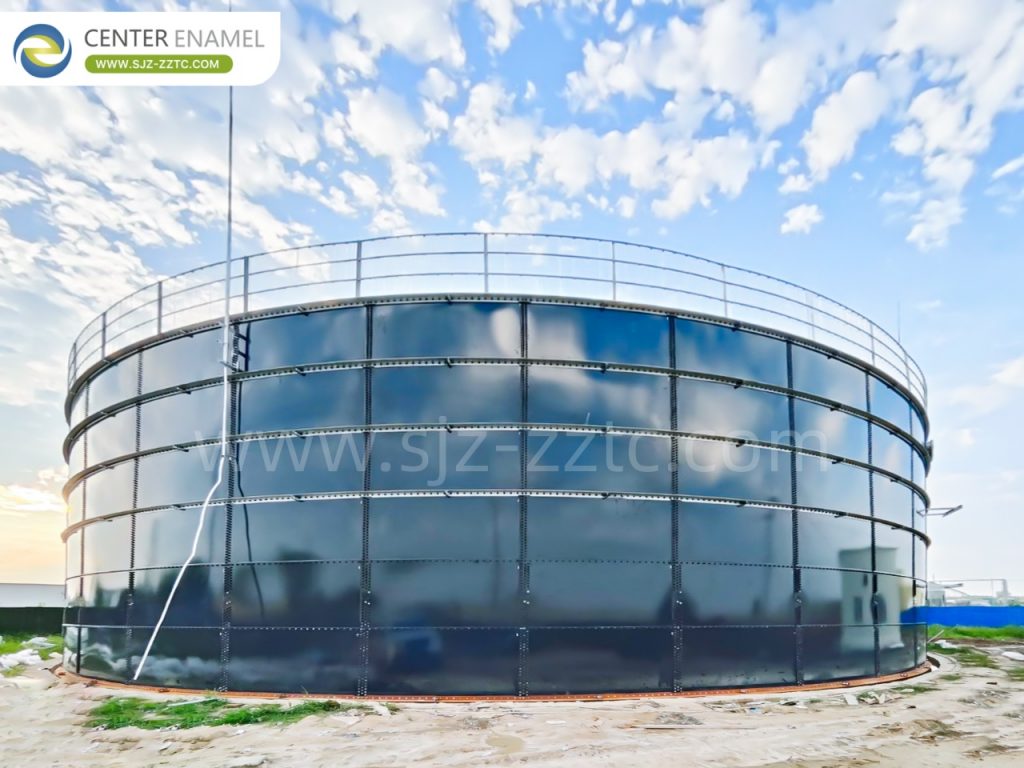
GFS tanks offer flexible customization of size and appearance, with higher land utilization rates, ideally suited for modern compact plant layouts. They present significant advantages over fixed poured concrete tanks. Concrete tanks cannot alter volume or shape after pouring, with heavy bases occupying large areas, making placement difficult on narrow or irregular plots. Their rough, uniform appearance cannot match modern facility aesthetic requirements.
GFS tank volume can be precisely customized as needed, with capacities ranging from dozens of cubic meters to 50,000 cubic meters freely selectable. Tank height and diameter can be flexibly combined to fit narrow or irregularly shaped plots, effectively saving plant land occupation. Enamel color customization is also supported, achieving visual harmony with plant buildings and environmental facilities. During later plant expansion, GFS tanks can be directly adjusted in layout and expanded; concrete tanks, being monolithic structures, must be demolished and rebuilt, offering less flexibility in land resource utilization. This aligns well with the intensive construction and aesthetic operation and maintenance needs of industrial parks, making GFS tanks the preferred structural foundation for implementing advanced anaerobic technologies in space-constrained facilities.
Supporting Equipment for UASB Anaerobic Systems
A robust anaerobic treatment process relies not only on the main reactor but also on a suite of well-designed supporting equipment. Understanding the function of each component is crucial for optimizing the performance of advanced anaerobic technologies.
Essential UASB Supporting Equipment
Core equipment includes the GFS anaerobic reactor tank, with the internal three-phase separator being the key component for gas-liquid-solid separation and sludge retention. The bottom high-precision distribution system (distribution pipes, distributors, pressure regulators) ensures uniform influent distribution, preventing short-circuiting and sludge accumulation. Supporting equipment includes influent lift pumps, equalization tanks, and flow meters to stabilize influent conditions.
The top biogas collection system includes gas collection hoods, gas piping, desulfurization/dehydration equipment, and gas storage. Online temperature, pH, and COD monitoring instruments are integrated for process control. Bottom sludge discharge pipes and pumps periodically remove excess sludge. The complete equipment package is compact, with no rotating wear parts, low equipment loss, and high operational stability. This comprehensive system design ensures that advanced anaerobic technologies can operate reliably and efficiently, delivering superior treatment results for your beverage wastewater treatment project.
Standardized Solutions for Beverage Wastewater
The beverage industry produces a high-sugar, highly biodegradable wastewater stream that is ideally suited for biological treatment. To address this, standardized treatment trains based on advanced anaerobic technologies have been developed, offering a reliable and efficient pathway to compliance.
Standardized Treatment Solutions for Beverage Wastewater
The treatment process uses a mature treatment train of "pretreatment + anaerobic digestion + aerobic treatment + advanced treatment," perfectly suited for high-sugar, easily biodegradable organic wastewater. Pretreatment uses screens and sieves to remove fruit pulp, tea residues, and other suspended impurities to prevent pipeline and equipment clogging. Equalization tanks balance high-concentration CIP and low-concentration wastewater to stabilize influent load. Alkali addition neutralizes acidic wastewater as needed.
The main stage uses UASB/IC anaerobic processes for high-efficiency high-concentration sugar degradation-sugars are readily anaerobically degraded with high biogas production and COD removal exceeding 80%-outstanding energy recovery benefits. Subsequent A/O or SBR aerobic processes deeply degrade residual organics and remove nitrogen/phosphorus. Final sedimentation, filtration, and disinfection ensure compliance. Anaerobic digesters use Center Enamel GFS tanks resistant to organic acid and sugar fermentation corrosion. The entire process is simple and stable, suitable for the beverage industry's intermittent and seasonal discharge patterns, with high automation and convenient O&M. This integrated approach demonstrates how advanced anaerobic technologies form the cornerstone of an effective beverage wastewater treatment project.
Center Enamel's Comprehensive Product Matrix
Delivering a successful treatment project requires a broad and reliable portfolio of equipment. Center Enamel has built a complete product matrix that covers everything from core storage tanks to complete engineering services, ensuring seamless integration and performance.
Full-Category Complete Product Matrix
Center Enamel has built a complete product matrix of "core storage tanks + supporting covers + specialty pressure vessels + complete environmental engineering services"-the only company globally to achieve integrated enamel frit R&D, self-manufacturing, and GFS tank application.
① Core: Proprietary GFS Tanks
Using proprietary double-sided hot-rolled double-layer enamel anti-corrosion technology-resistant to strong acids/alkalis, high salinity, and microbial corrosion-modular quick assembly-suitable for all strong-corrosion conditions in wastewater, biogas, and chemical applications.
② Supporting: Fusion Bonded Epoxy Tanks
Produced on China's first intelligent standardized production line-primarily for drinking water, fire water, and neutral medium storage.
③ Sealing: Aluminum Dome Covers
Proprietary high-strength aluminum alloy self-supporting structure-meeting international waterproof and load-bearing standards-suitable for tank sealing and biogas collection.
④ Other Tanks: Carbon Steel Tanks, Stainless Steel Tanks, Composting Tanks, Various Non-Standard Pressure Vessels.
⑤ Engineering Services: Environmental EPC General Contracting, Anaerobic Process Section Subcontracting-one-stop coverage across food waste, leachate, municipal wastewater, livestock biogas, petrochemical/metallurgical, and seawater desalination industries-customizable tank volume, corrosion protection grade, and complete process solutions with integrated equipment manufacturing and engineering construction. This comprehensive product range ensures that every element of your advanced anaerobic technologies system is perfectly matched and efficiently delivered.
The Marketing and Engineering Support Team
The successful deployment of complex treatment systems is supported by a team of experts who understand local regulations, project economics, and technical nuances. Center Enamel's global team provides invaluable guidance from initial consultation to project completion.
Expert Marketing and Engineering Support for Global Projects
The marketing team brings together environmental industry multi-skilled professionals and multilingual foreign trade specialists, with deep expertise in global biogas, wastewater treatment, and biomass new energy markets-accumulating extensive practical project experience in Southeast Asia, Africa, Europe, and the Americas.
The team is proficient in various countries' wastewater discharge regulations, biogas subsidy policies, and carbon trading rules-providing one-stop preliminary site survey, solution planning, and investment return analysis consulting services. With multilingual capabilities (English, French, Spanish, Arabic), the team effectively communicates with clients worldwide-precisely matching regional industrial resources, project budgets, and environmental requirements-customizing high-cost-performance GFS tanks and anaerobic reactor solutions based on client production capacity, treatment targets, and gas production expectations. Leveraging extensive overseas project experience, the team proactively helps clients avoid risks in overseas approvals, equipment import, and construction implementation-building a globally adaptable integrated environmental equipment business service system. This expert support ensures that your beverage wastewater treatment project benefits from local knowledge and global best practices.
Advanced Tank Cover Solutions: Aluminum Geodesic Dome Roof
In addition to the tanks themselves, sealing and gas collection systems are critical for biogas capture and odor control. Center Enamel's proprietary aluminum dome roof technology represents a significant advancement in this area, enhancing the performance and safety of anaerobic digestion systems.
The Aluminum Geodesic Dome Roof: Innovation in Tank Sealing
The Aluminum Geodesic Dome Roof independently developed by Center Enamel is manufactured using high-strength aluminum alloy plates through integral stamping. It features a triangular grid spherical self-supporting structure, enabling large-span full coverage without internal support columns. Made of aluminum alloy, the roof offers excellent weather resistance and corrosion resistance, capable of long-term protection against acid rain, salt spray, and UV radiation, suitable for various extreme outdoor climate conditions.
The structural design complies with international AWWA D108 standards, with aluminum plate thickness, rib cross-sections, and joint connections all verified by finite element stress analysis, ensuring wind and snow load resistance that meets building code requirements across different global regions. The weight of the Aluminum Geodesic Dome Roof is only one-third to one-half of a steel roof with the same span, significantly reducing the load on the tank top and allowing direct installation without tank wall reinforcement. The roof provides superior overall sealing performance, with double sealing between panels using specialized sealant strips and mechanical interlocking, enabling both airtight gas storage and enclosed odor control-suitable for biogas collection and storage, wastewater tank odor control, and drinking water contamination prevention. The support-column-free design does not interfere with the installation and operation of internal equipment such as mixers and water distributors. The aluminum material does not support microbial growth, requiring no anti-corrosion maintenance over long-term use, resulting in low total life-cycle costs. This innovative cover solution perfectly complements advanced anaerobic technologies, optimizing gas capture and long-term system integrity for any beverage wastewater treatment project.
Frequently Asked Questions (FAQ)
1. Why are advanced anaerobic technologies the preferred choice for beverage wastewater treatment?
Beverage wastewater is characterized by high concentrations of soluble sugars and excellent biodegradability. Advanced anaerobic processes like UASB are exceptionally efficient at converting these sugars into biogas, achieving over 80% COD removal. They operate without aeration, significantly reducing energy costs, and produce valuable renewable energy, making them both economically and environmentally superior to aerobic-only systems.
2. What specific features of GFS tanks make them ideal for anaerobic digestion projects?
Glass-Fused-to-Steel (GFS) tanks are highly corrosion-resistant, essential for withstanding the acidic and high-salt environment within anaerobic digesters. Their modular, bolted design allows for flexible sizing, easy shipping, and rapid on-site assembly, which is crucial for modern, compact plant layouts. The durable enamel coating ensures a long service life and low maintenance.
3. What is the role of the Aluminum Geodesic Dome Roof in a treatment project?
The Aluminum Geodesic Dome Roof provides a durable, corrosion-resistant, and self-supporting cover for GFS tanks. It enables safe and efficient collection of biogas generated during anaerobic digestion, while also controlling odors and preventing contamination. Its lightweight design reduces tank load, and its maintenance-free aluminum construction offers excellent long-term value.