
How Can Advanced CBG Plant EPC Solutions with GFS Tanks Solve Your POME Treatment Challenges?
Global industrial wastewater treatment policies are escalating from “compliance discharge” to mandatory “resource recovery” and “zero liquid discharge.” The EU, through its Circular Economy Action Plan, requires member states to increase industrial wastewater reuse rates and extends carbon footprint accounting to the full life cycle of wastewater treatment. China continuously updates and tightens industrial water pollutant discharge standards, with increasingly stringent limits on total nitrogen, total phosphorus, and characteristic pollutants for industries such as chemicals, pharmaceuticals, and printing and dyeing. Some water-scarce regions and highly polluting industries are mandated to adopt zero or near-zero liquid discharge technologies.
Germany has established a differentiated pretreatment technical standard system by industry, requiring industrial wastewater to meet specific quality requirements before discharge into municipal wastewater treatment plants, implementing strict source control. This global regulatory tightening directly impacts high-strength organic waste streams such as palm oil mill effluent, where compliant, resource-recovering POME Treatment is no longer optional but essential. Meeting these standards requires both robust treatment processes and infrastructure engineered for decades of reliable service.
GFS Tanks Engineered for Extreme Climates and Seismic Zones
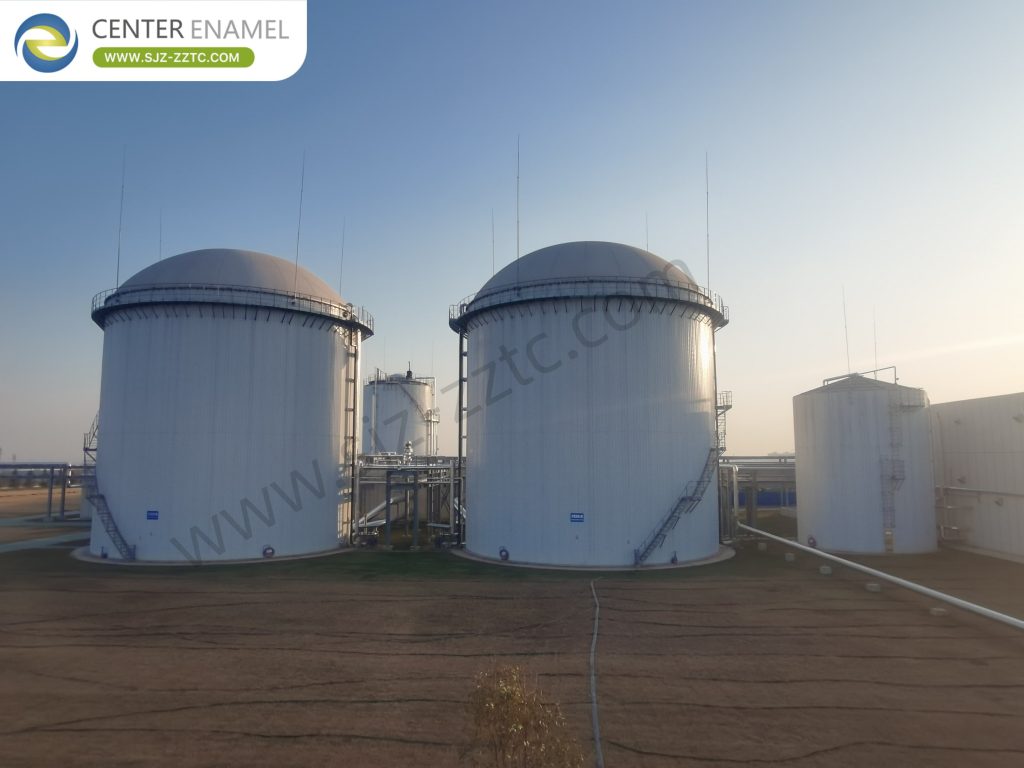
GFS Tanks can undergo customized wind and seismic design based on project site climate and geological conditions, with environmental adaptability far superior to concrete tanks. Concrete tanks are cast-in-place monolithic structures, with seismic and wind resistance entirely dependent on on-site construction quality. In remote areas, typhoon-prone zones, and earthquake belts, construction quality is difficult to control. Under strong earthquakes or typhoons, concrete tanks are prone to cracking and base settlement damage, with subsequent reinforcement costs equivalent to rebuilding.
GFS Tanks undergo collection of local seismic intensity, maximum wind pressure, and foundation bearing capacity data before construction, with customized thickened steel panels, stiffening ribs, and anchored base components-all factory-prefabricated to standardized specifications. The bolted panel structure has excellent stress distribution capability, making it less prone to overall fracture under seismic and typhoon impacts, and minor foundation settlement will not cause through-cracking. Structural parameters can be flexibly adjusted for mountainous, coastal typhoon-zone, and high-seismic-zone projects, providing long-term protection against extreme natural climate damage. These structural advantages are especially important for anaerobic digestion systems, where gas-tightness and dimensional stability directly affect biogas yield and process stability. It is this combination of durability and sealing integrity that makes GFS Tanks the backbone of modern CBG Plant EPC Solutions.
USR Process Advantages for High-Solids Organic Wastewater
High solids tolerance, clog resistance, and strong adaptability make the USR process perfectly suited for high-suspended-solids, high-impurity, high-solids organic wastewater. Extremely simple equipment structure, no precision wear parts, low capital investment, long service life, virtually no clogging failures, and extremely low subsequent maintenance requirements. These characteristics are precisely what make the USR process a natural fit for POME Treatment, where conventional anaerobic systems frequently fail due to oil scaling, fiber clogging, and sludge washout. When integrated into a complete CBG Plant EPC Solution, the USR process transforms a problematic waste stream into a reliable source of renewable energy.
POME Environmental Toxicity and Ecological Impact
POME pollutants are primarily natural plant organics with no synthetic toxic chemicals, heavy metals, or persistent organics-low acute chemical toxicity, but high-concentration organic and oil pollution have severe ecological impacts. High-concentration organics discharged to natural waters rapidly deplete dissolved oxygen-BOD load far exceeds self-purification capacity, causing severe oxygen depletion, anaerobic production of hydrogen sulfide and ammonia, black-odor conditions, mass mortality of fish and benthic organisms, and complete ecosystem collapse.
High-concentration oil forms surface films blocking atmospheric-water oxygen exchange-exacerbating oxygen depletion; oil adheres to fish gills and aquatic organism surfaces, directly affecting respiration, feeding, and movement; oil degrades slowly, causing persistent ecological damage. Acidic raw water (pH 4–5) acidifies receiving waters, causing pH drops beyond aquatic organism tolerance-leading to fish kills and aquatic vegetation die-off; acidic conditions promote heavy metal mobilization from sediments, creating secondary pollution risks. High suspended solids settle and cover riverbed sediments, blocking benthic habitats and fish spawning grounds; fruit pulp and fiber decomposition consumes sediment oxygen, causing anaerobic conditions and hydrogen sulfide accumulation.
High ammonia nitrogen undergoes nitrification consuming dissolved oxygen-exacerbating eutrophication. Nitrogen and phosphorus nutrient enrichment triggers algal blooms (water blooms, red tides)-further degrading water quality. In Southeast Asian palm oil producing regions with dense mill concentrations, untreated POME discharge can cause severe water quality degradation over tens of kilometers of rivers, with irreversible aquatic ecosystem damage-POME is a core source of water pollution in tropical regions, with increasingly strict environmental regulations. These severe ecological consequences underscore why professional POME Treatment and properly engineered CBG Plant EPC Solutions are now mandatory for the palm oil industry.
Full-Process Standardized Installation Quality Control
Demonstrating high-standard installation quality through long-term stable global project performance, Center Enamel has established full-chain quality control standards across four dimensions: factory protection, on-site assembly construction, completion inspection, and long-term warranty-ensuring quality control for every GFS Tank.
At the factory stage, all enameled panels, seals, and structural components receive rust-proof and moisture-proof independent packaging with dedicated protective supports-preventing damage during sea and land transport and avoiding enamel coating damage. On-site construction strictly follows unified assembly process specifications-panel by panel tightening and leak testing in layers, with airtightness and verticality testing after each tank section completion-dual-membrane covers and anaerobic piping undergo simultaneous pressure testing and acceptance.
Differentiated quality acceptance standards are customized for different regions: EU/US projects follow stringent CE/NSF inspection criteria; Southeast Asian hot humid regions receive enhanced corrosion protection and sealing acceptance; remote African sites have additional foundation settlement re-inspection procedures. Upon project completion, complete construction inspection reports, pressure test records, and anti-corrosion appearance acceptance documents are issued, with full photo/video archives retained. Over 10,000 tanks delivered globally have operated long-term without large-scale leakage or structural deformation-preventing future O&M issues at source. This rigorous quality framework is what allows Center Enamel to guarantee the long-term performance of every GFS Tank delivered as part of its CBG Plant EPC Solutions.
Center Enamel’s Extensive Global Benchmark Project Cases
Center Enamel‘s project portfolio covers over 100 countries across Southeast Asia, Africa, Europe, and the Americas-30,000+ mature projects-accumulating complete industry solutions across palm oil, livestock, municipal, brewing, and food waste biogas-rapidly matching customized solutions for different regional climates, water quality, and regulations. This extensive track record provides a proven foundation for delivering reliable POME Treatment systems and integrated CBG Plant EPC Solutions tailored to each client’s specific site conditions and regulatory environment.
Single and Double Membrane Roof Cover Solutions for Biogas Collection
Single and Double Membrane Roofs are proprietary airtight tank cover systems for anaerobic digestion and biogas storage projects, specifically developed for biogas collection and odor containment, representing a benchmark lightweight sealing solution for fermentation tanks. The single-layer membrane roof features a simple structure with economical cost, meeting basic biogas containment needs. The double-layer membrane roof consists of inner and outer corrosion-resistant membrane materials, with pressurized air in the interlayer forming rigid support, providing outstanding thermal insulation that reduces biogas condensate formation inside the tank, with enhanced wind and snow load resistance suitable for high-altitude and windy outdoor sites.
The membrane material is specialized aging-resistant and biogas-slurry-corrosion-resistant PVDF membrane, which will not leak or degrade from long-term contact with biogas or hydrogen sulfide. The flexible structure accommodates tank settlement and slight deformation without cracking or gas leakage. The lightweight design eliminates heavy steel support trusses, significantly reducing the load on the tank and foundation, saving construction costs. The roof integrates biogas outlets, safety pressure relief valves, and access channels, fully enabling closed gas collection for anaerobic fermentation tanks, recovering biogas for power generation and heating while blocking odor diffusion to meet environmental odor control requirements.
It is widely used in large-scale livestock biogas projects, municipal sludge anaerobic digestion, and food waste fermentation projects, compatible with large-volume glass-fused-to-steel anaerobic tanks, with fast construction and simple maintenance requiring only periodic membrane seal integrity checks, offering significant overall engineering advantages. When paired with GFS Tanks and USR-based anaerobic processes, these membrane roofs complete the gas-handling loop that is essential to any high-performance CBG Plant EPC Solution.
Ready to turn your POME challenge into clean biogas energy? Contact Center Enamel today-our team will respond within 24 hours with a customized CBG Plant EPC Solution featuring GFS Tanks and proven POME Treatment technology.
Frequently Asked Questions
1. What are CBG Plant EPC Solutions and why do they matter for POME Treatment?
CBG Plant EPC Solutions cover engineering, procurement, and construction of compressed biogas plants-integrating GFS Tanks, anaerobic reactors, membrane roofs, and biogas upgrading for full POME Treatment and energy recovery.
2. Why are GFS Tanks preferred for POME Treatment projects?
GFS Tanks offer superior corrosion resistance, gas-tightness, and seismic adaptability. Their factory-prefabricated bolted structure ensures consistent quality in remote tropical sites where concrete construction is unreliable.
3. How does Center Enamel ensure long-term biogas plant performance?
Through four-stage quality control-factory protection, on-site assembly, completion inspection, and long-term warranty-plus 30,000+ global projects and 10,000+ tanks operating without major leakage or deformation.