
How Do Restaurants Deal with Food Waste?
Restaurants worldwide face a pressing challenge: food waste. The numbers are staggering. The global food service sector generates approximately 290 million tonnes of food waste annually, accounting for 28% of total food waste . In the United States alone, full-service restaurants contribute 6.1 million tons of food waste annually at a cost of $67.6 billion, while limited-service restaurants add another 2.6 million tons . This waste not only represents lost revenue—up to 10% of a restaurant's food costs—but also creates significant environmental harm, as food rotting in landfills generates 14% of global methane emissions .
Given these pressures, the question "How do restaurants deal with food waste?" has become critical for both operational efficiency and environmental responsibility. Restaurants are adopting a multi-layered approach, from prevention and donation to composting and, increasingly, advanced biogas conversion technologies.
Source Reduction: Preventing Waste Before It Happens
The most effective way restaurants deal with food waste is to prevent it from being created in the first place. Source reduction strategies focus on kitchen operations and menu design. Many restaurants are implementing tracking systems to monitor what is being thrown away—some using intuition-based methods, others adopting AI-powered waste tracking technology .
AI-enabled waste tracking systems have proven remarkably effective. Studies show that data-driven interventions using computer vision and deep learning can achieve 23–51% reductions in food waste, particularly in food preparation and overproduction . For example, hotels using Winnow's AI system have cut food waste by 50–69% .
Menu design is another powerful prevention tool. Chefs are repurposing ingredients creatively, designing menus that utilize ingredients efficiently, and offering half-size portions to encourage more reasonable ordering . The "Clear Your Plate" campaign in China, for instance, helped slash kitchen waste by nearly 50% .
Donation and Redistribution: Feeding People, Not Landfills
When surplus food is safe for consumption but cannot be sold, many restaurants turn to donation programs. Food banks and redistribution networks connect restaurants with community organizations serving food-insecure populations . However, logistical challenges—including liability concerns and inconsistent surplus—often limit this approach's scalability .
Composting: Returning Nutrients to the Soil
Composting transforms food scraps into nutrient-rich soil amendments. Many chefs view composting as a practical solution for unavoidable food waste, including trimmings and preparation scraps . While effective for waste diversion, composting does not capture the energy potential of food waste and can still release methane if not managed properly.
Upcycling: Turning Waste into Culinary Innovations
A growing trend among chefs is upcycling food waste into new menu items. This creative approach transforms what was once considered worthless into culinary assets. For example, chefs are turning surplus sourdough into crackers, vegetable trimmings into pesto, and chicken skin into amuse-bouche . The global upcycling movement is gaining momentum, though currently only 10–15% of food waste is repurposed, with potential to reach 30–40% through enhanced practices and technologies .
Advanced Solution: Converting Food Waste to Biogas
While prevention, donation, and composting are essential, they do not address one critical opportunity: the energy potential locked in food waste. Converting restaurant food waste to biogas through anaerobic digestion represents a transformative approach that delivers environmental and economic benefits simultaneously.
The CSTR Process (Continuous Stirred-Tank Reactor) is the core technology enabling this conversion. The CSTR reactor is a closed, insulated tank equipped with mechanical stirring that ensures complete mixing of food waste and microorganisms at a constant temperature of approximately 35°C . This continuous agitation prevents solids from settling, maintains stable fermentation, and maximizes methane production.
Research shows that anaerobic digestion can reduce waste volume by 60% while generating renewable energy—up to 5 MW per year per ton of food waste processed . The process reduces greenhouse gas emissions by 0.8 kg CO₂ equivalent per kg of food waste compared to landfilling, and electricity generation costs are estimated at US$0.08/kWh, 30% lower than fossil sources . For a restaurant producing 10 kilograms of food waste daily, biogas can replace approximately one industrial LPG cylinder every 20 days .
The remaining digestate from the process serves as a nutrient-rich organic fertilizer, supporting circular economy principles and sustainable agriculture . The economic payback period for commercial biogas plants is estimated at two to three years through savings on energy costs and reduced waste disposal fees .
GFS Tanks: The Infrastructure for Biogas Projects
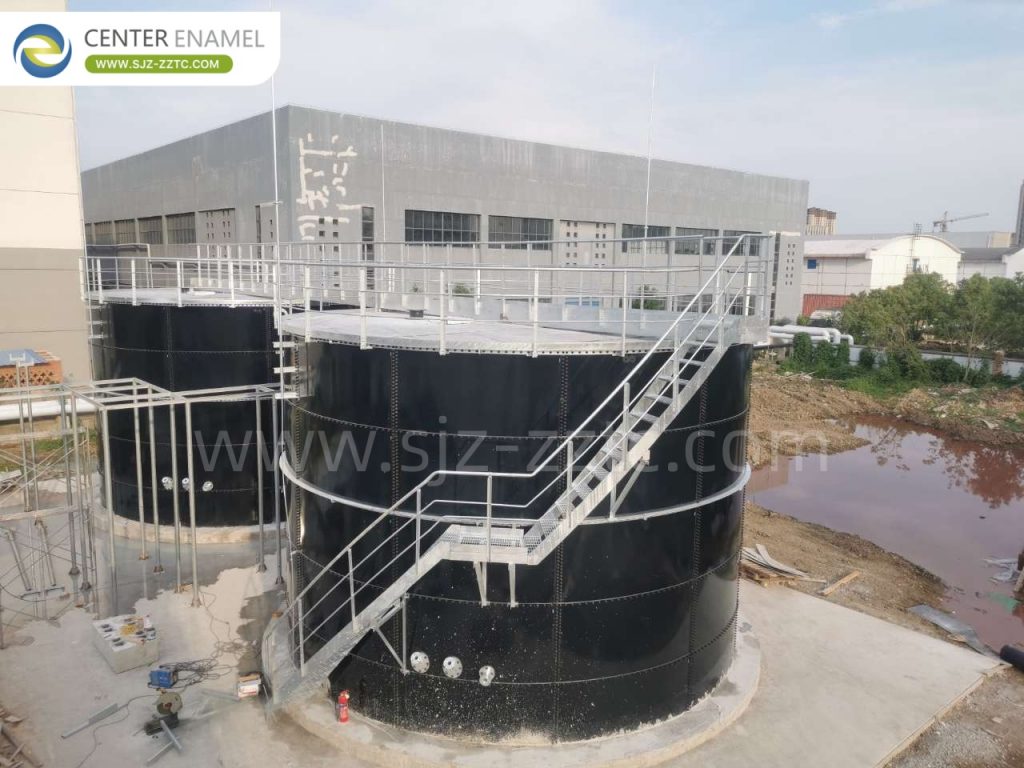
For biogas projects, the reliability of storage and digestion infrastructure is paramount. GFS Tanks (Glass-Fused-to-Steel) are the premier choice for these demanding applications. These tanks are manufactured through a unique high-temperature firing process (820°C–930°C), fusing glass to steel to create an inert, inorganic bond .
The advantages of GFS Tanks in biogas applications are significant:
Superior Corrosion Resistance: The glass coating resists the aggressive organic acids and hydrogen sulfide generated during anaerobic digestion, ensuring a service life exceeding 30 years with minimal maintenance .
Modular, Rapid Installation: Factory-prefabricated panels are bolted together on-site, eliminating the need for extensive welding and enabling assembly even in remote locations .
Space Efficiency: Paired with a Double Membrane Roof, the gas holder is integrated directly on top of the tank, eliminating the need for separate ground-mounted gas holders and saving valuable land .
Proven Performance: GFS Tanks have been successfully deployed in biogas projects worldwide, including a recent Malaysia project featuring five tanks with a total volume of 28,180 m³ .
Center Enamel: A Leader in Biogas Solutions
Center Enamel (Shijiazhuang Zhengzhong Technology Co., Ltd.) has emerged as a premier EPC Contractor in sustainable energy, with over 36 years of experience, a 150,000㎡ R&D and production base, and an annual production capacity of 250,000 tank sheets . As a full-service provider, Center Enamel delivers turnkey biogas solutions covering the entire project lifecycle—from feasibility studies and process engineering to equipment manufacturing, installation, and commissioning.
Center Enamel has successfully executed biogas projects across more than 100 countries. The company's portfolio includes large-scale biogas projects in Malaysia, Singapore, Indonesia, and Sweden, demonstrating expertise in diverse climates and applications . Their solutions are specifically designed to withstand local conditions—whether tropical humidity, high temperatures, or coastal environments—ensuring long-term system reliability .
Conclusion
Restaurants deal with food waste through a hierarchy of strategies: prevention, donation, composting, upcycling, and increasingly, biogas conversion. While source reduction remains the most important approach, biogas offers a compelling solution for waste that cannot otherwise be recovered. By harnessing the CSTR Process within durable GFS Tanks and relying on experienced EPC Contractor expertise, restaurants can transform an environmental liability into a renewable energy asset. Center Enamel stands ready to support this transition, delivering robust, efficient, and cost-effective solutions for sustainable food waste management.
Frequently Asked Questions (FAQ)
Q1: What is the most effective way for restaurants to reduce food waste?
Source prevention is most effective—tracking waste patterns, using AI monitoring systems, and designing menus that minimize overproduction. Studies show AI-enabled tracking can reduce waste by 23–51% .
Q2: How much biogas can restaurant food waste produce?
Ten kilograms of food waste can generate gas equivalent to one kilogram of LPG. A commercial biogas plant can save approximately one industrial LPG cylinder every 20 days .
Q3: How long do GFS Tanks last in biogas applications?
GFS Tanks provide a service life of over 30 years with minimal maintenance due to their corrosion-resistant glass coating, making them ideal for the acidic environment of anaerobic digestion .