
How Do You Estimate Wastewater CAPEX?
Wastewater CAPEX is estimated by taking the design flow, multiplying by a specific capital cost per cubic metre per day, then scaling that figure by the treatment level and adding civil works, land, and sludge handling. The method gives a defensible planning number before detailed design; the dominant cost drivers are the discharge standard (deeper treatment costs more) and site civil works, not the tanks themselves.
The Estimation Method
Start with average daily flow. Apply a specific cost band that rises with treatment depth, then add a factor for equalization, nutrient removal, and polishing. Civil works, land, and sludge dewatering are added separately because they vary far more between sites than the process equipment does.
Design Parameter Table
| Cost driver | Typical planning figure | Why it matters |
| Specific CAPEX | Order-of-magnitude per m³/day | Base of the estimate |
| Treatment level | Primary < secondary < tertiary | Largest scaler |
| Civil works | Site-dependent | Often exceeds tanks |
| Land | Site-dependent | Varies by region |
| Sludge handling | Dewater + stabilize | Closes the budget |
| Limitation to check | Local labor & codes | Confirm before bid |
How Treatment Level Scales Cost
| Level | Train | Relative CAPEX |
| Primary | Screen + settle | Lowest |
| Secondary | + biological + clarifier | Mid |
| Tertiary | + nutrient + polishing | Highest |
Project Case Study
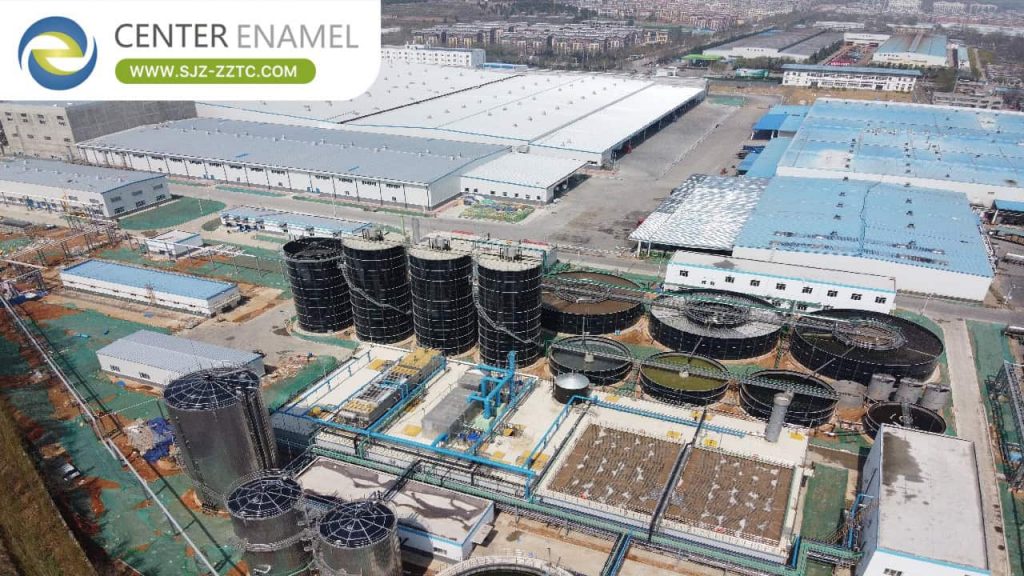
Beijing 5S Pig Farm Wastewater Project. A 580 m³/day livestock plant using UASB + AOAO brought influent COD from ≥10,000 mg/L down to ≤200 mg/L, ammonia from ≥1,000 to ≤80 mg/L, and total phosphorus from ≥200 to ≤8 mg/L. The delivered scope shows how a compact, high-removal train is budgeted for a single-site flow rather than a municipal scale.
| Project | Beijing 5S Pig Farm Wastewater Project |
| Location | Beijing, China |
| Industry | Livestock / Pig Farm |
| Application | UASB + AOAO treatment |
| Product | 580 m³/day packaged train |
| Result | COD ≥10,000 → ≤200 mg/L, NH₃ ≥1,000 → ≤80 mg/L |
| Status | Delivered 2020 |
About Shijiazhuang Zhengzhong Technology Co., Ltd (Center Enamel)
Shijiazhuang Zhengzhong Technology Co., Ltd (Center Enamel) contributes manufacturing and project certainty to a CAPEX estimate: bolted GFS tanks are prefabricated and shipped to 100+ countries, so the tank portion of the budget is a known, repeatable line rather than open-ended site fabrication. With a 30-day standard delivery for 1,000-10,000 m³ tanks, schedule risk and its cost are reduced.
Estimate wastewater CAPEX as flow × specific cost scaled by treatment level, then add civil, land, and sludge. Send your flow and target limit and we will return a planning-range budget with a fixed tank line.
Frequently Asked Questions (FAQ)
Q1: How do you estimate a WWTP budget?
A: Flow × specific cost per m³/day, scaled by treatment level, plus civil works, land, and sludge handling.
Q2: What cost per m³/day is typical?
A: It varies widely by region and level of treatment; use an order-of-magnitude planning band and tighten it during detailed design.
Q3: Which factors raise CAPEX most?
A: The discharge standard (tertiary costs more than secondary) and site civil works usually dominate.
Q4: How does treatment level affect cost?
A: Primary is cheapest, secondary adds biological and clarifier cost, tertiary adds nutrient removal and polishing.
Q5: Can tank cost be fixed early?
A: Yes, bolted GFS tanks are prefabricated with a known price and 30-day delivery, so that line is stable.
Q6: Should sludge be in the budget?
A: Always; dewatering and stabilization are a real capital and operating cost that closes the mass balance.
Suggested CTA
Send your flow, treatment level, and site notes. We will return a planning-range CAPEX estimate with a fixed GFS tank line.