
How Do You Scope a Wastewater Treatment Project?
Scope a wastewater treatment project by first fixing the design basis — average and peak flow, pollutant load (COD/BOD/TSS/N/P), and the discharge limit — then selecting a treatment train, sizing tankage (equalization, reactors, sludge), and building a CAPEX/OPEX envelope before any procurement. A written design basis prevents oversizing, change-orders, and failed guarantees.
1. Fix the Design Basis (Flow and Load)
Record daily flow (Qavg) and peak factor (Qpeak ≈ 1.3–2.5×), then the influent concentrations and mass loads. A slaughterhouse and a municipal plant may share a flow number but differ 10× in COD; mass load — not flow alone — drives reactor and tank volume. Capture seasonality and future expansion headroom.
2. Set the Effluent Discharge Limit
The discharge standard (local regulation or reuse target) sets the required removal. Discharge to sewer needs only primary plus basic biological; direct-to-surface often needs tertiary nitrogen and phosphorus polish. Reuse for irrigation or cooling tightens suspended solids and pathogens. The limit decides whether you need UASB, MBR, or a tertiary stage.
| Design-basis item | Typical data needed | Why it matters |
| Flow (m³/d) | Qavg, Qpeak, hourly profile | Sizes equalization and reactors |
| COD / BOD (mg/L) | Influent, mass load | Drives biological reactor volume |
| TSS (mg/L) | Settleable fraction | Primary clarifier and sludge |
| N / P (mg/L) | Total N, Total P | Decides anoxic/tertiary stage |
| Discharge limit | Regulation or reuse | Sets the whole train |
3. Select the Treatment Train
Map load to process: high-strength soluble wastewater → UASB/EGSB anaerobic first (saves aeration, makes biogas); low-strength municipal → activated sludge or UBF; stringent N/P → A²/O or MBR. Add equalization upstream and sludge dewatering downstream. Keep the train as short as the limit allows — every stage is capital and OPEX.
4. Size Tankage and Reactors
Size equalization for peak shaving, anaerobic/aerobic reactors by hydraulic retention time (HRT 6–12 h for high-strength UASB; 15–30 days for wet mesophilic AD), and sludge holds for storage and stabilization. Bolted Glass-Fused-to-Steel (GFS) tanks cover 200–60,000 m³, resist H₂S and acidic liquors, and cut civil works versus concrete.
5. Build the CAPEX / OPEX Envelope
Tankage is a major line but not the whole plant; the envelope should also carry reactors, mechanical/electrical, and installation. OPEX is dominated by energy — aerobic aeration runs 0.5–1.5 kWh per kg COD removed, which anaerobic avoids by recovering biogas instead. A simple mass-balance sheet lets suppliers quote fast and fairly.
6. Plan Commissioning and O&M
Define startup seed sludge, monitoring points, spare-part list, and operator training before handover. A realistic O&M plan protects the guarantee and keeps the plant at design removal for its service life.
Project Case Study
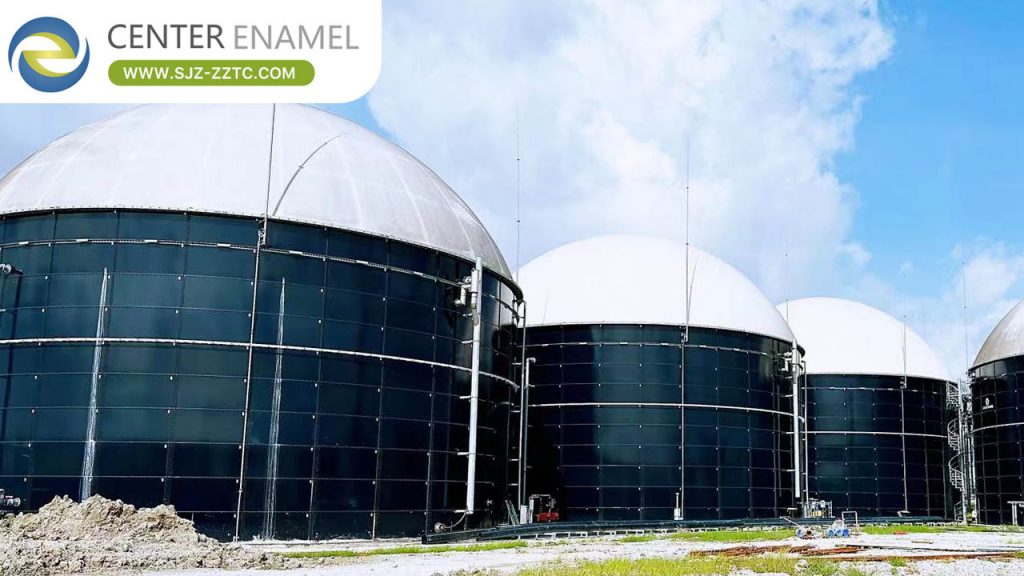
Indonesia Biogas Project — Anaerobic Reactors. An anaerobic reactor system for a palm oil wastewater treatment plant in Indonesia, supplied with 3 GFS tanks in two sizes (Ø17.58 × 8.4 m and Ø16.82 × 7.2 m) for flexible anaerobic capacity. It shows how tankage is sized to a specific process and site rather than a generic catalogue.
| Project | Indonesia Biogas Project — Anaerobic Reactors |
| Location | Indonesia |
| Industry | Palm Oil / Agro-industry |
| Application | Anaerobic reactors at palm oil WWTP |
| Product | 3 GFS tanks (Ø17.58×8.4 m + Ø16.82×7.2 m) |
| Capacity | Site-specific anaerobic capacity |
| Process | Anaerobic Digestion |
| Status | Delivered 2013 |
About Center Enamel
Center Enamel applies its customization capability to wastewater projects: bolted GFS tank systems are engineered to the client’s flow, load, and discharge limit rather than forced into a standard size. The factory builds tanks to verified volumes and coatings, ships flat-pack, and supports site-specific layout — the customization that a correct scope demands.
Advantages and Limitations
A disciplined scope cuts both capital risk and operating cost. Limits: a weak design basis (missing peak or load data) undermines every downstream choice; and some limits need unit processes the tank supplier does not provide, so integrate early with the process designer.
Comparison: Under-scoped vs Properly Scoped
| Factor | Under-scoped | Properly scoped |
| Basis | flow only | flow + mass load + limit |
| Tank volume | often wrong | matched to HRT |
| Guarantee risk | high | low |
| Change-orders | frequent | rare |
Scoping a wastewater project starts and ends with the design basis: flow, load, and discharge limit. From there select the shortest train that meets the limit, size GFS tankage to HRT, and build a CAPEX/OPEX envelope before procurement. Send your flow and concentration profile and we will size the train and tankage.
Frequently Asked Questions (FAQ)
Q1: What is the design basis for a wastewater project?
A: Average and peak flow, influent COD/BOD/TSS/N/P concentrations, and the discharge or reuse limit.
Q2: Which treatment train fits a high-strength effluent?
A: Start with anaerobic (UASB/EGSB) to cut COD and recover biogas, then aerobic polish to the limit.
Q3: How is tankage sized?
A: By hydraulic retention time — 6–12 h for high-strength UASB, 15–30 days for wet mesophilic AD — in GFS tanks of 200–60,000 m³.
Q4: What drives OPEX most?
A: Aeration energy, about 0.5–1.5 kWh per kg COD removed; anaerobic routes avoid this by making biogas.
Q5: Can GFS tanks be customized?
A: Yes — Center Enamel builds bolted GFS tanks to site-specific volume, coating, and roof requirements.
Q6: What should I send for a quote?
A: Flow, concentrations, discharge limit, footprint, and expansion plans; a mass-balance sheet speeds accurate quoting.
Send your flow, concentration profile, and discharge limit. We will help scope the treatment train, size GFS tankage to the right HRT, and prepare a CAPEX/OPEX envelope for your wastewater project.