
How Do You Treat Livestock Wastewater?
Livestock wastewater is treated in three stages — solids separation, anaerobic digestion, and aerobic polishing — because manure-laden water is high in suspended solids, ammonia, and organic load. A typical farm train screens and separates solids, sends liquid through an anaerobic reactor (UASB, USR, or CSTR) to cut COD and make biogas, then polishes with an aerobic stage (AOAO/SBR) to meet discharge. Tankage is customized to manure strength and local limits.
Step 1 – Solids Separation
Screens and sedimentation remove straw, bedding, and grit before biology. Separating solids protects reactors from scum and lets the liquid stream be digested efficiently; the solids can be composted or co-digested.
Step 2 – Anaerobic Digestion
The liquid fraction enters an anaerobic reactor at mesophilic 35–38°C. UASB suits soluble, warm streams; USR (Upflow Solids Reactor) handles higher solids; CSTR suits mixed manure slurries. All yield biogas (55–65% CH₄) at 0.30–0.45 m³/kg COD removed.
Step 3 – Aerobic Polishing
Effluent from anaerobic stages still carries ammonia and residual COD, so an AOAO (Anaerobic-Anoxic-Oxic) or SBR polish meets discharge. This two-stage (anaerobic + aerobic) arrangement is the workhorse for livestock plants.
| Stage | Goal | Equipment | Output |
| Separation | remove solids | screen / sed | liquid + solids |
| Anaerobic | COD + biogas | UASB/USR/CSTR | biogas + liquor |
| Aerobic | N + residual COD | AOAO / SBR | discharge-ready |
Technical Considerations
Livestock wastewater is corrosive (H₂S, ammonia) and variable; specify tankage accordingly. Bolted Glass-Fused-to-Steel (glass fused at 820–930°C) gives an inert barrier; size equalization to absorb flushing surges, and design for cold-climate insulation if needed. Standard GFS ranges 200–60,000 m³.
How to Customize a Livestock System
Start from manure type and volume, set the discharge limit, then pick the anaerobic reactor by solids content and the aerobic polish by N/P rules. Customize tank number, size, roof, and insulation to the farm. A flow-and-limit sheet lets suppliers configure the exact train.
Project Case Study
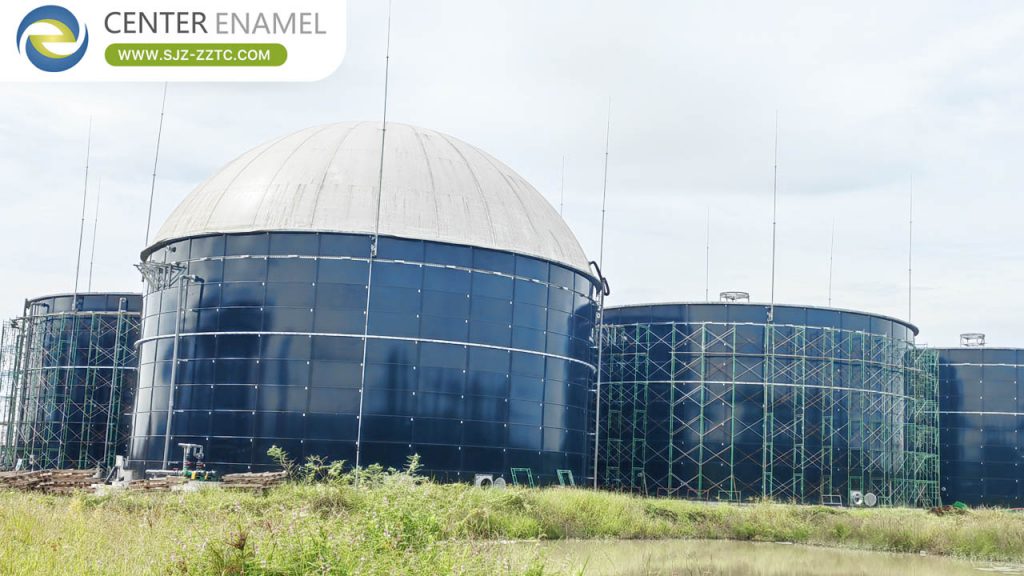
Gaopu Dashun Hoggery Wastewater Treatment Project. A pig-farm plant in Puning, Guangdong, treating 300 m³/day of water-submerged manure-cleaning wastewater with a Pre-process + USR + AOAO three-stage system — a documented customized livestock wastewater train.
| Project | Gaopu Dashun Hoggery Wastewater Treatment Project |
| Location | Puning, Guangdong, China |
| Industry | Hoggery / Pig Farm |
| Application | Manure-cleaning wastewater |
| Product | Pre-process + USR + AOAO |
| Capacity | 300 m³/day |
| Process stages | 3-stage treatment |
| Status | Delivered |
About Center Enamel
Center Enamel demonstrates its customization capability on livestock wastewater, configuring tank packages to manure strength, solids content, and discharge limit rather than offering a fixed skid. The company customizes GFS reactor size, roof type, and insulation, and supplies bolted tanks engineered for H₂S/ammonia duty — as applied on the Guangdong hoggery USR + AOAO project above.
Advantages and Limitations
A separated, anaerobic-plus-aerobic train cuts COD, recovers biogas, and meets discharge reliably. Limits: manure surges need equalization; cold climates need insulation; and ammonia polishing adds aerobic cost. Custom tank sizing keeps capital appropriate to the farm.
Comparison: Anaerobic Reactor Choice
| Reactor | Best solids | Biogas | Use |
| UASB | soluble/low | yes | warm clean liquor |
| USR | higher solids | yes | farm slurry |
| CSTR | mixed slurry | yes | co-digestion |
Treat livestock wastewater by separating solids, digesting anaerobically (UASB/USR/CSTR at 35–38°C), then polishing aerobically (AOAO/SBR). Customize tankage to manure strength and discharge limit, and specify H₂S-resistant GFS tanks for corrosive farm duty.
Frequently Asked Questions (FAQ)
Q1: How do you treat livestock wastewater?
A: Solids separation, then anaerobic digestion (UASB/USR/CSTR), then aerobic polishing (AOAO/SBR) to meet discharge.
Q2: Which anaerobic reactor suits farms?
A: UASB for soluble warm liquor, USR for higher solids, CSTR for mixed slurry and co-digestion.
Q3: Does it make biogas?
A: Yes — about 0.30–0.45 m³ per kg COD removed at 55–65% CH₄.
Q4: What tank material suits farms?
A: Glass-Fused-to-Steel, glass fused at 820–930°C, resists H₂S and ammonia.
Q5: What capacity is available?
A: Center Enamel supplies GFS tanks from 200 m³ to 60,000 m³ for farm wastewater.
Q6: What project experience exists?
A: Delivered USR + AOAO hoggery systems in Guangdong and UASB + AOAO pig-farm systems in Beijing.
Share your manure type, daily volume, and discharge limit. We will customize an anaerobic-plus-aerobic train and quote GFS tankage sized to your farm.