
How Does A2O Work? Understanding the Anaerobic-Anoxic-Oxic Wastewater Treatment Process
The A2O (Anaerobic-Anoxic-Oxic) process is one of the most widely used biological wastewater treatment technologies for simultaneous removal of organic matter, nitrogen, and phosphorus. At its core, the A2O process works by directing wastewater through three distinct zones-anaerobic, anoxic, and aerobic-each housing specialized microbial communities that perform different functions. This sequential approach allows for combined biological nutrient removal (BNR) in a single system, achieving removal efficiencies of 90-95% for BOD and SS, over 70% for total nitrogen, and approximately 90% for phosphorus. This article explains the science behind the A2O process, its key operational parameters, and how modern infrastructure supports its effective implementation.
The Three-Stage Biological Foundation of A2O
The A2O process is built on a simple yet powerful principle: creating three different environmental conditions in sequence, each favoring a specific group of microorganisms.
Stage 1 – Anaerobic Zone
In this oxygen-free environment, polyphosphate-accumulating organisms (PAOs) release phosphorus into the water while taking up readily biodegradable organic matter (volatile fatty acids). This "phosphorus release" step is essential—it puts the PAOs in a state of "hunger" that drives them to absorb excess phosphorus later.
Stage 2 – Anoxic Zone
This zone contains no dissolved oxygen but does contain nitrate (NO₃⁻) from the recycled mixed liquor. Denitrifying bacteria use nitrate as an electron acceptor to break down organic matter, converting nitrate into harmless nitrogen gas (N₂) that escapes to the atmosphere.
Stage 3 – Oxic (Aerobic) Zone
Oxygen is introduced here, enabling two critical functions. First, aerobic heterotrophic bacteria break down remaining organic pollutants. Second, nitrifying bacteria (Nitrosomonas and Nitrospira) convert ammonia (NH₄⁺) into nitrate (NO₃⁻), which is then recycled back to the anoxic zone for denitrification.
The sludge from this zone is partially returned to the anaerobic zone to maintain the microbial population, while excess phosphorus-rich sludge is wasted to permanently remove phosphorus from the system.
The Key Microbial Players: Why They Matter
The A2O process relies on a delicate balance between three functional groups of bacteria, each with different growth requirements:
Nitrifying Bacteria (Autotrophs): These slow-growing organisms oxidize ammonia to nitrate in the aerobic zone. They require long sludge retention times (SRT) to survive—typically 20–30 days. Research has shown that successful nitrification requires an SRT longer than 10.3 days.
Denitrifying Bacteria (Heterotrophs): These organisms thrive in the anoxic zone, using nitrate as an alternative electron acceptor. They need a readily available carbon source, which is why the influent carbon-to-nitrogen (C/N) ratio is critical.
Polyphosphate-Accumulating Organisms (PAOs): These bacteria alternate between phosphorus release in anaerobic conditions and phosphorus uptake under aerobic conditions. The amount of phosphorus removed depends on how much excess sludge is wasted, since phosphorus leaves the system only when PAO-rich sludge is removed.
Critical Factors That Affect A2O Performance
Several operational parameters must be carefully controlled to achieve optimal nutrient removal:
1. Carbon Source Availability
The influent must contain sufficient biodegradable organic matter. In the anaerobic zone, PAOs need volatile fatty acids to release phosphorus and store PHB. In the anoxic zone, denitrifiers need carbon for nitrate reduction. In the aerobic zone, organic matter should be low enough to avoid outcompeting nitrifiers. Typically, an influent COD/TKN ratio > 8 is needed for 80% nitrogen removal.
2. Dissolved Oxygen (DO) Control
Each zone requires tight DO management:
| Zone | DO Level | Purpose |
| Aerobic zone | ~2 mg/L | Optimal nitrification (too high wastes energy; too low starves nitrifiers) |
| Anoxic zone | < 0.5 mg/L | Allows denitrification |
| Anaerobic zone | < 0.2 mg/L | Maintains phosphorus release |
3. Sludge Retention Time (SRT)
This is a key trade-off point. Long SRT (15–20 days) supports nitrifying bacteria but reduces phosphorus removal because less phosphorus-rich sludge is wasted. A balanced SRT of 15–20 days is typically recommended.
4. Recycle Ratios
Two internal recycle streams are critical:
Mixed liquor recycle (internal return): Returns nitrate-rich mixed liquor from the aerobic zone to the anoxic zone for denitrification. Higher ratios improve nitrogen removal but increase pumping costs.
Sludge recycle (return activated sludge): Returns settled sludge from the clarifier to the anaerobic zone to maintain biomass concentration. Typical ratios are 60–100% of influent flow.
5. Hydraulic Retention Time (HRT)
The total HRT typically ranges from 6 to 8 hours, with a distribution of approximately 1:1:3–4 for anaerobic:anoxic:aerobic zones.
6. Temperature
Nitrification is temperature-sensitive and slows significantly below 12°C. Studies have shown that effluent ammonia can rise sharply between 12°C and 13°C, indicating a rapid decline in nitrifier activity.
How the A2O Process Removes Organic Matter, Nitrogen, and Phosphorus
The A2O process achieves three distinct treatment goals simultaneously:
Organic Matter Removal: BOD and COD are removed in all three zones, but primarily in the aerobic zone where aerobic heterotrophs oxidize organic carbon to CO₂ and water. Typical COD removal exceeds 96%.
Nitrogen Removal (Denitrification): Ammonia is first oxidized to nitrate in the aerobic zone (nitrification). The nitrate-rich mixed liquor is then recycled to the anoxic zone, where denitrifiers convert nitrate to nitrogen gas (N₂). This two-step process is why internal recycle is essential.
Phosphorus Removal: PAOs release phosphorus in the anaerobic zone while taking up organic matter. In the aerobic zone, they uptake phosphorus at levels far exceeding their metabolic needs (luxury uptake). By wasting phosphorus-rich sludge, the system permanently removes phosphorus from the wastewater stream.
It is important to note that the A2O process has inherent limitations. For example, recent research found that while the A2O process effectively removes surfactants (detergents) and phosphorus, nitrate removal can be constrained when the carbon source is insufficient or redox conditions are suboptimal. A comparison study also found that the "reverse A2O" configuration (anoxic → anaerobic → oxic) achieved slightly better phosphorus removal (76%) than the conventional configuration (70%), due to lower oxidation-reduction potential in the anaerobic zone.
Infrastructure That Supports Effective A2O Operation
The reliability of an A2O wastewater treatment plant depends heavily on the integrity of its containment infrastructure. Anaerobic, anoxic, and aerobic zones each require tanks that can withstand corrosive conditions, varying hydraulic loads, and decades of continuous operation.
Glass-Fused-to-Steel (GFS) tanks have become the industry standard for A2O reactors and associated process tanks. By fusing a silica-based glass coating to steel at temperatures exceeding 820°C, GFS technology creates a material that combines the structural strength of steel with the chemical inertness of glass.
Key advantages for A2O applications include:
Corrosion Resistance: The glass coating provides a pH 1–14 tolerance, resisting attack from organic acids, hydrogen sulfide, and other corrosive compounds generated during biological treatment.
Impermeability: The non-porous surface prevents liquid and vapor migration, protecting the tank structure and ensuring containment integrity.
Low Maintenance: Unlike painted steel or concrete, GFS tanks never need repainting or recoating, significantly reducing lifecycle costs.
Modular Design: Bolted construction allows for fast, on-site assembly even in remote locations, with no welding required.
Compliance: GFS tanks meet international standards including AWWA D103, ISO 28765, and NSF/ANSI 61, ensuring quality and safety.
These tanks are suitable not only for the three primary A2O reactors but also for clarifiers, flow equalization tanks, digestate storage, and process water tanks.
Center Enamel: Your Complete A2O Wastewater Treatment Project Partner
Center Enamel (Shijiazhuang Zhengzhong Technology Co., Ltd) is a globally recognized leader in providing comprehensive wastewater treatment solutions, specializing in Glass-Fused-to-Steel tank technology and turnkey EPC (Engineering, Procurement, and Construction) services. With over 30 years of experience and installations in more than 100 countries, Center Enamel delivers the durable infrastructure essential for reliable A2O process performance.
Our comprehensive A2O project solutions include:
High-Quality GFS Tanks: Engineered specifically for anaerobic, anoxic, and aerobic reactors, with proven corrosion resistance and gas-tightness.
Epoxy Coated Tanks: Cost-effective alternatives for equalization, storage, and auxiliary applications.
Advanced Roof Systems: Aluminum geodesic domes, double-membrane gas holders, and other roof options for odor control and environmental protection.
Full EPC Services: From initial design and fabrication to on-site installation and commissioning, we manage the entire project lifecycle.
Global Project Experience: Successful installations across diverse industries—including brewing, papermaking, starch, palm oil, and dairy wastewater treatment—demonstrate our capability to handle complex biological nutrient removal projects.
Center Enamel's GFS tanks are built to last decades with minimal maintenance, ensuring your A2O wastewater treatment plant operates reliably and cost-effectively over the long term. Our modular construction approach enables rapid installation, reducing project timelines and allowing earlier system startup.
Project Case Study: Domestic Sewage Treatment Plant in Ghana
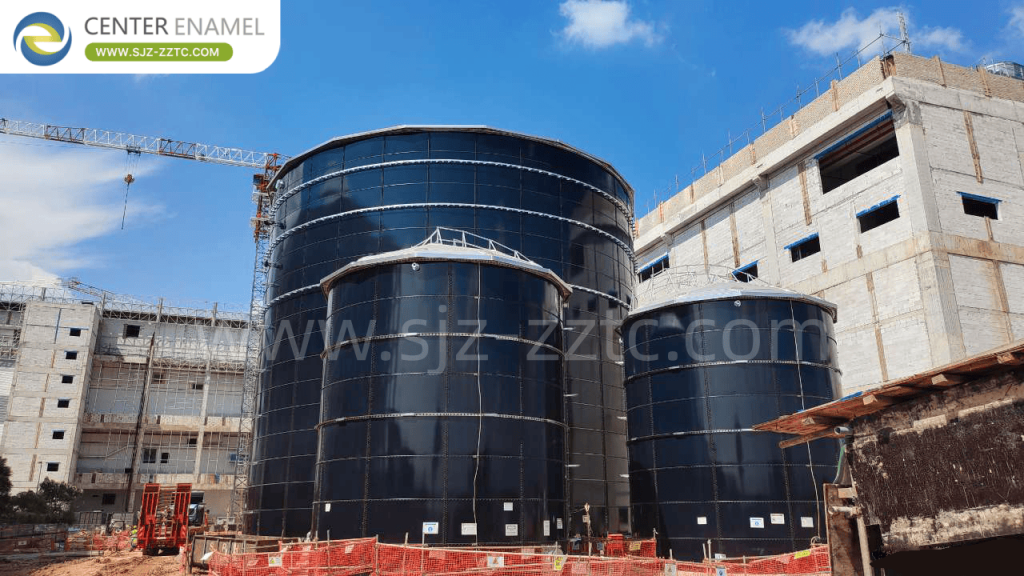
The following case study demonstrates a successful A2O-based domestic sewage treatment project delivered by Center Enamel in West Africa. This project showcases the effectiveness of combining GFS tank technology with the A2O biological nutrient removal process to meet stringent effluent discharge standards.
| Project Parameter | Details |
| Project Name | Domestic Sewage Treatment Project in Ghana |
| Installation Year | 2021 |
| Location | Ghana, West Africa |
| Daily Treatment Volume | 1,800 m³/day |
| Reactor Type | UBF (Upflow Blanket Filter) + A2/O (Anaerobic-Anoxic-Oxic) |
Key Project Outcomes:
The combined UBF + A2/O system successfully treats 1,800 m³ of domestic sewage per day.
All effluent parameters meet or exceed local environmental discharge standards.
The GFS tank configuration (with outer and inner tank design) optimizes space utilization while maintaining process integrity.
The modular bolted tank system enabled rapid on-site installation in Ghana with minimal local infrastructure requirements.
Client Testimonial:
"Center Enamel provided a complete turnkey solution for our municipal sewage treatment needs. The installation was completed on schedule in 2021, and the system has been operating reliably ever since. The effluent quality consistently meets our national discharge standards, and the GFS tanks have shown no signs of corrosion or leakage after years of continuous service. We are particularly impressed with the thoughtful tank design that integrates UBF and A2/O processes in a compact footprint."
Frequently Asked Questions (FAQ)
Q1: What is the difference between A2O and conventional activated sludge?
The A2O process adds anaerobic and anoxic zones before the aerobic zone, whereas conventional activated sludge typically only has an aerobic zone. This three-stage configuration enables biological nitrogen removal (via nitrification-denitrification) and biological phosphorus removal (via PAO luxury uptake)—capabilities that conventional systems cannot achieve without chemical addition. However, A2O requires more complex control and higher capital costs.
Q2: What is the typical removal efficiency of the A2O process?
The A2O process typically achieves BOD and SS removal of 90–95%, total nitrogen removal exceeding 70%, and phosphorus removal around 90% under optimal conditions. In the Ghana project case study, the system achieved 95% BOD removal, 90% COD removal, 93.75% SS removal, and 80% total phosphorus removal, demonstrating strong performance even with high-strength influent (COD 1000 mg/L, BOD 500 mg/L).
Q3: Why is the internal recycle (mixed liquor return) so important in A2O?
The internal recycle returns nitrate-rich mixed liquor from the aerobic zone to the anoxic zone, providing the nitrate needed for denitrification. Without this recycle, nitrate would accumulate and nitrogen removal would be minimal. The recycle ratio directly affects denitrification efficiency; higher ratios improve nitrogen removal but increase pumping energy costs. Typical ratios range from 100% to 400% of influent flow.
Q4: How do seasonal temperature changes affect A2O performance, and how can they be managed?
Nitrification is highly temperature-sensitive, with activity dropping sharply below 12°C. In colder climates, operators can extend SRT, increase mixed liquor suspended solids (MLSS), or add supplemental heating to maintain nitrifier activity. Tank insulation (e.g., using GFS tanks with insulated roofing) also helps stabilize temperatures in winter months. In tropical regions like Ghana, temperature is generally favorable for stable A2O performance year-round.
Q5: What types of wastewater are best suited for the A2O process, and can it handle high-strength influent?
A2O is ideal for municipal sewage and industrial wastewaters with moderate to high organic loads and stringent nutrient discharge limits—particularly where both nitrogen and phosphorus removal are required. Common applications include food and beverage processing, pulp and paper mills, chemical plants, and agricultural processing facilities. The Ghana project demonstrates that A2O, when combined with a UBF pretreatment stage, can effectively handle high-strength domestic sewage with influent COD up to 1000 mg/L and BOD up to 500 mg/L, achieving excellent effluent quality.