
How Does Municipal Differ From Industrial WWTP? A Side-By-Side
Municipal and industrial wastewater treatment plants differ mainly in strength, variability, and what the permit targets. Municipal sewage is low-strength and steady, so it leans on biological nutrient removal to hit nitrogen and phosphorus limits; industrial effluent is high-strength and variable, so it needs pre-treatment and often an anaerobic stage before the biology. The tankage, the permit basis, and the operator skill set are therefore different, and a plant built for one is not automatically right for the other.
The Core Difference: Strength And Variability
Domestic sewage rarely exceeds a few hundred mg/L of BOD and changes slowly with the day and season. Industrial streams can arrive at COD above 10,000 mg/L with shock loads from batch production. That gap decides everything downstream: dilution, reactor volume, and how much the biology can be pushed.
| Parameter | Municipal Sewage | Industrial Effluent |
| COD / BOD | Low, hundreds mg/L | High, thousands to tens of thousands mg/L |
| Variability | Diurnal and seasonal | Batch shocks, pH and load swings |
| Key Target | Nitrogen, phosphorus | COD removal, specific pollutants |
| Typical Biology | A2/O, SBR, UBF | Anaerobic plus aerobic, pre-treatment |
Why The Process Emphasis Diverges
Municipal plants spend their effort on nutrient removal because the permit caps total nitrogen and total phosphorus; the carbon is easy. Industrial plants spend their effort on COD destruction and on neutralising specific hazards (salts, ammonia, organics) before the biology sees them. The same activated sludge that suits a town can be poisoned by an un-neutralised industrial spike.
Permit And Operator Profile
Municipal permits are written around public-health and receiving-water limits; industrial permits add source-specific parameters and often a pre-treatment ordinance that governs what the factory may discharge to the sewer. The industrial operator needs more process chemistry on site, while the municipal operator needs more hydraulic and nutrient management.
Project Case Study: Domestic Sewage Treatment Project In Ghana
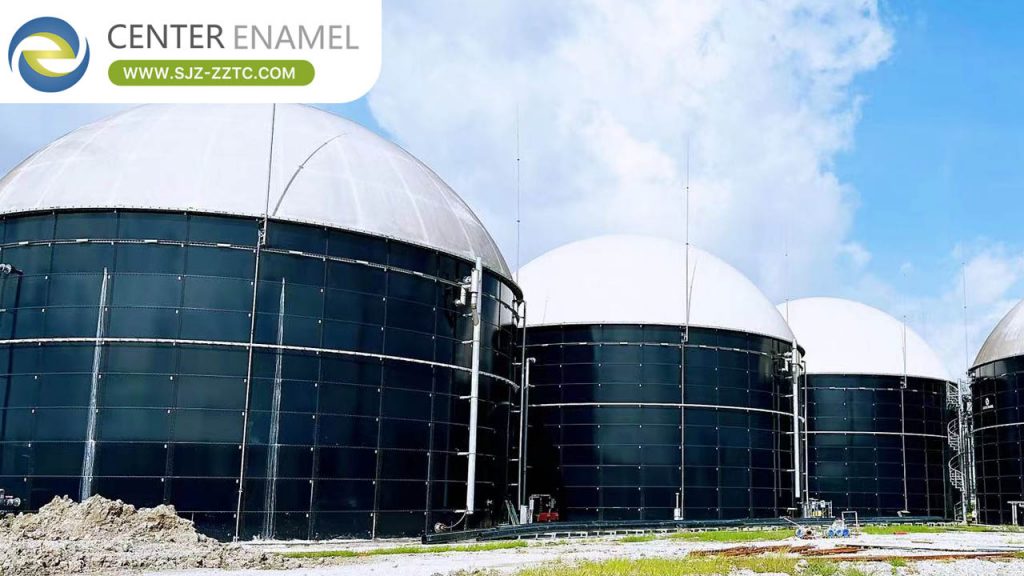
Project / Application: Municipal domestic sewage treatment, Ghana. Industry: Municipal. Tank Type: Glass-Fused-to-Steel (GFS). Key Requirements: Reliable nitrogen and phosphorus removal at community scale.
| Field | Value | Source / Evidence |
| Daily Treatment Volume | 1,800 m3/day | Company project reference |
| Reactor Types | UBF + A2/O + Sedimentation | Company project reference |
| UBF Tank | 1 set, O11.46 x 9.6 m | Company project reference |
| Secondary Sedimentation | 1 set, O14.52 x 4.8 m | Company project reference |
| A2/O Tanks | 2 sets, Outer O20.64 x 6.6 m | Company project reference |
| Installation Year | 2021 | Company project reference |
| Parameter | Influent | Effluent |
| COD Cr | 1,000 mg/L | 100 mg/L |
| BOD5 | 500 mg/L | 25 mg/L |
| Ammonia N | 30 mg/L | 10 mg/L |
| SS | 400 mg/L | 25 mg/L |
| Total P | 10 mg/L | 2 mg/L |
About The Supplier
Shijiazhuang Zhengzhong Technology Co., Ltd (Center Enamel) builds Glass-Fused-to-Steel tankage for both municipal and industrial duty, with enamel firing at 820-930 C and certifications including ISO 9001, NSF/ANSI 61, and CE-EN 1090. The Ghana reference is a municipal train (UBF + A2/O) delivering the nutrient removal a town permit demands; the same supplier delivers industrial scopes where the first job is taming a high-strength, variable feed.
Comparison: One Plant For Both?
| Scenario | Workable? | Condition |
| Municipal only | Yes | Standard nutrient permit |
| Industrial only | Yes | Pre-treatment plus anaerobic |
| Combined | Sometimes | Industrial pretreated to municipal limits first |
Municipal and industrial plants are different animals: one is built to strip nutrients from a gentle, steady stream, the other to survive a strong, spiky one. Design the tankage and biology to the actual strength and variability, and the permit becomes achievable.
Frequently Asked Questions
Q1: How do municipal and industrial WWTP differ? A1: In strength, variability, and the permit target, which change the biology and tankage.
Q2: Why is the process different? A2: Municipal leans on nutrient removal; industrial needs COD destruction and pre-treatment.
Q3: Which permits apply? A3: Municipal targets receiving-water limits; industrial adds source-specific parameters.
Q4: Can one plant do both? A4: Only if the industrial stream is pretreated to municipal limits first.
Q5: What tank suits both? A5: A Glass-Fused-to-Steel reactor resists corrosion in either duty.
Q6: What biology does municipal use? A6: A2/O, SBR, or UBF for carbon and nutrient removal.
Q7: What biology does industrial use? A7: Anaerobic plus aerobic, with pre-treatment ahead of it.
Q8: Does strength change tank size? A8: Yes; high COD needs far more anaerobic volume.
Suggested CTA
Share your stream strength and permit to an engineer, or request a municipal or industrial treatment and tankage plan.