
How Does the UASB Process Optimize Your Industrial Wastewater Treatment Project?
The global regulatory landscape is the primary force shaping treatment requirements across industries. Understanding these policies is essential for selecting a compliant and future-proof treatment approach for any industrial wastewater treatment project.
Global industrial wastewater treatment policies are escalating from "compliance discharge" to mandatory "resource recovery" and "zero liquid discharge." The EU, through its Circular Economy Action Plan, requires member states to increase industrial wastewater reuse rates and extends carbon footprint accounting to the full life cycle of wastewater treatment. China continuously updates and tightens industrial water pollutant discharge standards, with increasingly stringent limits on total nitrogen, total phosphorus, and characteristic pollutants for industries such as chemicals, pharmaceuticals, and printing and dyeing. Some water-scarce regions and highly polluting industries are mandated to adopt zero or near-zero liquid discharge technologies. Germany has established a differentiated pretreatment technical standard system by industry, requiring industrial wastewater to meet specific quality requirements before discharge into municipal wastewater treatment plants, implementing strict source control.
Given these varied and tightening regulations, the choice of core treatment technology becomes critical. The UASB process, with its proven efficiency and low operational cost, offers a robust solution that helps industrial facilities meet these stringent global standards while also enabling resource recovery through biogas generation.
UASB Process: Applicable Scenarios and Versatility
The effectiveness of the UASB process across a wide range of industries makes it a versatile tool for many wastewater challenges. Its design is particularly suited for certain types of effluent, which project planners must understand to ensure optimal performance.
UASB Applicable Scenarios Across Industries
The UASB process is suitable for soluble medium-to-high concentration organic wastewater, covering light industrial wastewater from brewing, sugar refining, starch, papermaking, food processing, printing and dyeing, and other sectors. It is particularly effective for wastewater where organics are predominantly soluble with low suspended solids content, and is not recommended for high-solids or high-viscosity wastewater.
The UASB process can be used alone as the primary treatment process or as a pretreatment for high-strength wastewater to reduce the load on downstream aerobic systems. It is also suitable for municipal wastewater anaerobic pretreatment and low-solids livestock wastewater treatment. With its low cost and stable operation advantages, it is well-suited for long-term continuous, large-flow industrial wastewater treatment projects. This wide applicability makes the UASB process a foundational technology for many industrial wastewater treatment projects across diverse sectors.
Beverage Wastewater: A Case Study in UASB Economics
The beverage industry provides an excellent example of the economic and operational benefits of the UASB process. The high-sugar, biodegradable nature of this wastewater makes it an ideal candidate for anaerobic treatment, delivering superior cost-effectiveness.
Operation and Maintenance Cost Analysis in Beverage Wastewater Treatment
For beverage wastewater, operation and maintenance (O&M) costs are very low with outstanding resource recovery benefits, resulting in industry-leading economics. The wastewater exhibits excellent biodegradability-sugars are the best anaerobic digestion substrate-so no specialty chemicals are needed, only small amounts of pH adjusters and flocculants, leading to very low chemical costs.
Anaerobic digestion produces large stable biogas volumes that can be used for plant heating and power generation, providing significant energy recovery benefits that can greatly offset or fully cover O&M energy costs. The equipment is simple and durable, consisting of conventional pumps, distributors, and three-phase separators-no high-end precision wear parts-resulting in extremely low failure rates and maintenance costs. Stable controllable water quality with high automation also reduces labor requirements and costs. Low suspended solids content leads to low sludge production and disposal costs. Overall, resource recovery revenues (biogas) generally cover O&M costs, making the economics superior to most food processing wastewaters and positioning this as the most economically favorable high-concentration organic wastewater category. This demonstrates how the UASB process can transform an industrial wastewater treatment project from a cost center into a value-generating operation.
Proven Application: Ghana Municipal Wastewater Project
The practical application of anaerobic technologies in diverse settings confirms their reliability and effectiveness. The Ghana municipal project showcases how robust UASB-related processes and high-quality GFS tanks can meet strict discharge standards.
Case Study: UBF + A²/O Process with GFS Tanks in Ghana
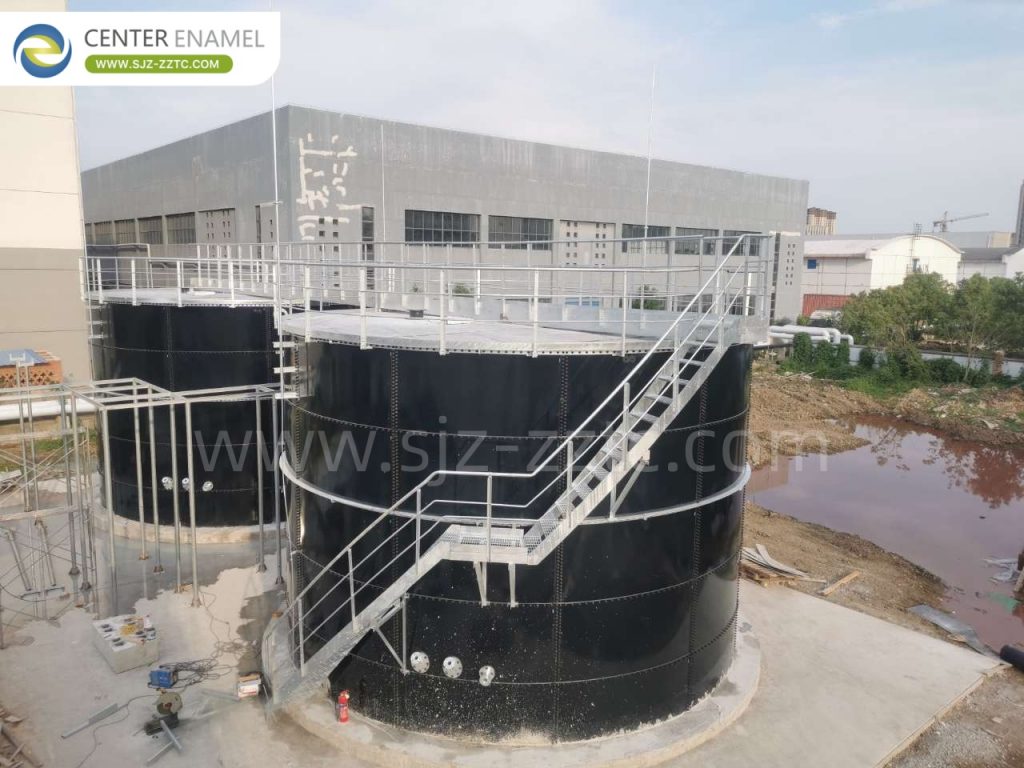
Completed installation in 2021, this project treats 1,800 m³/day of municipal wastewater using UBF anaerobic + A²/O nitrogen/phosphorus removal mature processes. It is equipped with multiple Center Enamel GFS tanks including 1 UBF anaerobic reactor, 1 secondary clarifier, and 2 internal/external double-layer A²/O biological tanks. Influent has high COD, BOD, suspended solids, and nitrogen/phosphorus concentrations. After full treatment, effluent parameters are significantly reduced with pH stable at 6.5-9.0, fully meeting local environmental discharge standards.
The corrosion-resistant, conveniently assembled GFS tanks efficiently solve urban domestic wastewater pollution while balancing treatment effectiveness and O&M economics. This project serves as a mature municipal wastewater case in Africa, demonstrating how integrated solutions combining anaerobic digestion and premium tank systems can be successfully deployed in remote or challenging locations, providing a model for similar industrial wastewater treatment projects worldwide.
Center Enamel's Global Market Presence
Delivering successful projects globally requires a deep understanding of local conditions and a robust service network. Center Enamel's extensive international footprint ensures that clients receive localized support wherever their project is located.
Extensive Global Market Presence and Expertise
Center Enamel's global business covers over 100 countries and regions, with 30,000+ successful overseas projects. Products are exported to all major regions including Europe, the Americas, the Middle East, Africa, Southeast Asia, and Latin America, with a well-established global localized service network.
Domestically, the company is organized into North, South, Central, East, and Southwest marketing regions, covering environmental, water utility, livestock, and petrochemical customers nationwide. Internationally, the company adopts a "standardized products + localized adaptation" model, adjusting tank corrosion protection, sealing, and pressure standards for different national water quality and environmental regulations. Multiple global landmark projects demonstrate this capability: large-volume GFS tanks in Italy, 20 m tower water supply tanks in Colombia, coastal seawater treatment tanks in Costa Rica, and large municipal wastewater aluminum dome projects in Saudi Arabia. The company has established long-term stable strategic partnerships with many Fortune 500 companies, underscoring its reliability as a partner for any industrial wastewater treatment project.
Flexible and Efficient Service Delivery
The ability to execute projects efficiently, especially in international contexts, is a key differentiator. Center Enamel's service delivery model is designed for speed, flexibility, and long-term reliability.
Flexible and Efficient Service Delivery System
Center Enamel's own cross-border construction teams, combined with a global localized agent network, ensure efficient project execution. The modular GFS tank assembly allows for short construction periods and the tanks are dismantlable and reusable, making them suitable for overseas short-term projects, phased expansions, and relocation needs.
This flexibility is complemented by full-lifecycle after-sales O&M support, ensuring long-term stable client operations. This comprehensive approach, from design through to operation, minimizes client coordination and ensures that every industrial wastewater treatment project is delivered on time, within budget, and to the highest quality standards.
Tank Cover Solutions: Aluminum Alloy Trough Deck Roof
In addition to the tanks and reactors, roofing solutions play a vital role in protecting water quality and ensuring safe operation. Center Enamel offers a range of cover options, including the cost-effective Aluminum Alloy Trough Deck Roof.
Aluminum Alloy Trough Deck Roof: Economical Protection for Storage Tanks
The Aluminum Alloy Trough Deck Roof is a cost-effective economical tank cover solution for clean water and wastewater storage scenarios. It is primarily designed for drinking water, production wastewater, and firewater reserve tanks, balancing practicality and cost advantages. The main body is integrally formed from anti-corrosion aluminum alloy plates, paired with aluminum support trusses.
Its lightweight design imposes less load on the tank foundation, reducing civil construction investment. A naturally formed dense oxide protective layer on the surface resists rain and mild wastewater corrosion, withstands outdoor sun and rain exposure, and effectively blocks wind, rain, insects, fallen leaves, and odor volatilization, protecting water quality by preventing dust and debris from causing secondary contamination.
The flat roof structure is neat and orderly, allowing installation of maintenance walkways, guardrails, vents, and level monitoring ports on top, facilitating daily inspection and equipment maintenance. The simple sealing structure enables straightforward installation with short construction timelines, and virtually eliminates the need for anti-corrosion painting maintenance, resulting in extremely low operational costs. It is suitable for various small, medium, and large atmospheric pressure water storage tanks, and has been widely implemented in waterworks clear water tanks, industrial circulating water tanks, park firewater tanks, and domestic wastewater temporary storage facilities. It is highly compatible with water storage applications that do not require biogas collection or high-pressure sealing, making it a versatile choice for many industrial wastewater treatment projects.
Frequently Asked Questions (FAQ)
1. What types of industrial wastewater is the UASB process best suited for?
The UASB process is ideal for soluble medium-to-high concentration organic wastewater with low suspended solids. This includes effluents from food processing, beverage production, brewing, sugar refining, starch, papermaking, and printing and dyeing. It is not recommended for high-solids or high-viscosity wastewaters. Its flexibility also allows it to serve as a standalone primary treatment or as a high-efficiency pretreatment step.
2. How does the UASB process contribute to cost savings in an industrial wastewater treatment project?
The UASB process offers significant cost advantages: low energy consumption (no aeration required), low chemical usage, low sludge production, and minimal maintenance due to its simple, durable design. Crucially, it generates biogas, which can be captured and used for heating or power generation, often offsetting or fully covering the plant's operational energy costs.
3. What makes GFS tanks a preferred choice for housing the UASB process?
Glass-Fused-to-Steel (GFS) tanks provide superior corrosion resistance, essential for the acidic and high-salt environment of anaerobic digesters. Their modular, bolted design allows for precise customization, easy shipping, and rapid on-site assembly. They are also expandable and relocatable, offering long-term flexibility. The durable enamel coating ensures a long service life with minimal maintenance, protecting the critical UASB process for decades.