
How GFS Tanks and Anaerobic Digestion Help Beverage Plants Overcome Wastewater Challenges
Industrial wastewater treatment today is defined by the "three highs": high difficulty, high cost, and high energy consumption. Wastewater from new energy, chemical, and pharmaceutical industries is complex in composition with numerous characteristic pollutants, and traditional treatment processes struggle to remove them effectively. The industry also faces continuous technological upgrade pressure from increasingly stringent emission standards, as well as new requirements for digitalization and low-carbon transformation on operational refinement management capabilities.
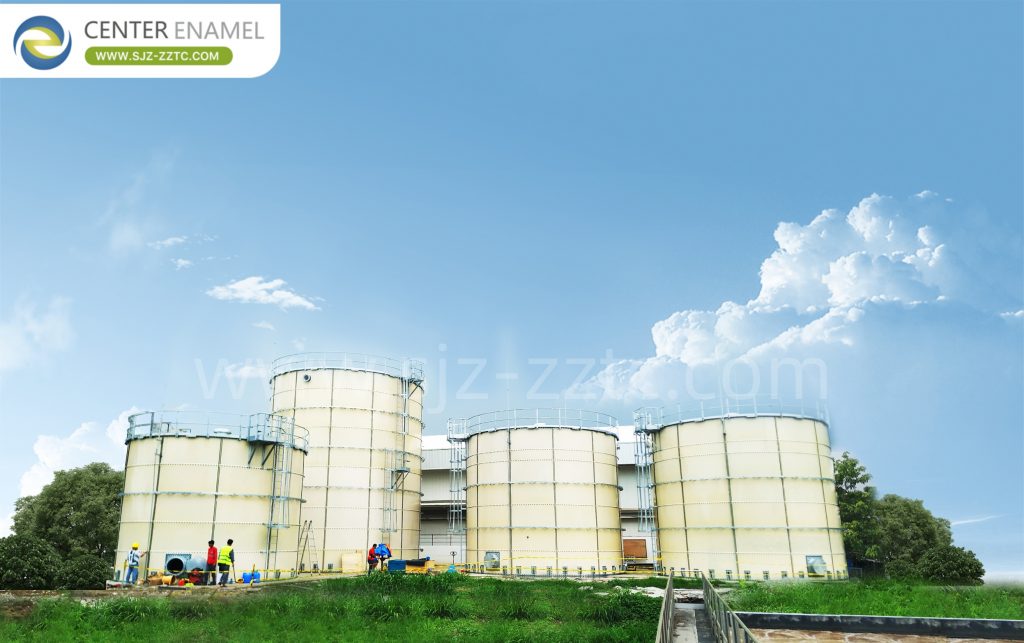
Beverage manufacturing sits squarely within this pressure cooker. Its effluent is a typical high-sugar, high-concentration organic stream that is simultaneously easy to treat biologically and difficult to manage operationally. The answer to this paradox lies in pairing the right biological process-Anaerobic Digestion-with containment infrastructure built to survive decades of corrosive service: GFS Tanks. Together, they convert a compliance burden into an energy-recovery asset.
Where Beverage Wastewater Comes From
Beverage wastewater originates from the entire processing chain of carbonated beverages, fruit juices, tea drinks, bottled water, energy drinks, and other beverage products-a typical high-sugar, high-concentration organic wastewater in the food processing sector. Key pollution stages include raw material pretreatment (fruit washing, crushing, juicing, syrup preparation), blending and mixing (beverage compounding, syrup mixing-high-sugar wastewater), filtration and clarification (juice and tea filtration-fruit and tea residue), filling and packaging (filler and bottle wash-low-concentration high-volume wastewater), CIP cleaning (pipeline, tank, and mixer cleaning-the core high-concentration wastewater source), and floor cleaning.
The composition varies by product line. Juice processing wastewater contains pectin, fruit pulp, and juice residues-extremely high organic concentration. Carbonated beverage wastewater contains syrup, phosphoric acid, and CO₂ residues. Tea beverage wastewater contains tea polyphenols and tea residues. Large and medium-sized beverage plants discharge hundreds to thousands of tons daily, with water quality varying with product type and CIP cleaning cycles. This variability is precisely why the treatment system must be both robust and flexible.
The IC Process: The Third-Generation Anaerobic Engine
At the center of any high-strength beverage treatment train is the anaerobic reactor, and the IC Process represents its most advanced commercial form. IC, or Internal Circulation Anaerobic Reactor, is the third-generation high-efficiency anaerobic treatment technology built upon UASB. Its core innovation is the built-in gas-lift internal circulation system, enabling autonomous wastewater recirculation without external return pumps.
The reactor features a dual-zone configuration: a lower main reaction zone and an upper polishing zone. Biogas gas-lift creates hydraulic internal circulation, significantly increasing upflow velocity and enhancing sludge-wastewater contact. With extremely high compactness, it is specifically designed for high-concentration, high-flow industrial organic wastewater, combining high efficiency, energy savings, and minimal footprint-the core process for modern industrial high-strength wastewater treatment.
Containment That Outlasts the Chemistry
Anaerobic Digestion produces organic acids and operates under fluctuating pH-conditions that destroy ordinary concrete and coated steel. This is where GFS Tanks earn their place. The fusion-bonded glass coating creates an inert barrier that resists the corrosive environment inside an anaerobic digester while maintaining the gas-tightness that biogas collection demands.
GFS tanks are also engineered for environmental adaptability far superior to concrete tanks. Concrete tanks are cast-in-place monolithic structures, with seismic and wind resistance entirely dependent on on-site construction quality. In remote areas, typhoon-prone zones, and earthquake belts, construction quality is difficult to control. Under strong earthquakes or typhoons, concrete tanks are prone to cracking and base settlement damage, with subsequent reinforcement costs equivalent to rebuilding.
GFS tanks undergo collection of local seismic intensity, maximum wind pressure, and foundation bearing capacity data before construction, with customized thickened steel panels, stiffening ribs, and anchored base components-all factory-prefabricated to standardized specifications. The bolted panel structure has excellent stress distribution capability, making it less prone to overall fracture under seismic and typhoon impacts, and minor foundation settlement will not cause through-cracking. Structural parameters can be flexibly adjusted for mountainous, coastal typhoon-zone, and high-seismic-zone projects.
| GFS Tank Design Factor | Adaptation Strategy |
| Seismic zones | Customized thickened panels and stiffening ribs |
| Typhoon/coastal zones | Anchored base components, stress-distributing bolted structure |
| Foundation settlement | Minor settlement will not cause through-cracking |
| Corrosive service | Fusion-bonded glass coating resistant to organic acids |
Sealing the System: Aluminum Geodesic Dome Roofs
Biogas capture is where Anaerobic Digestion turns cost into revenue, and it depends entirely on the roof. The Aluminum Geodesic Dome Roof independently developed by Center Enamel is manufactured using high-strength aluminum alloy plates through integral stamping. It features a triangular grid spherical self-supporting structure, enabling large-span full coverage without internal support columns.
Made of aluminum alloy, the roof offers excellent weather resistance and corrosion resistance, capable of long-term protection against acid rain, salt spray, and UV radiation, suitable for various extreme outdoor climate conditions. The structural design complies with international AWWA D108 standards, with aluminum plate thickness, rib cross-sections, and joint connections all verified by finite element stress analysis, ensuring wind and snow load resistance that meets building code requirements across different global regions.
The weight of the Aluminum Geodesic Dome Roof is only one-third to one-half of a steel roof with the same span, significantly reducing the load on the tank top and allowing direct installation without tank wall reinforcement. The roof provides superior overall sealing performance, with double sealing between panels using specialized sealant strips and mechanical interlocking, enabling both airtight gas storage and enclosed odor control-suitable for biogas collection and storage, wastewater tank odor control, and drinking water contamination prevention. The support-column-free design does not interfere with the installation and operation of internal equipment such as mixers and water distributors. The aluminum material does not support microbial growth, requiring no anti-corrosion maintenance over long-term use, resulting in low total life-cycle costs.
Delivery Capability: Teams and Materials Behind the Tanks
Even the best-engineered reactor fails without disciplined installation. Center Enamel has established its own domestic and international certified construction teams, with regular practical training on GFS tank installation and overseas construction standards for various countries. Domestically, regional construction teams cover multiple zones, capable of simultaneously deploying multiple teams for large tank farm projects. Internationally, cross-border professional installation teams are equipped to various country construction standards-sufficient manpower reserves ensure uninterrupted construction delivery for remote African sites, high-standard European and American facilities, and other projects.
This delivery capability rests on innovative material technology developed in-house, ensuring that every tank, roof, and fitting is manufactured to the same corrosion and sealing specifications regardless of destination.
Frequently Asked Questions
Q: Why choose GFS Tanks over concrete for anaerobic digesters?
GFS Tanks resist the organic acids and fluctuating pH produced during Anaerobic Digestion, while their bolted, factory-prefabricated structure withstands seismic and typhoon loads better than cast-in-place concrete-avoiding cracking and settlement damage.
Q: What makes the IC Process suitable for beverage wastewater?
The IC Process's gas-lift internal circulation and dual-zone design handle high-sugar, high-concentration effluent with strong shock tolerance, achieving high COD removal and biogas production in a footprint one-third that of traditional anaerobic systems.
Q: How are biogas and odors contained?
Aluminum Geodesic Dome Roofs provide airtight double sealing with mechanical interlocking, meeting AWWA D108 standards. They collect biogas for energy recovery and enclose odors, without internal support columns that would obstruct mixers.
Ready to turn your beverage plant's wastewater into an energy asset? Share your effluent data with our team for a tailored anaerobic design.
Contact Center Enamel today to discuss how GFS Tanks and Anaerobic Digestion can solve your toughest wastewater challenges.