
How Is Biogas Produced from Food Waste? Turning Waste into Clean Energy Guide
Food waste is one of the most abundant and problematic organic waste streams in the world. Every year, households, restaurants, and food processing facilities generate millions of tons of organic material that ends up in landfills, where it decomposes anaerobically and releases methane-a potent greenhouse gas. Yet this same waste holds tremendous energy potential. Through a natural biological process called anaerobic digestion, food waste can be transformed into biogas, a renewable energy source that can generate electricity, heat, and even renewable natural gas. This guide explains the science, engineering, and practical considerations behind converting food waste into biogas.
The Global Challenge of Food Waste and Its Energy Potential
Food waste represents a significant environmental and economic burden. When organic material decomposes in landfills without oxygen, it produces landfill gas containing roughly 50% methane-a greenhouse gas with over 25 times the global warming potential of carbon dioxide. Municipalities and industries increasingly recognize that diverting food waste from landfills to anaerobic digesters offers a dual benefit: reducing emissions while producing clean energy.
The scale of opportunity is substantial. Facilities like the Surrey Biofuel Facility in British Columbia process 115,000 tonnes of food waste annually, using billions of microbes to convert everything from banana peels to leftover pizza into renewable natural gas . Michigan State University operates a full-scale anaerobic digestion facility processing approximately 15,000 gallons of diverse animal and food wastes daily, generating 6,500 kilowatt-hours of renewable electricity per day . These operations demonstrate that food waste is not merely a disposal problem-it is a valuable energy resource.
The Four Stages of Anaerobic Digestion: How Microbes Convert Food Waste to Biogas
Anaerobic digestion is a complex biochemical process that occurs in four sequential stages: hydrolysis, acidogenesis, acetogenesis, and methanogenesis . Each stage relies on distinct groups of microorganisms that work in coordinated succession.
Hydrolysis is the first and often rate-limiting stage. Complex organic polymers-carbohydrates, proteins, and lipids-cannot be directly absorbed by microbes. Hydrolytic bacteria secrete extracellular enzymes that break these macromolecules into simpler soluble compounds: sugars, amino acids, and fatty acids. For food waste, which is rich in readily degradable organic matter, this stage proceeds relatively quickly compared to lignocellulosic feedstocks.
Acidogenesis follows, as fermentative bacteria convert the soluble compounds into volatile fatty acids (VFAs), alcohols, ammonia, carbon dioxide, and hydrogen. This stage produces the organic acids that give anaerobic digesters their characteristic acidity. In food waste digestion, acidogenesis can occur rapidly, sometimes faster than downstream stages can consume the products, leading to VFA accumulation and potential process inhibition .
Acetogenesis transforms the products of acidogenesis into acetic acid, hydrogen, and carbon dioxide-the direct precursors for methane formation. This stage bridges the fermentative and methanogenic microbial communities.
Methanogenesis is the final stage, performed by strictly anaerobic archaea called methanogens. These specialized microorganisms convert acetic acid and hydrogen into methane. Two primary pathways exist: acetoclastic methanogens cleave acetate into methane and carbon dioxide, while hydrogenotrophic methanogens combine hydrogen with carbon dioxide to produce methane. Methanogens are slow-growing and sensitive to environmental conditions, making this stage the most vulnerable to inhibition .
Microbial Communities That Drive Food Waste Digestion
The microbial ecosystem within an anaerobic digester is remarkably diverse and dynamic. Metagenomic studies have revealed that microbial diversity shifts significantly during the digestion process. In the early stages, Firmicutes bacteria dominate, reflecting their role in fermenting complex carbohydrates . As digestion progresses, Bacteroidetes and Proteobacteria increase, contributing to the breakdown of polysaccharides, proteins, and aromatic compounds .
Methanogenic archaea become increasingly important in later stages. Key genera include Methanosarcina, Methanosaeta, Methanobacterium, and Methanoculleus . A recent discovery by University of British Columbia researchers identified a previously unknown bacterium in the Natronincolaceae family that plays a crucial role in methane production, particularly in high-ammonia environments that would inhibit other methanogens . This finding helps explain why some digesters continue producing methane under challenging conditions where others fail.
Key Factors Affecting Biogas Yield from Food Waste
Several operational parameters determine how efficiently food waste is converted to biogas. The carbon-to-nitrogen (C/N) ratio is critical; food waste typically has a relatively low C/N ratio due to its high protein content, which can lead to ammonia accumulation during digestion . Ammonia inhibition is a common challenge, as excessive ammonia can halt methane production and cause VFA buildup, turning the digester acidic and unproductive .
Temperature regime influences both reaction rates and microbial community structure. Thermophilic digestion (around 55°C) generally achieves higher methane yields and faster reaction rates than mesophilic digestion (around 35°C), though it requires more energy input and is more sensitive to temperature fluctuations.
The inoculum-to-substrate ratio (SIR) affects batch digestion performance. Research has shown that optimal SIR values for food waste range from 0.25 to 0.4 on a volatile solids basis, with higher ratios potentially causing VFA accumulation and reduced methane yields .
Pretreatment and Co-Digestion Strategies to Enhance Methane Production
Raw food waste can present hydrolysis limitations due to its complex organic structure. Pretreatment methods help overcome these barriers by breaking down cell walls and increasing substrate accessibility. A techno-economic assessment of six pretreatment configurations found that mild-thermal pretreatment combined with disperser pretreatment (MTP + DP) achieved the highest biomethane yield at 282 mL/gCODremoved, with a net present value of $93,424 and a payback period of 2.2 years for a 25 m³ biogas plant .
Co-digestion is another powerful strategy. Mixing food waste with other organic substrates balances nutrient profiles, dilutes inhibitory compounds, and improves process stability. Research has demonstrated that co-digesting food waste with green waste enhances methane production by combining the high biodegradability and nitrogen content of food waste with the carbon-rich, buffering capacity of green waste . A study on food waste and cow dung co-digestion found that a 70:30 ratio under mesophilic conditions produced higher methane yields and improved biogas production efficiency compared to other ratios, with the potential to produce 600 kW of electricity daily . Co-digestion of food waste with fish waste or manure has also been shown to increase biogas output by up to 33% .
Table: Typical Biogas Yields from Different Food Waste Feedstocks
| Feedstock Type | Methane Yield (mL/g VS) | Key Considerations |
| Mixed food waste | 320–510 | Variable composition, high biodegradability |
| Food waste + green waste | Enhanced vs. mono-digestion | Balances C/N ratio, improves buffering |
| Food waste + cow dung (70:30) | High performance | Optimal nutrient balance, microbial synergy |
| Food waste + chicken litter | Variable by ratio | Thermophilic conditions enhance yield |
| Food waste + fish waste | Up to 33% increase | Nitrogen-rich, good co-substrate |
| Restaurant/market waste | 230–441 | High biodegradability, seasonal variability |
This table illustrates the range of biogas potentials achievable with different food waste feedstocks and co-substrate combinations. Site-specific testing is recommended to determine optimal mixes for any given project .
Environmental and Economic Benefits of Food Waste Biogas Systems
Converting food waste to biogas delivers substantial environmental benefits. Each ton of food waste diverted from landfill prevents uncontrolled methane emissions. The biogas produced displaces fossil fuels, reducing carbon emissions from energy generation. Digestate, the nutrient-rich by-product of anaerobic digestion, can be processed into organic fertilizer, closing nutrient loops and reducing dependence on synthetic inputs. Michigan State University’s 15 years of land application monitoring has shown no evidence of groundwater contamination at any of its 15 on-site wells .
The economic case is compelling. A study on food waste and cow dung co-digestion estimated operational costs at US$0.2–0.4 per cubic meter of treated effluent, including substrate processing, maintenance, and energy generation . For food processing facilities, on-site biogas production can offset substantial power and cooling demands. The Surrey Biofuel Facility demonstrates that municipal-scale food waste digestion can produce renewable natural gas for grid injection or vehicle fuel .
Implementing a Food Waste Biogas Project: Key Considerations
Successful food waste biogas projects require careful planning. Feedstock characterization is essential-food waste composition varies significantly by source, season, and collection method. Regular waste characterization helps ensure stable digester performance and identifies potential inhibitory compounds .
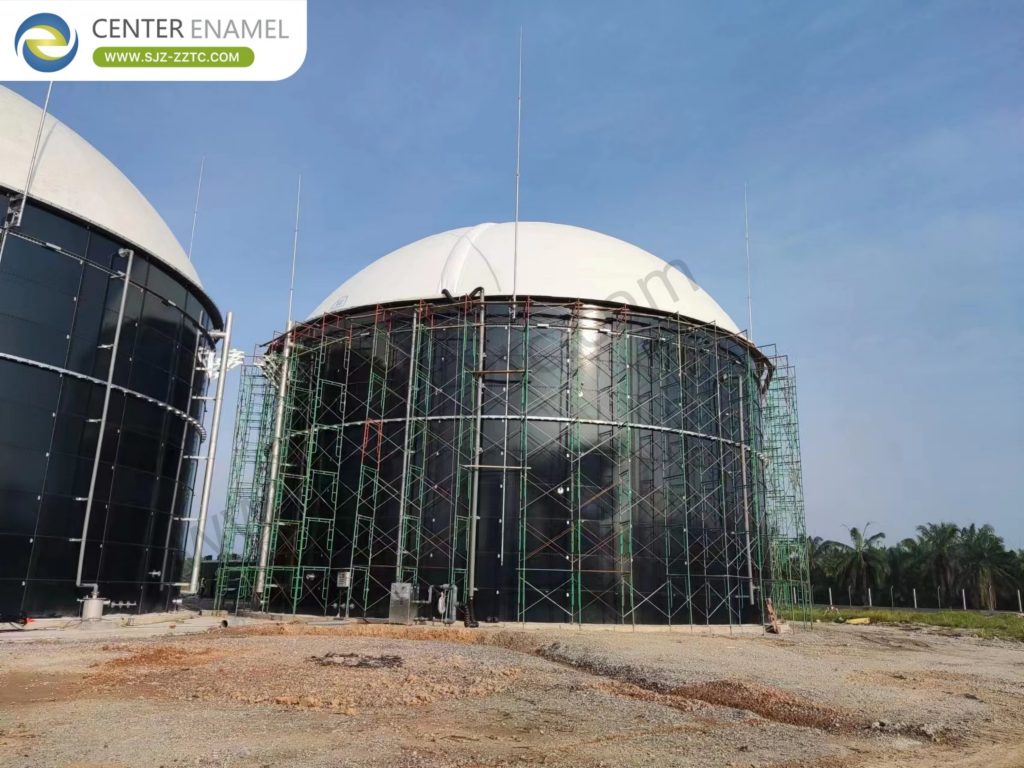
Technology selection depends on waste characteristics and project scale. For high-solid food waste, CSTR reactors with mechanical mixing handle the material effectively. For more dilute streams, UASB or other high-rate systems may be appropriate. Corrosion-resistant containment is critical, as food waste digestion produces organic acids and hydrogen sulfide that attack standard steel. Glass-fused-to-steel (GFS) tanks provide a proven solution with 30+ year service life in demanding environments.
Gas collection and utilization systems must handle variable production rates. Double membrane biogas holders provide buffer capacity, stabilizing gas flow to downstream equipment. For projects aiming to produce renewable natural gas, upgrading systems remove carbon dioxide, hydrogen sulfide, and water vapor to meet pipeline or vehicle fuel specifications.
Ready to turn your food waste into valuable biogas? Contact Center Enamel today for a free consultation and a customized anaerobic digestion solution tailored to your feedstock and energy goals. Our team is here to help-reach out now.
FAQ
How much biogas can be produced from one ton of food waste?
Biogas yield varies by composition and digestion conditions. Methane yields of 0.32–0.51 m³/kg VS have been reported for food waste, with biogas methane content typically 55–75%. Co-digestion with manure or green waste can enhance yields further.
What is the biggest challenge in producing biogas from food waste?
The main challenges are VFA accumulation and ammonia inhibition, both caused by food waste’s rapid degradation and high protein content. Co-digestion with carbon-rich substrates, pH management, and careful organic loading rates mitigate these issues.
Is food waste biogas production economically viable?
Yes. Techno-economic assessments show payback periods of 2–3 years for well-designed systems. Revenue streams include energy sales, tipping fees for waste reception, carbon credits, and fertilizer sales from digestate.