
How Is Palm Oil Wastewater Treated?
Palm oil wastewater - palm oil mill effluent, or POME - is treated by anaerobic digestion (open ponds or covered reactors) that recovers biogas from its very high organic load, followed by aerobic polishing and settling or constructed wetlands to meet discharge limits. The anaerobic stage is the key because POME is energy-rich and would otherwise waste that load as pollution.
What POME Is
POME is the hot, acidic, high-strength liquor from palm oil milling - COD routinely in the tens of thousands of mg/L. It is one of the most organically loaded industrial wastewaters, which is exactly why anaerobic treatment pays: the load becomes biogas instead of a discharge problem.
| Parameter | Typical POME | Note |
| COD | Tens of thousands mg/L | Very high |
| BOD | High | Biodegradable |
| Temperature | Warm (milling) | Helps anaerobic |
| pH | Acidic | Needs buffering |
Anaerobic First, Then Polish
Anaerobic ponds or covered reactors (CSTR, UASB, or anaerobic lagoons) take the bulk COD down and capture methane. Aerobic polishing - activated sludge, SBR, or aerobic ponds - finishes the BOD and nitrogen. The sequence is load-first: anaerobic for the energy-rich bulk, aerobic for the clean finish.
A Boundary Condition
POME's acidity and warm, variable flow demand buffering and stable loading; uncovered ponds lose the biogas. Capturing methane needs a covered or reactor system, which is where the energy and compliance cases meet.
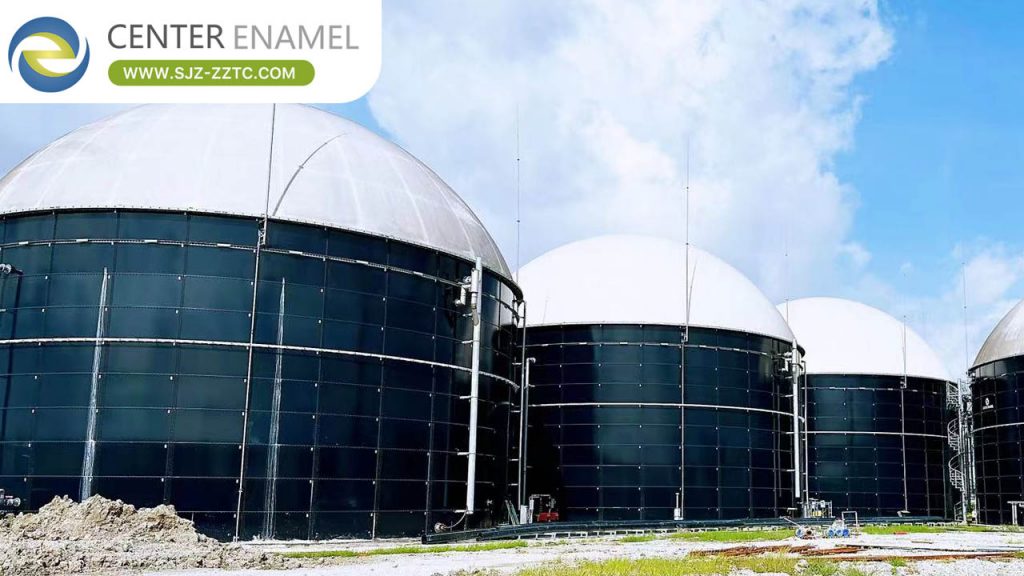
Project Case Study: Indonesia Biogas Project - Dumai
Project / Application: Palm oil wastewater treatment plant, Dumai, Indonesia. Industry: Palm oil / biogas. Tank Type: Glass-Fused-to-Steel (GFS) anaerobic tanks. Key Requirements: Rapid overseas deployment for a palm-oil mill effluent plant.
| Field | Value | Source / Evidence |
| Application | Palm Oil Wastewater Treatment Plant | Company project reference |
| Tank Model | O19.86 x 8.4 m | Company project reference |
| Tanks Quantity | 3 Nos. of GFS Tanks | Company project reference |
| Installation Team | 7 engineers / technicians | Company project reference |
| Installation Duration | 40 days | Company project reference |
| Installation Date | November 2009 | Company project reference |
About Company
Shijiazhuang Zhengzhong Technology Co., Ltd (Center Enamel) is a comprehensive high-tech enterprise specializing in wastewater engineering, process section contracting, and equipment manufacturing. The company delivers biogas and wastewater projects through three main lines - EPC (turnkey) contracting, equipment supply, and process packages - covering livestock and municipal wastewater, biomass energy, industrial wastewater, and food waste. Its reactor portfolio spans CSTR, USR, UBF, UASB, IC, and EGSB, backed by in-house Glass-Fused-to-Steel tank manufacturing (enamel firing at 820-930 C) and certifications including ISO 9001, NSF/ANSI 61, and CE-EN 1090. With 35+ years of operation, a 150,000 m2 manufacturing base, and projects in 100+ countries, Center Enamel provides the single-responsibility engineering behind palm-oil wastewater projects such as the Dumai plant, where 3 GFS anaerobic tanks (O19.86 x 8.4 m) were installed by a 7-person team in 40 days - anaerobic treatment of POME delivered as a rapid, single-responsibility scope.
Comparison: Pond Vs Reactor
| Option | Biogas capture | Footprint | Best when |
| Open pond | Lost | Large | Low regulation |
| Covered reactor | Captured | Compact | Energy + compliance |
Palm oil wastewater is treated by anaerobic digestion that recovers biogas from its high organic load, then aerobic polishing to meet limits - with covered reactors capturing the methane that open ponds waste.
Frequently Asked Questions
Q1: What is POME? A1: Palm oil mill effluent - a hot, acidic, very high-COD liquor from milling.
Q2: Is anaerobic used? A2: Yes; anaerobic ponds or reactors take the bulk COD and recover biogas.
Q3: What about polishing? A3: Aerobic polishing or ponds finish BOD and nitrogen.
Q4: Is biogas recovered? A4: With covered reactors or tanks, yes - open ponds lose it.
Q5: Why anaerobic first? A5: POME is energy-rich; anaerobic turns load into methane.
Q6: What temperature helps? A6: Warm milling effluent suits mesophilic anaerobic.
Q7: What tank resists POME? A7: A Glass-Fused-to-Steel tank resists the acidic, corrosive liquor.
Q8: How are limits met? A8: Anaerobic bulk removal plus aerobic polishing and settling.
Suggested CTA
Share your POME flow, COD, and limits to an engineer, or request a palm-oil wastewater treatment and biogas scope.