
How Is Sewage Biogas Used?
Sewage biogas is most often used in a combined heat and power (CHP) unit that makes electricity and useful heat, burned in a boiler for plant heating, or upgraded to ~98% biomethane for injection into the gas grid or as a transport fuel. Flaring is reserved for excess or backup gas, not the primary use.
On-Site CHP — The Default
CHP is the most common use because it consumes the gas where it is produced. A modern biogas CHP converts the gas at 35–45% electrical and 80–90% total efficiency, supplying the plant's own power and heat (digester heating, building warmth). For an energy-neutral WWTP, CHP is the engine that turns recovered methane into a net energy credit.
Boiler Heat and Thermal Use
Where electricity offtake is limited, biogas can fire a boiler to make hot water or steam for digester heating and sludge drying. Pure heat use is less efficient per unit of gas than CHP, but it is simple and reliable, and pairs well with CHP when heat demand exceeds the electrical match.
Upgrading to Biomethane
By removing CO₂ and traces of H₂S, siloxanes, and water, sewage biogas becomes biomethane at ~98% methane that is interchangeable with natural gas. It can then enter the gas grid or fuel compressed-natural-gas vehicles. Upgrading adds capital and a CO₂ stream, but unlocks higher-value, transportable energy.
Comparative Data Table: Biogas End-Uses
| Use | Methane needed | Value / role |
| CHP (power + heat) | raw biogas ok | energy-neutral core |
| Boiler heat | raw biogas ok | digester / sludge heat |
| Biomethane grid inject | ≥ 98% CH₄ | highest value, transportable |
| Vehicle fuel (CNG) | ≥ 98% CH₄ | transport decarbonization |
| Flare (backup) | any | safety / excess only |
Technical Considerations
Gas quality dictates the route: raw biogas suits CHP and boilers but must be de-humidified and H₂S-controlled to protect engines. Upgrading needs consistent gas composition and a biomethane offtake. CHP must be sized to steady biogas flow, not peaks; maintenance runs about $0.015–0.045 per kWh of electricity produced.
Advantages and Limitations
CHP gives the fastest payback and supports energy neutrality; biomethane gives the highest value and flexibility but costs more. Limits: engine wear from impurities, the need for steady gas, and that flaring wastes both energy and carbon. The best plants use CHP as the base and upgrade only when offtake justifies it.
Best Practices / How to Use It Well
Size CHP to steady biogas, clean the gas (H₂S, water) before the engine, and capture all heat. Add biomethane upgrading only with a confirmed grid or vehicle offtake. Treat flaring as a last resort and meter it—every cubic metre flared is lost energy and lost emissions credit.
Sewage biogas is used mainly in CHP for power and heat, in boilers for plant heating, and—where offtake exists—upgraded to 98% biomethane for grid or vehicle fuel. Flaring is the backup, not the business. Matching the use to steady gas flow is what makes recovery pay.
Frequently Asked Questions (FAQ)
Q1: How is sewage biogas used?
A: Mostly in CHP for electricity and heat, in boilers for plant heating, or upgraded to ~98% biomethane for grid/vehicle fuel; flaring is backup only.
Q2: Can it make electricity?
A: Yes—biogas CHP at 35–45% electrical and 80–90% total efficiency powers the plant and often flips it toward energy neutrality.
Q3: Can it become vehicle fuel?
A: Yes. Upgrading to ≥98% methane yields biomethane that fuels CNG vehicles or enters the gas grid, the highest-value route.
Q4: What if there is no use?
A: Plants flare excess gas for safety, but that wastes energy and carbon. Better to size CHP to steady flow and add storage or offtake.
Q5: Does gas quality matter?
A: Yes. Raw biogas needs H₂S and water control before engines; upgrading needs ~98% methane and a buyer to be worth the capital.
Q6: What does CHP maintenance cost?
A: Roughly $0.015–0.045 per kWh of electricity produced—lower on large units (>500 kWe), higher on small ones (<100 kWe).
Project Case Reference
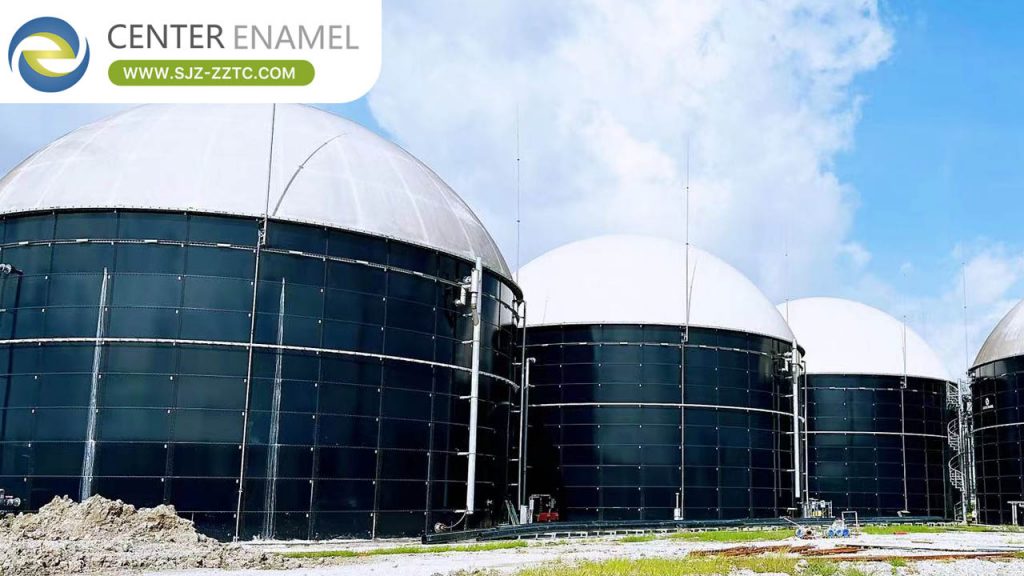
Malaysia Biogas Project — Malaysia · 2026
5 GFS Tanks · 27,000 m³ Total Volume · 22,000 m³ Biogas/Day
A large-scale biogas project in Malaysia featuring 5 Glass-Fused-to-Steel (GFS) tanks. The project achieves approximately 80% digestibility, with each single tank producing about 4,400 m³ of biogas daily, totaling 22,000 m³ per day across all 5 tanks.
Technical Specifications
Single Tank Volume: 5,400 m³ (Ø24.46 × 12 m)
Total Effective Volume: 27,000 m³ (5 tanks)
Daily Biogas Production: 22,000 m³ total
Digestibility: ≈ 80%
Gas Production Rate: 0.45 m³ / kg COD removed
Tank Type: Glass-Fused-to-Steel (GFS)
Water Quality Data
| Parameter | Inlet Water | Effluent |
| COD | ≥ 60,000 mg/L | ≥ 12,000 mg/L |
| BOD | ≤ 25,000 mg/L | ≤ 5,000 mg/L |