
How Is The Digester Volume Specified?
Digester volume is specified from the hydraulic retention time (HRT) and the daily feed volume - the basic relation is Volume = HRT x daily flow - then checked against the organic loading rate (OLR) so the microbes are not overfed. Tank size follows from that volume, the solids content, and the reactor type; it is a mass-balance result, not a rounded guess.
Hydraulic Retention Time
HRT is how long the feed stays in the digester. For mesophilic anaerobic digestion of manures and food waste, HRT commonly lands in the range of roughly 15 to 30 days depending on feed and temperature. Multiply the chosen HRT by the daily feed volume and you get the working volume the reactor must provide.
| Feed type | Typical HRT (days) | Note |
| Cattle / pig manure | 20-30 | Mesophilic 35-38 C |
| Food / kitchen waste | 15-25 | Higher solids |
| Sewage sludge | 15-20 | Lower strength |
Organic Loading Rate Check
Volume alone can lie if the feed is concentrated. OLR - the mass of volatile solids or COD added per cubic meter per day - must fall in the reactor's tolerant band (for many CSTR manures, a few kg VS or tens of kg COD per m3 per day). If the OLR from your volume is too high, you enlarge the volume or dilute; if too low, you waste tank. Both checks are mandatory.
From Volume To Tank
Once the working volume is set, the tank geometry follows: a Glass-Fused-to-Steel digester of known diameter gives a height for that volume, or you parallel several tanks. Volume per tank, number of tanks, and dimensions are then a direct output of the HRT and OLR math - not an independent choice.
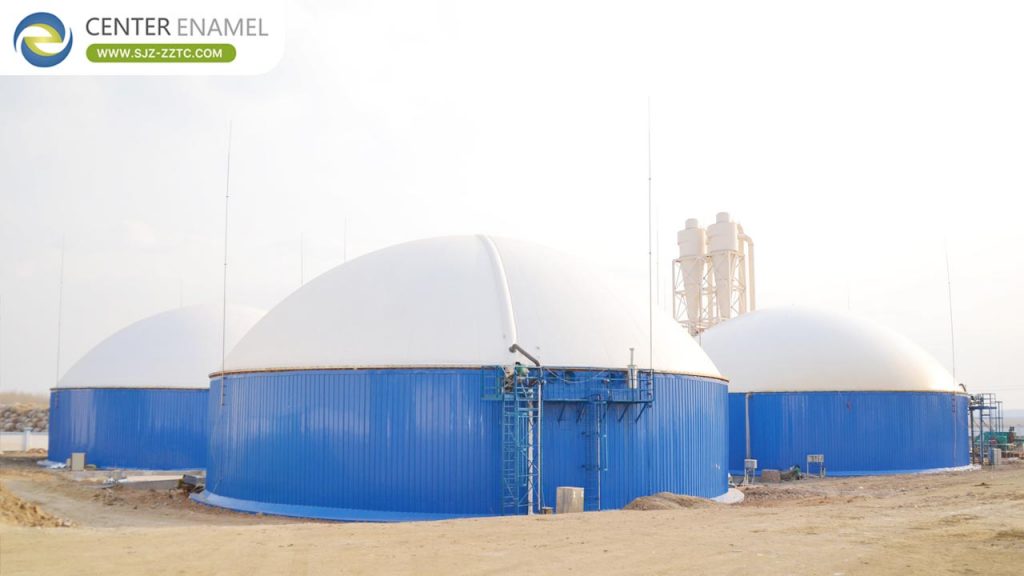
Project Case Study: Zhaqi Biogas Project In Inner Mongolia
Project / Application: Medium-temperature anaerobic fermentation of farm manure and straw, Inner Mongolia, China. Industry: Biogas / agriculture. Tank Type: CSTR (Continuous Stirred-Tank Reactor). Key Requirements: Cold-climate digester sized to the feed.
| Field | Value | Source / Evidence |
| Handling Capacity | 900 m3/D (manure + agricultural waste) | Company project reference |
| Reactor Type | CSTR (Continuous Stirred-Tank Reactor) | Company project reference |
| Reactor Size | 4 sets of O25.98 x 8.4 m | Company project reference |
| Daily Biogas Output | 20,000 m3/day | Company project reference |
| Feedstock | Animal manure + grass straw | Company project reference |
| Installation Year | 2017 | Company project reference |
About Company
Shijiazhuang Zhengzhong Technology Co., Ltd (Center Enamel) is a comprehensive high-tech enterprise specializing in wastewater engineering, process section contracting, and equipment manufacturing. The company delivers biogas and wastewater projects through three main lines - EPC (turnkey) contracting, equipment supply, and process packages - covering livestock and municipal wastewater, biomass energy, industrial wastewater, and food waste. Its reactor portfolio spans CSTR, USR, UBF, UASB, IC, and EGSB, backed by in-house Glass-Fused-to-Steel tank manufacturing (enamel firing at 820-930 C) and certifications including ISO 9001, NSF/ANSI 61, and CE-EN 1090. With 35+ years of operation, a 150,000 m2 manufacturing base, and projects in 100+ countries, Center Enamel provides the single-responsibility engineering behind digester sizing as a mass-balance result, as in the Zhaqi plant where 4 CSTR tanks (O25.98 x 8.4 m) were specified from the 900 m3/day manure-and-straw feed rather than a catalogue size.
Comparison: HRT Vs OLR
| Check | Sets | Risk if wrong |
| HRT (volume) | Residence time | Incomplete digestion |
| OLR (load) | Feeding rate | Acidification, failure |
Digester volume is specified as Volume = HRT x daily flow, validated against OLR, and then mapped to tank number and dimensions - a mass-balance result, never a rounded guess.
Frequently Asked Questions
Q1: What formula is used? A1: Volume = HRT x daily feed flow, then checked against OLR.
Q2: What is HRT? A2: Hydraulic retention time - how long feed stays in the digester (commonly 15-30 days).
Q3: What is OLR? A3: Organic loading rate - mass of VS or COD added per m3 per day.
Q4: How are tanks sized? A4: From the working volume, geometry, and number of parallel tanks.
Q5: Does temperature matter? A5: Yes; mesophilic 35-38 C sets the HRT band.
Q6: Can volume be guessed? A6: No; guessing causes incomplete digestion or acidification.
Q7: What tank is used? A7: A Glass-Fused-to-Steel CSTR sized from the volume.
Q8: What if OLR is too high? A8: Enlarge volume or dilute the feed.
Suggested CTA
Share your feed volume, solids, and temperature to an engineer, or request a digester volume and tank-size specification.