
How Is Wastewater Treated in the Textile Industry? A Step-by-Step Process Guide
The textile industry is one of the largest consumers of water globally, using approximately 93 billion cubic meters annually . A substantial portion of this water returns as wastewater, carrying a complex mixture of dyes, chemicals, salts, and other pollutants. Treating this effluent is not just an environmental necessity-it is increasingly a regulatory and economic imperative. This article provides a comprehensive, step-by-step guide to how textile wastewater is treated, covering the primary, secondary, and advanced treatment stages, and explores the critical role of modern storage infrastructure like Glass-Fused-to-Steel (GFS) tanks in ensuring effective treatment.
The Complex Nature of Textile Wastewater
Before examining treatment methods, it is essential to understand what makes textile effluent so challenging. Most textile wastewater originates from "wet processing" stages, including desizing, scouring, bleaching, mercerizing, dyeing, and finishing . Each stage contributes distinct pollutants.
The resulting effluent is typically characterized by high chemical oxygen demand (COD), elevated ammonia nitrogen levels, and low biodegradability . It contains synthetic dyes that are chemically stable and persist in the environment, high concentrations of salts (often 2,000-3,000 mg/L), and various toxic chemicals. This complex and variable composition-often mixed from multiple production stages-makes treatment particularly difficult and necessitates a multi-stage approach .
Why a Multi-Stage Treatment Approach Is Essential
Due to the diverse nature of pollutants in textile wastewater, no single technology can address all contaminants effectively. A combination of physical, chemical, and biological processes-often referred to as a multi-stage or integrated system-is required to achieve the desired effluent quality .
A typical treatment train progresses from primary (physical/chemical) treatment to remove solids and bulk pollutants, followed by secondary (biological) treatment to degrade dissolved organic matter, and finally, advanced (tertiary) polishing to remove residual color, trace contaminants, and enable water reuse . This integrated approach ensures that the specific characteristics of the effluent and the local discharge regulations are met.
Primary Treatment: Coagulation, Flocculation, and Flotation
The first stage of treatment focuses on removing suspended solids, a portion of the chemical oxygen demand, and initial color reduction.
Coagulation and Flocculation: Chemicals like ferric chloride or aluminum salts (coagulants) are added to the wastewater. These neutralize the electrical charges on fine particles, causing them to clump together into larger, heavier aggregates called flocs . A polymer (flocculant) is often added to help these flocs grow larger.
Dissolved Air Flotation (DAF): A widely used primary treatment method, DAF introduces fine microbubbles into the water. These bubbles attach to the flocs and other suspended particles, causing them to float to the surface, where they are skimmed off as sludge . Coagulation-flocculation followed by DAF can effectively remove dyes and reduce color from initial levels (e.g., 1,500 Pt-Co units) to much lower levels (e.g., under 150 Pt-Co units) .
Secondary Treatment: Biological Processes
Following primary treatment, the wastewater still contains significant dissolved organic matter. Biological treatment uses microorganisms to break down these organic pollutants.
Activated Sludge Process: This common method involves aerating the wastewater in a tank containing a "sludge" rich in bacteria and other microorganisms. The bacteria consume the organic waste, significantly reducing the BOD (Biological Oxygen Demand) and COD . This is an environmentally sustainable and economically efficient approach .
Moving Bed Biofilm Reactor (MBBR) or Sequencing Batch Reactor (SBR): Other biological methods like MBBR, which uses plastic carriers for biofilm growth, or SBR, which treats wastewater in batches, are also used, particularly in space-constrained mill sites . These systems effectively degrade surfactants and other organic matter.
Advanced Treatment: Polishing and Reuse
To meet strict discharge limits or enable water reuse, tertiary or advanced treatment is often necessary. This "polishing" step targets residual pollutants that persist after primary and secondary treatment.
Ozonation: Ozone (O₃) is a powerful oxidant that is highly effective at breaking down dye molecules and removing color. Ozone gas is bubbled through the wastewater, where it reacts with and destroys residual color and other organic compounds . Ozonation can reduce color to below 50 Pt-Co units .
Membrane Filtration: Technologies like ultrafiltration (UF) and nanofiltration (NF) use semi-permeable membranes to physically separate contaminants . These processes offer high separation precision and can remove dyes, salts, and even microplastics . New integrated processes, such as the coagulation–flotation–hollow fiber nanofiltration (iCFN) process, combine these steps for enhanced efficiency and fouling control .
Electron Beam Irradiation (EBI) and Electrocoagulation: Emerging technologies like electron beam irradiation and electrocoagulation (EC) are being explored for their ability to break down toxic compounds . Electrocoagulation, for instance, uses sacrificial electrodes (iron or aluminum) to generate coagulants in situ, effectively removing pollutants . These can be used as pre-treatments to make wastewater more biodegradable .
The Critical Role of Storage: The GFS Tank Advantage
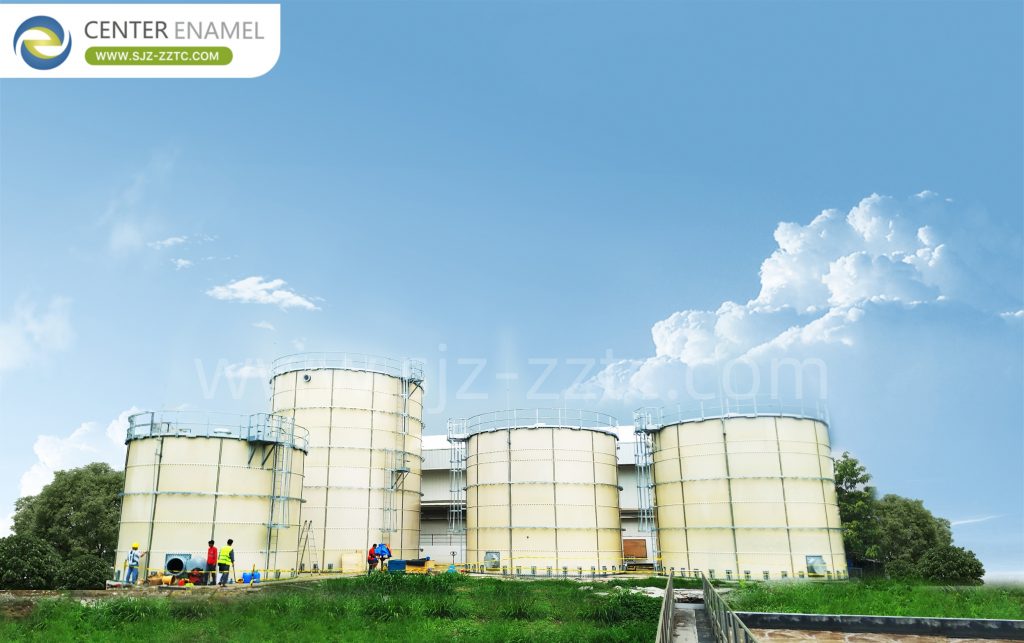
Effective treatment relies on a robust infrastructure to store, equalize, and process wastewater. Glass-Fused-to-Steel (GFS) tanks have emerged as a preferred solution for textile wastewater applications due to their exceptional durability and corrosion resistance .
Unmatched Corrosion Resistance: Textile wastewater is highly aggressive, containing acids, alkalis, and salts. GFS tanks are manufactured by fusing a glass coating to steel at approximately 850°C, creating an impermeable, inert barrier . This coating is highly resistant to the harsh chemicals found in textile effluent, preventing corrosion and ensuring a long service life of over 30 years .
Durability and Low Maintenance: The glass coating is also abrasion-resistant, with a Mohs hardness of 6.0, allowing it to withstand mechanical mixing and abrasive solids . The smooth, non-porous surface resists bacterial growth and is easy to clean, minimizing maintenance requirements . This makes GFS tanks ideal for demanding applications like equalization, aeration, and sludge storage .
Rapid Installation and Scalability: The modular bolted design of GFS tanks allows for fast, efficient installation-up to 60% faster than concrete alternatives . This is a significant advantage in industrial settings where minimizing downtime is critical. The design also allows for easy expansion, providing flexibility as treatment needs grow .
Conclusion
Treating textile wastewater is a complex but crucial process that combines primary physical/chemical treatment, secondary biological treatment, and advanced polishing to remove a diverse range of pollutants. The industry is moving towards integrated systems that are more efficient and capable of producing water suitable for reuse. Underpinning these processes is the need for robust and reliable infrastructure. Glass-Fused-to-Steel tanks, with their superior corrosion resistance, durability, and rapid installation, have become an essential component of modern textile wastewater treatment plants, providing a secure and sustainable solution for one of the world's most challenging industrial effluents.
FAQ
1. What is the most common treatment method for textile wastewater?
Most textile plants use a multi-stage approach. The most common primary method is coagulation and flocculation, often followed by dissolved air flotation (DAF), to remove suspended solids and reduce color. This is then followed by biological treatment (like activated sludge) to break down dissolved organics .
2. How is the color removed from textile wastewater?
Color is typically removed in two stages. First, primary treatment using coagulants and flocculants removes a large portion of the dye. Second, advanced ozonation is highly effective at destroying remaining color molecules, often bringing color levels below 50 Pt-Co units .
3. Why are Glass-Fused-to-Steel (GFS) tanks preferred in textile wastewater treatment?
GFS tanks are preferred for their superior corrosion resistance to the harsh chemicals and salts in textile effluent. Their glass coating creates an inert, leak-proof barrier, ensuring long-term durability (over 30 years) and low maintenance, making them a reliable and cost-effective solution for storage and treatment processes .