
How Long Does Digestion Take?
For wet anaerobic digestion, the typical retention time is 15–30 days at mesophilic 35–38°C and 10–20 days at thermophilic 50–55°C. This is the hydraulic retention time (HRT)—how long feed stays in the digester. Dry AD and cold-climate or poorly mixed systems run longer; the time is set by feed type, temperature, and how completely you need the organics converted.
What Retention Time Means
Hydraulic retention time (HRT) = digester volume ÷ daily feed volume. It is the average time a particle spends inside. Too short and organics leave unconverted (low yield, weak digestate); too long and you have built capital you are not using efficiently.
Typical HRT by Mode
Mesophilic wet AD: 15–30 days is the common band; thermophilic: 10–20 days (faster kinetics but more sensitive). Dry AD (TS >15–20%) often uses 20–40 days. High-rate UASB reactors are different—see the UASB articles—with HRT of hours for soluble wastewater.
| Mode | Temp | Typical HRT |
| Mesophilic wet AD | 35–38°C | 15–30 days |
| Thermophilic wet AD | 50–55°C | 10–20 days |
| Dry AD | 35–38°C | 20–40 days |
| UASB (soluble WW) | 25–38°C | 6–12 hours |
What Changes the Time
Feed composition dominates: easily degradable food waste digests faster than lignocellulosic manure or straw. Temperature, mixing, and inoculum health matter; co-digestion and pre-treatment (thermal/mechanical) can shorten effective HRT by raising the conversion rate.
Cold Climate and Insulation
In cold regions the digester must be insulated and heated to hold 35–38°C; without it, kinetics slow and HRT must stretch. Insulated CSTR designs (see Inner Mongolia cases) keep mesophilic performance despite ambient cold.
Technical Considerations
Size the digester from HRT × daily feed. Watch organic loading rate (OLR) alongside HRT—too high an OLR at a given HRT causes acid accumulation. Stable mesophilic operation with good mixing gives the most predictable residence time and yield.
How to Pick the Right HRT
Start from feed biodegradability and temperature, then confirm with a batch BMP test. Default to 20–25 days mesophilic for mixed manure/food waste; shorten toward 15 days only with proven, easily degradable feed and healthy inoculum.
Project Case Study
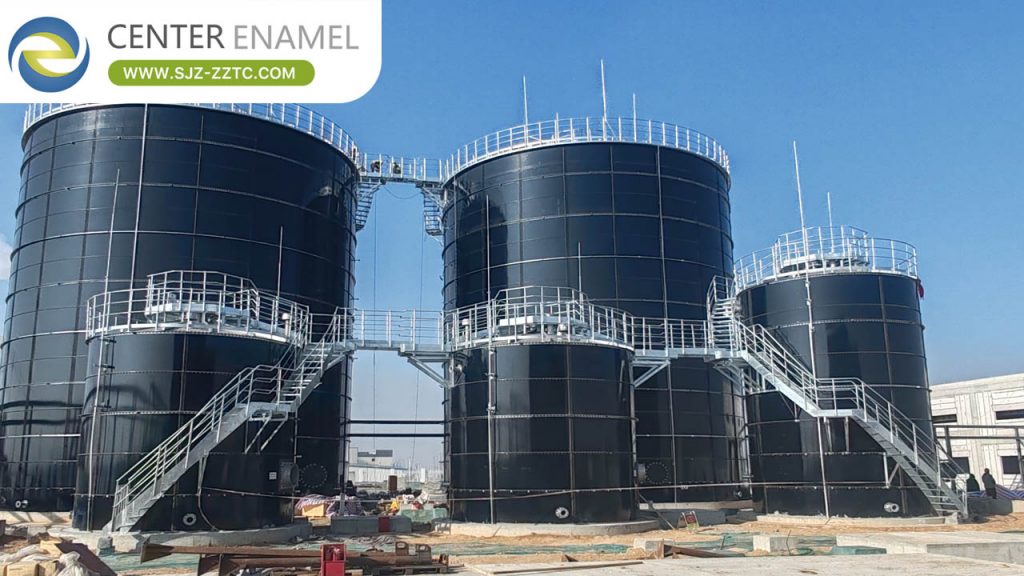
Zhenyuan Group Biogas Project in Henan. A CSTR plant treating 650 T/D of manure and washing wastewater with 3 primary plus 1 secondary reactors for two-stage digestion—an industrial example where retention time and staging are engineered around a high-throughput manure feed to maximize methane yield.
| Project | Zhenyuan Group Biogas Project (Henan) |
| Location | Xinzheng, Henan, China |
| Industry | Renewable vehicle fuel |
| Application | Manure + washing wastewater digestion |
| Product | CSTR digesters (two-stage) |
| Capacity | 650 T/D; 3,000,000 m³/yr CH₄ |
| Quantity | 3 primary + 1 secondary CSTR |
| Material | Glass-Fused-to-Steel (GFS) |
| Standards | ISO 28765, AWWA D103 |
| Status | Delivered reference project |
About Center Enamel
Center Enamel supports reliable retention-time performance through quality control in tank manufacture: every GFS panel is enamel-fired and inspected so the digester holds volume, seals gas, and resists the warm H₂S environment across the full HRT cycle. Built under ISO 9001 with ISO 28765 / AWWA D103 standards, the tanks keep the designed residence time intact—no leaks, no volume loss—so the digestion kinetics the engineer specified actually occur inside.
Advantages and Limitations
Shorter HRT means smaller, cheaper tanks but risks incomplete conversion; longer HRT is safer but uses more steel. Thermophilic is faster but less stable. The optimum is feed-specific and should be confirmed by testing, not guessed.
Comparison: Time vs Temperature
| Lever | Effect on HRT | Trade-off |
| Higher temp | shorter | less stable |
| Easier feed | shorter | feed-dependent |
| Pre-treatment | shorter | extra CapEx/energy |
| Cold/unmixed | longer | more volume needed |
Digestion typically takes 15–30 days mesophilic or 10–20 days thermophilic for wet AD; dry AD and cold or poorly mixed systems run longer. HRT is set by feed, temperature, and conversion target—size the digester as HRT × daily feed and confirm with a BMP test.
Frequently Asked Questions (FAQ)
Q1: How long does digestion take?
A: Wet AD runs 15–30 days mesophilic (35–38°C) or 10–20 days thermophilic (50–55°C); dry AD and cold systems take longer.
Q2: What is hydraulic retention time?
A: HRT is digester volume divided by daily feed—the average time feed spends inside; it sets conversion completeness.
Q3: Does temperature change the time?
A: Yes—thermophilic is roughly 30–50% faster than mesophilic but more sensitive to upset.
Q4: Why does it vary so much?
A: Feed biodegradability, temperature, mixing, and inoculum health; food waste digests faster than straw or manure.
Q5: Can I shorten it?
A: Co-digestion, pre-treatment, and good mixing raise conversion rate; confirm with a BMP test before cutting HRT.
Q6: How do I size the tank?
A: Volume = HRT × daily feed; Center Enamel supplies GFS digesters sized to your confirmed HRT.
Share your feed type, daily volume, and climate. We will estimate the right HRT, size the GFS digester, and confirm standards and delivery for stable, predictable retention.