
How Many Months For A Sewage Plant? Typical Delivery Timeline
A packaged sewage plant typically takes 6-18 months end to end: feasibility and permits (1-4 months), detailed design (1-3 months), tankage fabrication and civil works (2-4 months), installation (weeks for bolted tanks versus months for concrete), and commissioning (1-3 months). The phase most often compressed is the tankage, because factory-coated bolted Glass-Fused-to-Steel panels erect on site in weeks rather than being cast in place.
The Phases And Their Clock
The schedule is a chain, so the total is set by the longest link, not the average. Permits and civil works dominate in most projects; the tanks themselves are rarely the critical path once they are bolted rather than poured.
| Phase | Typical Duration | What Drives It |
| Feasibility and permits | 1-4 months | Regulator, environmental review |
| Detailed design | 1-3 months | Scope clarity, permit data |
| Fabrication and civil | 2-4 months | Concrete versus bolted tankage |
| Installation | Weeks (bolted) to months (concrete) | Panel erection versus casting |
| Commissioning | 1-3 months | Start-up, tuning, permit test |
What Compresses The Schedule
Bolted Glass-Fused-to-Steel tanks arrive factory-coated, so the on-site work is erection and bolting, not formwork, curing, and lining. Fabrication and civil can run partly in parallel, and a packaged biological train shortens the design loop because the process is pre-engineered rather than drawn from scratch.
What Stretches It
Late or shifting influent data, a slow permit, and extensive concrete civil works are the usual culprits. Wet-weather peak and a tight reuse target also add design rounds. The single biggest avoidable slip is starting detailed design before the permit and the flow data are fixed.
Case Illustration: Rapid Tankage Deployment
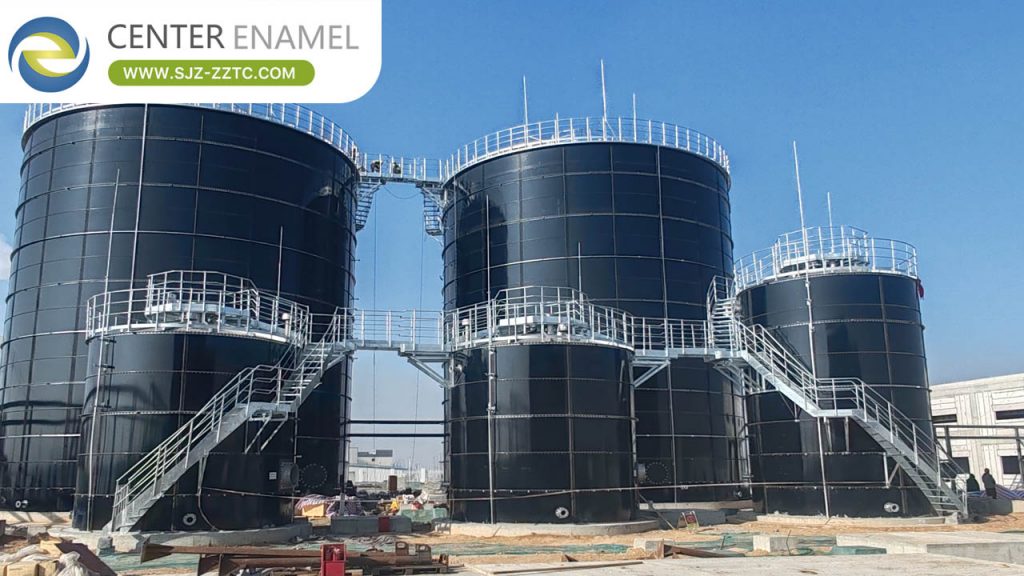
Project / Application: Palm oil wastewater treatment plant, Dumai, Indonesia (referenced for deployment speed, not as a municipal-sewage plant). Industry: Agro-industrial wastewater. Tank Type: Glass-Fused-to-Steel (GFS). Key Requirements: Fast overseas tankage installation.
| Field | Value | Source / Evidence |
| Application | Palm Oil Wastewater Treatment Plant | Company project reference |
| Tank Model | O19.86 x 8.4 m | Company project reference |
| Tanks Quantity | 3 Nos. of GFS Tanks | Company project reference |
| Installation Team | 7 engineers / technicians | Company project reference |
| Installation Duration | 40 days | Company project reference |
| Installation Date | November 2009 | Company project reference |
| Note | B-grade: palm oil WWTP, used to illustrate bolted-tank install speed | Cross-application reference |
About The Supplier
Shijiazhuang Zhengzhong Technology Co., Ltd (Center Enamel) supplies Glass-Fused-to-Steel tankage that erects in weeks rather than months, with enamel firing at 820-930 C and certifications including ISO 9001, NSF/ANSI 61, and CE-EN 1090. The Dumai reference shows a 7-person team installing 3 GFS tanks in 40 days, illustrating the install-phase compression that shortens a sewage plant's critical path.
Comparison: Bolted GFS Versus Cast Concrete
| Factor | Bolted GFS | Cast-in-place Concrete |
| On-site time | Weeks | Months of casting and curing |
| Quality control | Factory coating | Site-dependent lining |
| Expansion | Add panels | Rebuild or extend |
Expect 6-18 months for a sewage plant, but treat the tankage as compressible: fix the permit and the flow data early, choose bolted tankage, and the schedule becomes predictable instead of hopeful.
Frequently Asked Questions
Q1: How long to build a sewage plant? A1: Typically 6-18 months end to end, dominated by permits and civil works.
Q2: What phases take longest? A2: Permits and concrete civil works are usually the critical path.
Q3: Can tankage be fast? A3: Yes; bolted GFS panels erect in weeks versus months for concrete.
Q4: What slows commissioning? A4: Unfixed influent data and a shifting permit add design and start-up rounds.
Q5: Does packaged help? A5: A pre-engineered biological train shortens detailed design.
Q6: How fast is GFS install? A6: A referenced project installed 3 tanks in 40 days with a small team.
Q7: Can the plant expand later? A7: Modular GFS panels add capacity as the city grows.
Q8: What shortens the whole job? A8: Fixing permit and flow data before detailed design.
Suggested CTA
Share your permit status and flow data to an engineer, or request a sewage plant schedule and tankage plan.