
How Much Biogas Can Be Produced from 1 kg of Food Waste? A Complete Guide
Food waste is a global challenge, but it also presents a remarkable opportunity for renewable energy generation. One of the most common questions from businesses and municipalities exploring sustainable waste management is: How much biogas can be produced from 1 kg of food waste? The answer depends on several factors, but on average, 1 kg of food waste can yield between 0.1 to 0.2 cubic meters (100 to 200 liters) of biogas under optimal conditions. This guide explores the science behind food waste-to-energy conversion and how modern storage solutions maximize this potential.
Understanding the Biogas Potential of Food Waste
Biogas production from food waste is a complex biochemical process where microorganisms break down organic matter in an oxygen-free environment through anaerobic digestion (AD). Studies demonstrate that biogas yields vary significantly based on the specific type of food waste used as feedstock. Research on different food waste categories reveals that leftover cooked food produces up to 261.4 liters of biogas per kilogram of total solids, while fish waste yields approximately 248.5 liters, and potato waste generates around 137.15 liters under similar conditions.
The composition of food waste plays a critical role in determining biogas output. Waste rich in carbohydrates and fats typically produces higher methane content, with methane percentages ranging from 55% to 74% depending on the substrate. Mixed food waste from urban areas demonstrates the potential to produce approximately 220 liters of biogas per kilogram of waste, making it a viable solution for municipal waste management strategies.
Key Factors Affecting Biogas Yield from Food Waste
Several operational parameters significantly influence the biogas production volume from food waste. The substrate-to-inoculum ratio has a strong impact on digestion performance, with lower ratios typically yielding better results under both mesophilic (37°C) and thermophilic (55°C) conditions. Temperature control is essential, as maintaining optimal conditions ensures microorganisms remain active and efficient throughout the digestion process.
Retention time represents another critical factor. Research indicates that the optimum hydraulic retention time for food waste digestion is approximately 60 days, achieving biogas production rates of 69 liters per day with 81.62% total solid removal efficiency. The carbon-to-nitrogen ratio also affects performance, as food waste typically exhibits significant variations in physicochemical parameters that influence microbial activity and biogas yield.
Pretreatment Methods That Enhance Biogas Production
Pretreatment techniques can dramatically improve biogas yields from food waste by breaking down complex organic structures and increasing biodegradability. Thermal heating and microwave irradiation have emerged as effective pretreatment methods, with studies showing that thermal pretreatment at 250°C for 30 minutes increases soluble chemical oxygen demand by 47%, resulting in 69.77% higher biogas yields compared to untreated food waste.
Microwave irradiation at 1000W for 2 minutes achieves even better results, with a 63% increase in soluble chemical oxygen demand and 54.22% higher biogas production. These pretreatment methods enhance the digestion process rate and reduce the time required for complete decomposition. Research also demonstrates that co-digestion with other organic materials, such as cattle manure, can improve methane production by 41.1% compared to digesting food waste alone.
Storage Solutions for Large-Scale Biogas Projects
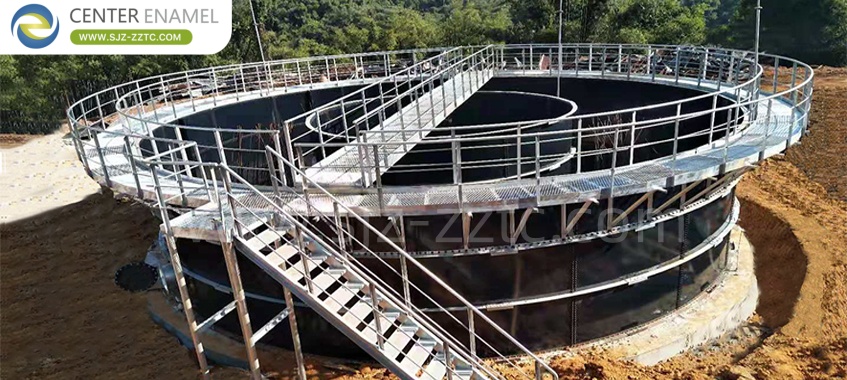
Scaling up biogas production from food waste requires reliable storage infrastructure that can withstand corrosive conditions and maintain gas-tight integrity. Glass-Fused-to-Steel (GFS) tanks have become the preferred choice for biogas projects worldwide due to their exceptional durability and corrosion resistance. The glass-fused coating creates an impermeable barrier that prevents corrosion even when exposed to biogas and acidic materials.
Center Enamel's GFS tanks offer key advantages for biogas production and storage, including high corrosion resistance, long service life, easy installation, and excellent gas-tightness. The modular bolted design allows for quick construction and assembly, reducing project timelines. These tanks meet strict international standards including AWWA D103, ISO 28765, and other global quality requirements, ensuring reliable performance in demanding operational environments.
Real-World Biogas Project Applications
Successful biogas projects worldwide demonstrate the effectiveness of modern storage solutions. The China Biogas Project in Henan utilizes GFS tanks with a total capacity of 4,407 cubic meters, featuring sizes ranging from φ16.81m × 9.6m to φ9.17m × 8.4m for biogas production and storage. This project, operational since 2017, showcases the long-term reliability and performance of glass-fused-to-steel technology in renewable energy applications.
In Sweden, Center Enamel completed a biogas project featuring a large GFS tank measuring φ19.11m × 19.2m with a total volume of 5,504 cubic meters. The Indonesia Biogas Project demonstrates the versatility of these solutions with three fermentation tanks measuring φ19.86 × 8.4m each. These international installations prove that GFS tanks effectively support sustainable energy production while maintaining operational integrity across diverse climate conditions.
Maximizing Economic and Environmental Benefits
The economic viability of food waste-to-biogas projects depends on efficient infrastructure that minimizes maintenance costs while maximizing energy recovery. GFS tanks require minimal maintenance due to their durable glass coating, leading to reduced long-term operational costs and enhanced durability. The gas-tight design ensures safe biogas containment with no leakage, preventing greenhouse gas emissions and protecting environmental quality.
Anaerobic digestion can account for significantly lower emissions than landfill disposal while generating valuable renewable energy. The digestate produced from the process serves as high-quality organic fertilizer, supporting circular economy principles and reducing reliance on chemical fertilizers. This integration of waste treatment, energy production, and agricultural benefits creates compelling value propositions for municipalities and agricultural operations alike.
Center Enamel as Your Biogas Project Partner
Center Enamel stands as a comprehensive biogas project solution provider with over 30 years of experience in advanced storage solutions. Our expertise covers the entire project lifecycle, from engineering design and manufacturing to installation and after-sales support. We deliver fully customized GFS tanks specifically engineered for your biogas project requirements, with systems already installed in over 100 countries across the globe.
Our GFS tanks feature an exceptional fusion process where glass enamel and steel are molecularly bonded at temperatures exceeding 820°C, creating exceptional resistance to pH 1–14 corrosion. This makes them ideal for the demanding conditions of anaerobic digestion. With international certifications including ISO 9001, NSF/ANSI 61, and AWWA D103-09, Center Enamel provides reliable, durable, and cost-effective solutions supporting your transition to clean energy and efficient organic waste management.
Partner with Center Enamel for your biogas storage needs and benefit from our proven track record in delivering high-quality solutions for renewable energy projects worldwide.
Frequently Asked Questions
1. What is the average biogas yield from 1 kg of food waste?
On average, 1 kg of food waste produces approximately 100 to 220 liters of biogas, depending on the specific composition and digestion conditions. Leftover cooked food can yield up to 261.4 L/kg of total solids, while mixed food waste typically produces around 220 L/kg. The methane content of the biogas ranges from 55% to 74%, influencing the energy value of the gas produced.
2. How do pretreatment methods affect biogas production from food waste?
Pretreatment methods significantly enhance biogas yields by breaking down complex organic structures and increasing biodegradability. Thermal heating at 250°C improves biogas yields by 69.77%, while microwave irradiation at 1000W increases production by 54.22% compared to untreated food waste. These methods increase soluble chemical oxygen demand by 47-63%, accelerating the digestion process and improving overall efficiency.
3. Why are Glass-Fused-to-Steel tanks ideal for biogas projects?
Glass-Fused-to-Steel tanks combine the structural strength of steel with the chemical resistance of glass, providing exceptional corrosion resistance, durability, and gas-tightness essential for biogas production and storage. The modular bolted design enables quick installation, while the impermeable glass coating prevents corrosion from acidic biogas environments, ensuring long-term reliability with minimal maintenance requirements.