
How Much Biogas From Fermentation? Yield Factors And Numbers
Biogas yield from fermentation is set by the feed's volatile solids and the reactor type: typical mesophilic digestion returns 0.30-0.45 m3 of biogas per kg of COD removed, with 55-65% methane. A referenced poultry-manure plant processing 47 tonnes per day produced about 4,900 m3 of biogas daily, enough for roughly 9,800 kWh of power at about 2.0 kWh per m3 of biogas.
The Yield Equation
Yield is not a single number; it is the volatile solids fed, the methane fraction, and the reactor performance multiplied together. The carbon-to-nitrogen ratio near 20-30:1 and a stable 35-38 C keep the methanogens productive, so the same feed gives different gas in different plants depending on how well those are held.
| Feedstock (per kg VS) | Typical Biogas Yield | Note |
| Cattle manure | 0.20-0.30 m3 | Lower, wet feed |
| Food waste | 0.35-0.60 m3 | Energy-dense, watch fats |
| Sludge | 0.20-0.35 m3 | Depends on origin |
| Crop silage | 0.30-0.45 m3 | Good carbon partner |
What Moves The Number
Higher volatile solids and a balanced carbon-to-nitrogen ratio lift yield; cold temperature, inhibitors (ammonia, salts), and short retention cut it. The methane fraction also varies with feed, which is why the gas volume alone does not tell you the energy value; the methane percentage does.
From m3 To kWh
Energy recovery depends on the conversion path. Combustion or a generator typically delivers around 1.8-2.2 kWh per m3 of methane-rich biogas, so a project's daily gas volume translates to a concrete power figure only once the methane content and the engine efficiency are known.
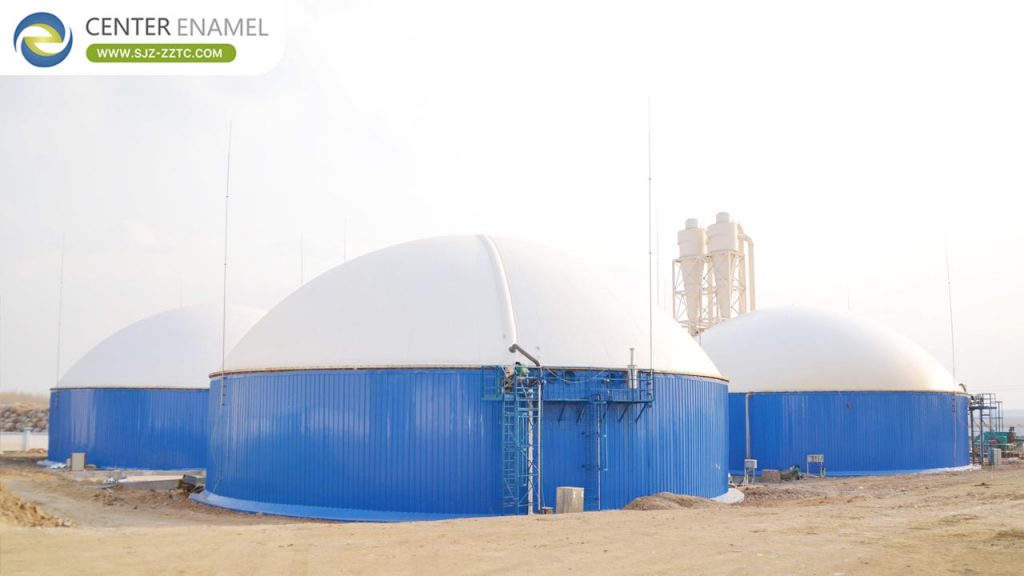
Project Case Study: Bangladesh Poultry Farm Waste Treatment Project
Project / Application: Poultry manure waste treatment at a chicken farm, Bangladesh. Industry: Livestock (poultry). Tank Type: CSTR plus UASB anaerobic reactors. Key Requirements: Reliable biogas and power from manure.
| Field | Value | Source / Evidence |
| Daily Treatment Capacity | 47 t/d (poultry manure) | Company project reference |
| Treatment Process | CSTR + UASB anaerobic reactors | Company project reference |
| Biogas Production | approx 4,900 m3/day | Company project reference |
| Power Generation | approx 9,800 kWh/day (2.0 kWh/m3 biogas) | Company project reference |
| Effluent Standard | Complies with local regulations | Company project reference |
| Installation Year | 2026 | Company project reference |
About The Supplier
Shijiazhuang Zhengzhong Technology Co., Ltd (Center Enamel) supplies Glass-Fused-to-Steel digester tanks for biogas projects including the Bangladesh poultry plant, with enamel firing at 820-930 C and certifications including ISO 9001, NSF/ANSI 61, and CE-EN 1090. The reference shows 47 t/d of manure yielding about 4,900 m3/day of biogas and 9,800 kWh/day of power, a concrete yield figure rather than a generic promise.
Comparison: How Yield Is Expressed
| Metric | What It Tells You | Risk If Used Alone |
| m3 biogas/day | Volume produced | Ignores methane % |
| Methane % | Energy value | Needs volume to size plant |
| kWh/day | Usable energy | Depends on engine efficiency |
Biogas yield from fermentation is a function of feed volatile solids, methane fraction, and reactor performance, not a fixed quota. Size the plant from the measured feed and the methane content, and confirm it against a real project yield like the Bangladesh reference.
Frequently Asked Questions
Q1: How much biogas from fermentation? A1: About 0.30-0.45 m3 per kg of COD removed at mesophilic temperatures, 55-65% methane.
Q2: What sets the yield? A2: Volatile solids, carbon-to-nitrogen ratio, temperature, and inhibitors.
Q3: How is m3 converted to kWh? A3: Roughly 1.8-2.2 kWh per m3 of methane-rich biogas at the generator.
Q4: What is a real project yield? A4: A 47 t/d poultry plant produced about 4,900 m3/day and 9,800 kWh/day.
Q5: Does feed type matter? A5: Yes; food waste yields more than cattle manure per kg of VS.
Q6: What is the methane content? A6: Mature feed typically yields 55-65% methane in the biogas.
Q7: What temperature is used? A7: Mesophilic fermentation typically runs at 35-38 C.
Q8: What tank resists the feed? A8: A Glass-Fused-to-Steel CSTR with a corrosion-resistant enamel lining.
Suggested CTA
Share your feedstock type and tonnage to an engineer, or request a biogas yield estimate and digester scope.