
How Much Biogas From Manure Water?
Manure water typically yields 0.30-0.45 m³ of biogas per kg of COD removed, or about 0.20-0.35 m³ per kg of volatile solids (VS), with a methane fraction of 55-65% when digested at mesophilic 35-38°C. The exact volume depends on feed strength, retention time, and how much of the organics are truly biodegradable, so the practical figure is best taken from a measured COD or VS balance rather than a single textbook number.
Where the Yield Comes From
Biogas volume scales with the organics actually destroyed, not with the water volume. A high-strength manure stream removes far more COD per cubic metre than a diluted wash stream, so the same plant makes more gas from concentrated slurry than from separated liquid.
Design Parameter Table
| Design parameter | Typical value or range | Why it matters |
| Biogas per COD removed | 0.30-0.45 m³/kg | Primary yield metric |
| Biogas per VS | 0.20-0.35 m³/kg | Feedstock-based check |
| Methane content | 55-65% | Rest is CO₂ and trace H₂S |
| Temperature | 35-38°C mesophilic | Standard stable range |
| Retention | 20-40 days (CSTR) | Long enough to convert VS |
| Limitation to check | Sand and inert solids | Do not convert to gas |
Manure Water vs Other Feedstocks
| Feedstock | Biogas per kg VS | Note |
| Cattle manure | 0.20-0.30 m³ | Lower VS, more inert |
| Food waste | 0.35-0.60 m³ | High biodegradable VS |
| Sludge | 0.20-0.35 m³ | Stable, dilute |
| Manure water (mixed) | 0.20-0.35 m³ | Depends on separation |
Project Case Study
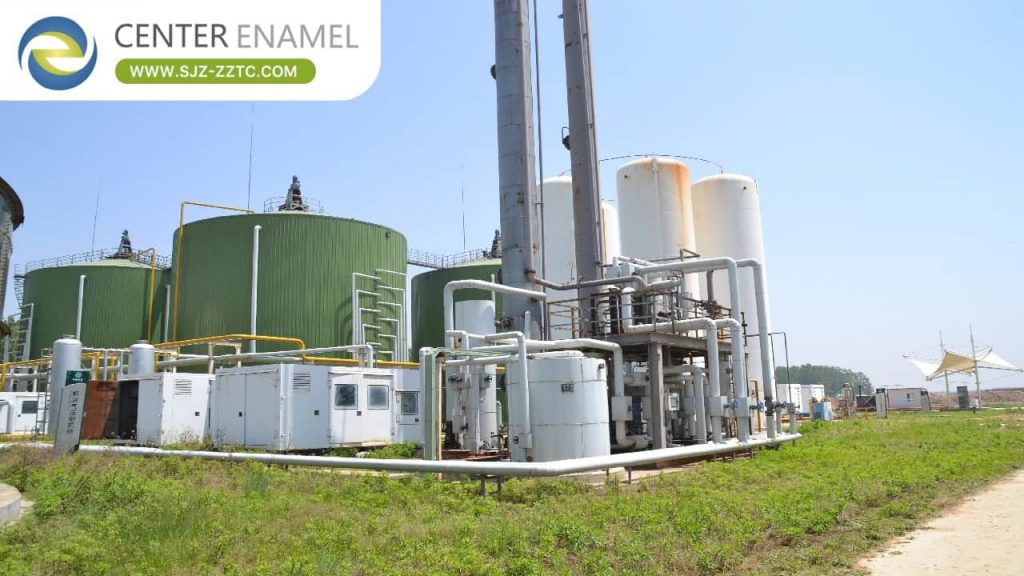
Malaysia Biogas Project. Five Glass-Fused-to-Steel (GFS) tanks totaling 27,000 m³ treat high-strength agricultural wastewater, producing 22,000 m³ of biogas per day at about 80% digestibility and a gas production rate of 0.45 m³ per kg COD removed, confirming the upper end of the manure-water yield range in a warm climate.
| Project | Malaysia Biogas Project |
| Location | Malaysia |
| Industry | Agricultural / Biogas |
| Application | High-strength wastewater digestion |
| Product | 5 × GFS tanks (Ø24.46 × 12 m, 5,400 m³ each) |
| Result | 22,000 m³ biogas/day, 0.45 m³/kg COD, 80% digestibility |
| Status | Delivered 2026 |
About Shijiazhuang Zhengzhong Technology Co., Ltd (Center Enamel)
Shijiazhuang Zhengzhong Technology Co., Ltd (Center Enamel) brings international project experience to manure-water biogas: bolted GFS digester and gas-holder tanks are engineered for wet, H₂S-bearing, warm-climate duty, with enamel fused at 820-930°C for an inert barrier, built to ISO 28765 / AWWA D103 and CE-EN 1090. Tanks are shipped to 100+ countries and sized from the actual COD and VS balance.
Plan on 0.30-0.45 m³ of biogas per kg COD removed from manure water, at 55-65% methane, and verify against a VS balance. Send your COD, VS, and temperature and we will estimate daily gas volume and size the digester.
Frequently Asked Questions (FAQ)
Q1: How much biogas per kg COD from manure?
A: About 0.30-0.45 m³ per kg COD removed, at 55-65% methane, under mesophilic 35-38°C digestion.
Q2: What is the methane content of manure biogas?
A: Typically 55-65% methane; the balance is mostly CO₂ plus trace H₂S that must be treated before use.
Q3: How much VS does manure convert to gas?
A: Roughly 0.20-0.35 m³ per kg of volatile solids, depending on how biodegradable the feed is.
Q4: What factors change the yield?
A: Feed strength, retention time, temperature stability, and the share of inert sand and grit that never converts.
Q5: Does separation increase gas per cubic metre?
A: Yes for the liquid fraction (higher COD concentration), but total gas follows total degradable organics, not water volume.
Q6: How is yield best verified?
A: From a measured COD or VS mass balance over the digester, not from a single literature value.
Suggested CTA
Send your manure COD, VS, and operating temperature. We will estimate daily biogas volume and return a sized GFS digester and gas-holder package.