
How Much Biogas From Manure?
Cattle manure yields about 0.20-0.30 m3 of biogas per kg of volatile solids at 55-65% methane, so a livestock plant feeding 900 m3/day of manure and agricultural waste can produce around 20,000 m3 of biogas daily; the exact volume scales with the volatile-solids content and how close the digester runs to its design loading. Pig and poultry manure sit in similar or slightly different ranges, but cattle manure is the reference case.
1. Yield Is per Volatile Solids, Not per Tonne
Biogas is made from volatile solids, not from wet weight. A tonne of dairy manure with, say, 6-8% VS yields far less than a tonne of food waste at 15% VS. Quoting per-kg-VS keeps the number honest across feedstocks and lets an owner size the digester from a lab VS test rather than a guess.
2. Yield by Species
| Manure type | Biogas per kg VS | Methane |
| Cattle (dairy/beef) | 0.20-0.30 m3 | 55-65% |
| Pig | 0.20-0.30 m3 | 55-65% |
| Poultry | 0.25-0.40 m3 | 55-65% |
| Food waste (ref) | 0.35-0.60 m3 | 55-65% |
3. From Yield to Plant Output
Take 900 m3/day of manure at roughly 6% VS and 35-38 C digestion: the daily VS load, multiplied by 0.20-0.30 m3/kg, lands in the low tens of thousands of cubic metres. A delivered livestock plant in Inner Mongolia confirms the scale, producing 20,000 m3/day from 900 m3/day of feed across 4 CSTR reactors. Retention is 20-40 days for wet digestion.
Project Case Study
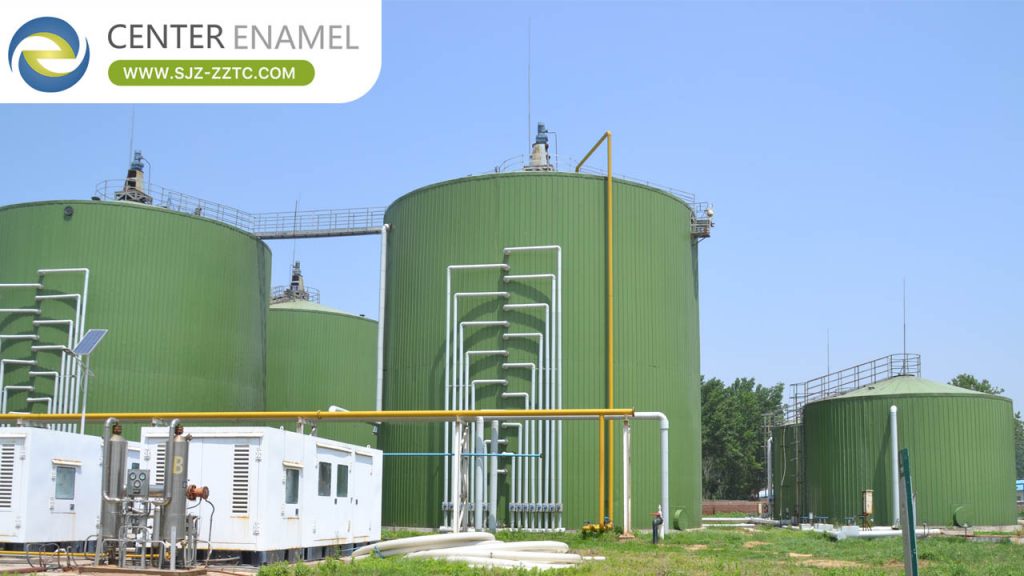
Zhaqi Biogas Project in Inner Mongolia. A mesophilic AD plant processing 900 m3/day of farm animal manure and agricultural waste, producing 20,000 m3 of biogas daily across 4 CSTR reactors (25.98 x 8.4 m) - a delivered reference for manure-to-biogas output at scale.
| Project | Zhaqi Biogas Project in Inner Mongolia |
| Location | Xing'an, Inner Mongolia, China |
| Industry | Agriculture / Renewable Energy |
| Application | Manure-to-biogas at scale |
| Product | 4 CSTR reactors (25.98 x 8.4 m, GFS) |
| Input | 900 m3/day manure + residue |
| Output | 20,000 m3 biogas/day |
| Status | Delivered 2017 |
About Shijiazhuang Zhengzhong Technology Co., Ltd (Center Enamel)
Shijiazhuang Zhengzhong Technology Co., Ltd (Center Enamel) delivers the manufacturing capability that holds the yield: bolted GFS digester tanks fused at 820-930 C give an inert, impermeable barrier against corrosive, H2S-bearing digestate, built to ISO 28765 and AWWA D103, shipped flat-pack, and assembled on site - the shell that keeps the 35-38 C biology productive.
Comparison: Yield Bases
| Basis | What it means | Use |
| Per kg VS | Honest, lab-testable | Sizing |
| Per tonne wet | Easy but misleading | Rough estimate only |
Cattle manure yields about 0.20-0.30 m3 biogas per kg VS at 55-65% methane; size from VS, not wet weight, and expect 20,000 m3/day from a 900 m3/day livestock feed. Send your manure VS and volume and we will size the GFS digester and confirm the biogas output.
Frequently Asked Questions (FAQ)
Q1: How much biogas does manure make?
A: About 0.20-0.30 m3 per kg volatile solids at 55-65% methane for cattle manure.
Q2: Is yield per tonne or per VS?
A: Per kg VS is the honest basis; per-tonne wet weight is only a rough estimate.
Q3: How does species affect yield?
A: Cattle and pig near 0.20-0.30, poultry 0.25-0.40, all at 55-65% methane.
Q4: What does a real plant produce?
A: An Inner Mongolia plant makes 20,000 m3/day from 900 m3/day of manure feed.
Q5: What retention applies?
A: About 20-40 days at mesophilic 35-38 C for wet manure digestion.
Q6: What tank capacity is available?
A: GFS digester tanks from 200 m3 to 60,000 m3.
Suggested CTA
Send your manure VS content and daily volume. We will size the GFS digester and confirm the biogas output for your farm.