
How Much Biogas per Tonne of Sludge?
A tonne of dewatered sewage sludge at 20–25% dry solids typically yields about 90–180 m³ of biogas, because the gas comes from the volatile solids (VS) it contains, not the water. With efficient digestion, each kg of VS produces roughly 0.75–1.1 m³ of biogas (about 60% methane), so the drier and more organic the sludge, the more gas per tonne.
Why Volatile Solids, Not Weight
Biogas is produced from the biodegradable fraction—the volatile solids—of the sludge. A wet tonne is mostly water that contributes nothing. That is why the honest basis is per tonne of dry solids or per kg of VS, and why dewatering (raising dry-solids content) concentrates the gas-yielding material into less mass.
Working It Out
Take 1 tonne of dewatered sludge at 25% dry solids: that is 250 kg of solids, of which perhaps 60% is VS—150 kg VS. At ~0.9 m³ biogas per kg VS, that is about 135 m³ of biogas per tonne. Lower dry solids (20%) or lower VS pull the figure toward 90 m³; better dewatering and digestion push it past 180 m³.
Comparative Data Table: Sludge Yield by Dry Solids
| Sludge state | Dry solids | Approx. biogas / tonne |
| Dewatered (typical) | 20–25% | 90–180 m³ |
| Well dewatered | 28–30% | 160–220 m³ |
| Digested vs raw | lower VS after AD | raw yields more |
| Per kg VS | — | 0.75–1.1 m³ |
Technical Considerations
Yield tracks feedstock more than reactor. Primary sludge (more fat/grease) is richer than waste activated sludge; co-digestion with high-energy organics lifts the band. Holding mesophilic 35–38°C and stable loading protects the rate. Measuring VS and gas continuously turns the estimate into a plant-specific actual.
Advantages and Limitations
Expressing yield per tonne of dewatered sludge is intuitive for hauling and plant sizing. The limit is that the number swings with dry solids and VS, so a single figure misleads unless the sludge state is stated. Always pair it with dry-solids and VS context.
Best Practices / How to Use the Number
Report yield against dry solids and VS, not raw tonnage. Dewater harder to concentrate gas-yielding solids, co-digest to lift VS, and meter gas to confirm. Use the per-tonne figure for logistics and the per-kg-VS figure for design and comparison.
Per tonne of dewatered sludge at 20–25% dry solids, expect about 90–180 m³ of biogas, set by volatile-solids content and digestion efficiency. The figure only means something with dry-solids and VS stated—that is the context that makes it comparable.
Frequently Asked Questions (FAQ)
Q1: How much biogas per tonne of sludge?
A: About 90–180 m³ per tonne of dewatered sludge at 20–25% dry solids; 0.75–1.1 m³ per kg of volatile solids, ~60% methane.
Q2: What sets the number?
A: Volatile-solids content and digestion efficiency, not wet weight. Drier, more organic sludge yields more gas per tonne.
Q3: Why does dry solids matter?
A: Water yields no gas. Raising dry solids concentrates the gas-yielding VS into less mass, lifting m³ per tonne.
Q4: How much methane?
A: Roughly 60% of the biogas volume is methane, so 90–180 m³ biogas per tonne is about 55–108 m³ methane.
Q5: Raw or digested sludge?
A: Raw (undigested) sludge yields more biogas; after digestion its VS is partly consumed, so the gas-yield-per-tonne of the residue is lower.
Q6: Can co-digestion raise it?
A: Yes—adding high-energy feedstock lifts the VS yield band, pushing per-tonne output toward the top of the range.
Project Case Reference
Malaysia Biogas Project — Malaysia · 2026
5 GFS Tanks · 27,000 m³ Total Volume · 22,000 m³ Biogas/Day
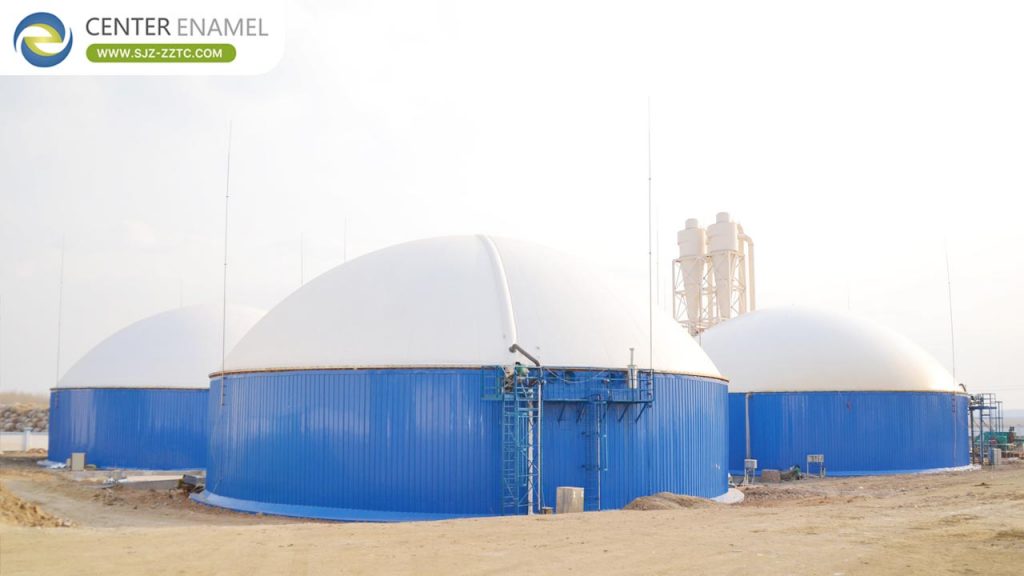
A large-scale biogas project in Malaysia featuring 5 Glass-Fused-to-Steel (GFS) tanks. The project achieves approximately 80% digestibility, with each single tank producing about 4,400 m³ of biogas daily, totaling 22,000 m³ per day across all 5 tanks.
Technical Specifications
Single Tank Volume: 5,400 m³ (Ø24.46 × 12 m)
Total Effective Volume: 27,000 m³ (5 tanks)
Daily Biogas Production: 22,000 m³ total
Digestibility: ≈ 80%
Gas Production Rate: 0.45 m³ / kg COD removed
Tank Type: Glass-Fused-to-Steel (GFS)
Water Quality Data
| Parameter | Inlet Water | Effluent |
| COD | ≥ 60,000 mg/L | ≥ 12,000 mg/L |
| BOD | ≤ 25,000 mg/L | ≤ 5,000 mg/L |