
How Much Does Biogas CHP Maintenance Cost per kWh?
Biogas CHP maintenance typically runs $0.015–0.045 per kWh of electricity generated, or about 1.5–4.5 €-cent per kWh. Large units above 500 kWe sit at the low end ($0.01–0.02/kWh) because fixed service is spread over more output, while small sub-100 kWe units reach $0.03–0.05/kWh. The band covers oil, filters, spark plugs or injectors, and scheduled major overhaul, but not the biogas itself or the labour overhead of a poorly run gas train.
What the Maintenance Cost Actually Covers
Reciprocating gas engines need oil and filter changes every few thousand running hours, ignition and valve service, and a major overhaul every 30,000–60,000 hours where pistons, rings, and bearings are renewed. Poor gas quality shortens every interval: H₂S corrodes and siloxanes form abrasive microcrystalline deposits on valves and pistons, so a plant that skips gas cleaning pays in both parts and downtime. Heat-recovery circuit and control checks are part of the same budget.
Comparative Data Table: Maintenance Cost by Engine Size
| Engine size | Maintenance $/kWh elec | Major overhaul interval | Key driver |
| < 100 kWe | 0.03–0.05 | 20,000–30,000 h | fixed cost spread over little output |
| 100–500 kWe | 0.02–0.035 | 30,000–45,000 h | balanced |
| > 500 kWe | 0.01–0.02 | 40,000–60,000 h | scale, better specific output |
| Gas turbine | 0.01–0.025 | 25,000–40,000 h | fewer reciprocating parts |
How to Keep the Number Down
Three levers dominate. Clean the gas properly—biological or activated-carbon desulphurisation and siloxane filtration typically cut parts wear sharply, often paying back within a year on small engines. Run at stable high load rather than throttling, because part-load operation raises specific maintenance per kWh. And contract a planned maintenance programme with guaranteed response time instead of running to failure; unplanned downtime on a fuel-intensive plant costs far more than the scheduled service it replaces.
Frequently Asked Questions (FAQ)
Q1: How much does biogas CHP maintenance cost per kWh?
A: Typically $0.015–0.045 per kWh of electricity—about 1.5–4.5 €-cent—including oil, filters, and overhaul. Larger engines land near $0.01–0.02/kWh; small units reach $0.03–0.05/kWh.
Q2: What is included in CHP maintenance?
A: Routine oil and filter changes, ignition or injector service, valve work, and a scheduled major overhaul every 30,000–60,000 hours, plus gas-train and heat-recovery checks. It excludes fuel and unscheduled failure repair.
Q3: Why is a larger engine cheaper to maintain?
A: Fixed service effort and overhead are spread over far more kilowatt-hours, and large engines have better specific output and longer overhaul intervals, so maintenance per kWh falls with size.
Q4: How can I lower biogas CHP maintenance?
A: Clean the gas to remove H₂S and siloxanes, run at stable high load, and use a planned maintenance contract with guaranteed response. Good gas treatment alone often pays back within a year on small engines.
Project Case Reference
Malaysia Biogas Project — Malaysia · 2026
5 GFS Tanks · 27,000 m³ Total Volume · 22,000 m³ Biogas/Day
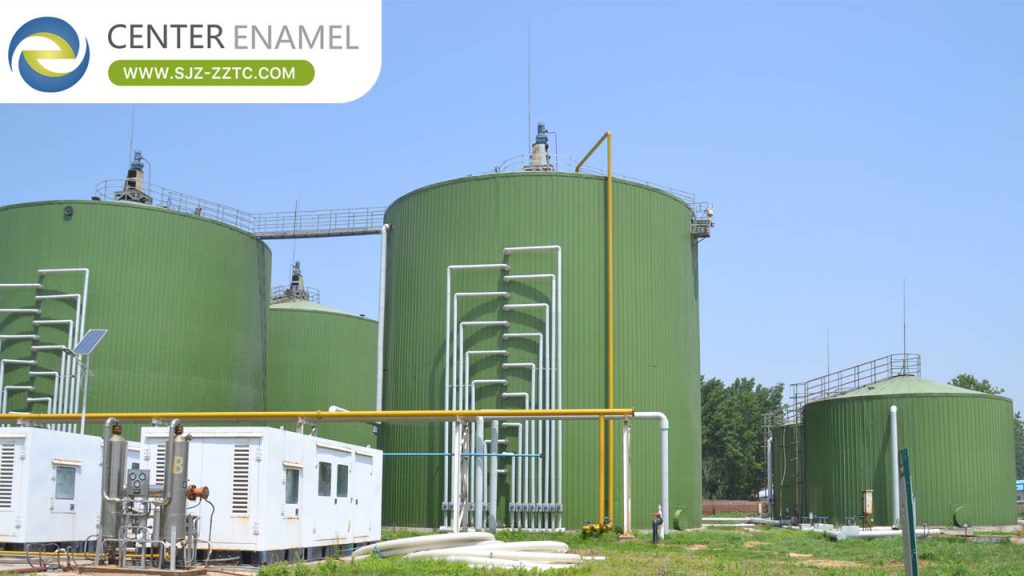
A large-scale biogas project in Malaysia featuring 5 Glass-Fused-to-Steel (GFS) tanks. The project achieves approximately 80% digestibility, with each single tank producing about 4,400 m³ of biogas daily, totaling 22,000 m³ per day across all 5 tanks.
Technical Specifications
Single Tank Volume: 5,400 m³ (Ø24.46 × 12 m)
Total Effective Volume: 27,000 m³ (5 tanks)
Daily Biogas Production: 22,000 m³ total
Digestibility: ≈ 80%
Gas Production Rate: 0.45 m³ / kg COD removed
Tank Type: Glass-Fused-to-Steel (GFS)
Water Quality Data
| Parameter | Inlet Water | Effluent |
| COD | ≥ 60,000 mg/L | ≥ 12,000 mg/L |
| BOD | ≤ 25,000 mg/L | ≤ 5,000 mg/L |