
How to Build an Effluent Treatment Project
An effluent treatment project (ETP) is the engineered plant that brings industrial wastewater to a permitted discharge or reuse standard by matching the process train to the effluent’s load, toxicity, and variability. The two things a B2B buyer must get right are the process selection and the tank material, because industrial effluent is often hot, acidic, saline, or biologically inhibitory.
Characterize the Effluent First
Before any design, measure flow, COD/BOD, TSS, pH, salinity, and inhibitory compounds (heavy metals, phenols, antibiotics). A palm-oil mill effluent (POME) at 65,600 mg/L COD needs a very different train than a low-strength cooling stream. Characterization dictates everything downstream.
Process Train Options
Common ETP trains: equalization → anaerobic (UASB / granular sludge) → aerobic (activated sludge / SBR / MBR) → clarification → polishing. Anaerobic front-ends cut energy and COD cost; for POME, SBR can take COD from 65,600 to ≤400 mg/L and BOD from 7,480 to ≤250 mg/L.
| Process | Role | Typical COD removal | Best for |
| Anaerobic (UASB) | high-rate COD cut | 80–90% | high-COD (>2,000 mg/L) |
| Aerobic (SBR/AS) | polish + N removal | 85–95% | medium load |
| MBR | solid-liquid sep | high | reuse / tight limit |
| Polishing | final meet limit | variable | strict discharge |
Tank Material: GFS vs Epoxy
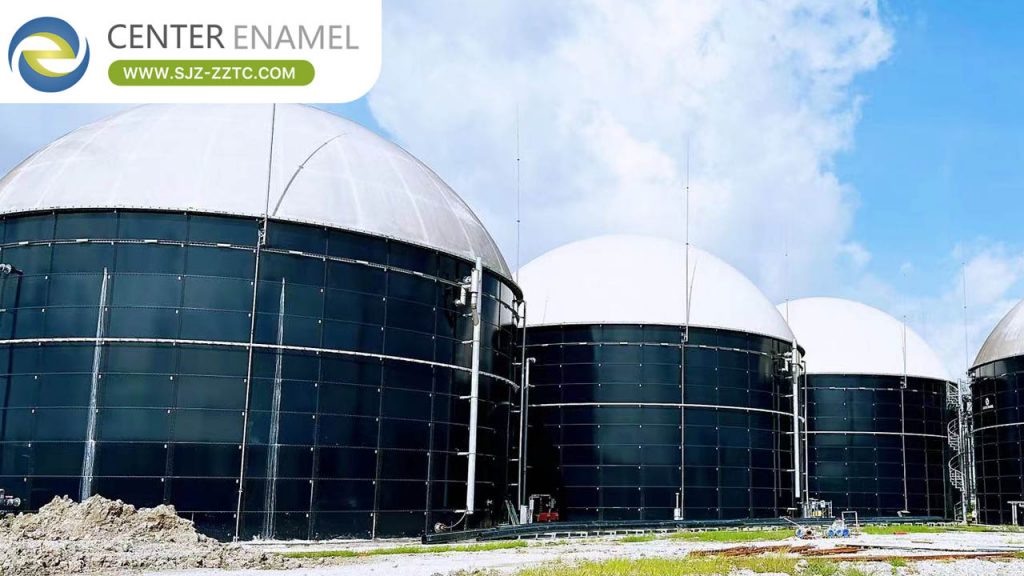
Bolted Glass-Fused-to-Steel (GFS) fuses an inert glass layer to steel at 820–930°C, resisting acids, salts, and H₂S—ideal for anaerobic and equalization tanks. Epoxy-coated steel is a lower-cost option for less aggressive streams but depends on field application quality. Stainless suits extreme duty at higher cost.
Technical Considerations
Size equalization to absorb shock loads; keep anaerobic at 25–38°C with OLR 5–15 kg COD/m³·day; specify tank material by the most aggressive species present. GFS tanks span 200–60,000 m³; high-salinity feeds (e.g. 6,000 mg/L) demand verified enamel grade.
How to Scope the ETP
Fix discharge limit, then work backward: characterize → set equalization → pick anaerobic/aerobic → size clarification → specify tank material and standards. A one-page effluent profile (flow + concentrations + limit) lets suppliers quote a tank package quickly.
Project Case Study
Sri Lanka Palm Oil Wastewater Treatment Project. A 250 T/D POME plant using SBR process with 2 reactor sets (each Φ 24.46 × 6 m), reducing COD from 65,600 to ≤400 mg O₂/L and BOD from 7,480 to ≤250 mg O₂/L. A documented international effluent treatment project with GFS reactor tankage.
| Project | Sri Lanka Palm Oil Wastewater Treatment |
| Location | Sri Lanka |
| Industry | Palm Oil |
| Application | POME (palm oil mill effluent) |
| Product | SBR reactors (GFS) |
| Capacity | 250 T/D |
| Quantity | 2 sets, Φ 24.46 × 6 m |
| Material | Glass-Fused-to-Steel (GFS) |
| Standards | ISO 28765 |
| Status | Delivered 2026 |
About Center Enamel
Center Enamel contributes the product technology at the core of any ETP: bolted GFS and epoxy-coated steel tanks engineered for corrosive industrial duty. The enameled GFS shell (glass fused at 820–930°C, ISO 28765 / AWWA D103, ISO 9001, CE/EN 1090) resists acid, salt, and H₂S far better than field-painted steel, and is available 200–60,000 m³—equalization, anaerobic, aerobic, and clarification tanks built as a coordinated package.
Advantages and Limitations
GFS gives inert, long-life corrosion resistance and fast modular installation; epoxy is cheaper for mild streams. Limits: very high salinity or fluoride may need special enamel grades; stainless is the fallback for extreme duty. Match material to the worst species present.
Comparison: GFS vs Epoxy vs Stainless
| Material | Corrosion | Cost | Best for |
| GFS | high (inert glass) | medium | acid/salt/H₂S |
| Epoxy steel | good | low–medium | mild effluent |
| Stainless | very high | high | extreme duty |
An effluent treatment project succeeds by matching process to load and toxicity, then specifying the right tank material. For aggressive industrial effluent, bolted GFS (glass fused at 820–930°C) gives inert, long-life corrosion resistance; epoxy suits milder streams.
Frequently Asked Questions (FAQ)
Q1: How do you build an effluent treatment project?
A: Characterize the effluent, set the discharge limit, then select equalization → anaerobic → aerobic → clarification and specify tank material by the most aggressive species.
Q2: Which tank material is best?
A: GFS for acid/salt/H₂S duty; epoxy-coated steel for mild streams; stainless for extreme duty at higher cost.
Q3: What process treats high-COD effluent?
A: Anaerobic UASB or granular sludge cuts 80–90% COD first, then aerobic polishing; SBR handled POME at 65,600→400 mg/L COD.
Q4: What standards apply?
A: GFS tanks to ISO 28765 / AWWA D103, ISO 9001, CE/EN 1090.
Q5: What capacity is available?
A: GFS tanks from 200 m³ to 60,000 m³ for ETP duty.
Q6: How is an ETP sized?
A: From flow, COD/BOD, and discharge limit; OLR 5–15 kg COD/m³·day guides anaerobic volume.
Send your effluent profile (flow, COD/BOD, salinity, limit). We will recommend the process train and specify GFS or epoxy ETP tanks with the right grade and standards.