
How to Convert Food Waste to Biogas: A Step-by-Step Engineering Guide
Municipalities, commercial kitchens, grocery chains, and food processing plants generate millions of tons of organic waste annually. Disposing of this material in landfills creates severe environmental hazards, releasing massive amounts of unmanaged methane.
Learning how to convert food waste to biogas offers a powerful circular economy solution. Through advanced anaerobic digestion (AD), organic scraps are transformed into high-yield renewable energy and nutrient-rich bio-fertilizer, turning a costly waste disposal problem into a sustainable asset.
Step 1: Collection, Sorting, and Contamination Removal
The conversion process begins long before organic material enters a bioreactor. Effective pre-treatment is essential for smooth plant operations.
- Source Separation: Organic food waste—such as kitchen scraps, vegetable peels, restaurant plate waste, and expired grocery goods—must be isolated from non-organic streams.
- Depackaging and Screening: Commercial food waste frequently arrives packaged in plastics, cardboard, or metal cans. Industrial depackagers and mechanical screening systems remove these contaminants.
- Maceration and Slurry Preparation: Cleaned food waste is shredded and mixed with water or recycled liquid digestate inside reception pits to create a pumpable slurry with an optimal total solids (TS) concentration.
Step 2: Feedstock Conditioning and Nutrient Balancing
Food waste is nutrient-dense and degrades rapidly, which introduces specific engineering challenges like rapid acidification.
- Carbon-to-Nitrogen (C:N) Optimization: Pure food waste often has a low C:N ratio. Co-digesting food waste with carbon-rich agricultural materials (such as straw or manure) establishes a balanced C:N ratio between 20:1 and 30:1.
- Thermal Pasteurization: To meet environmental and sanitary safety standards, the conditioned slurry is frequently heated (e.g., at 70°C for one hour) to eliminate pathogenic bacteria and weed seeds before entering the reactor.
Step 3: Anaerobic Digestion in a Sealed Bioreactor
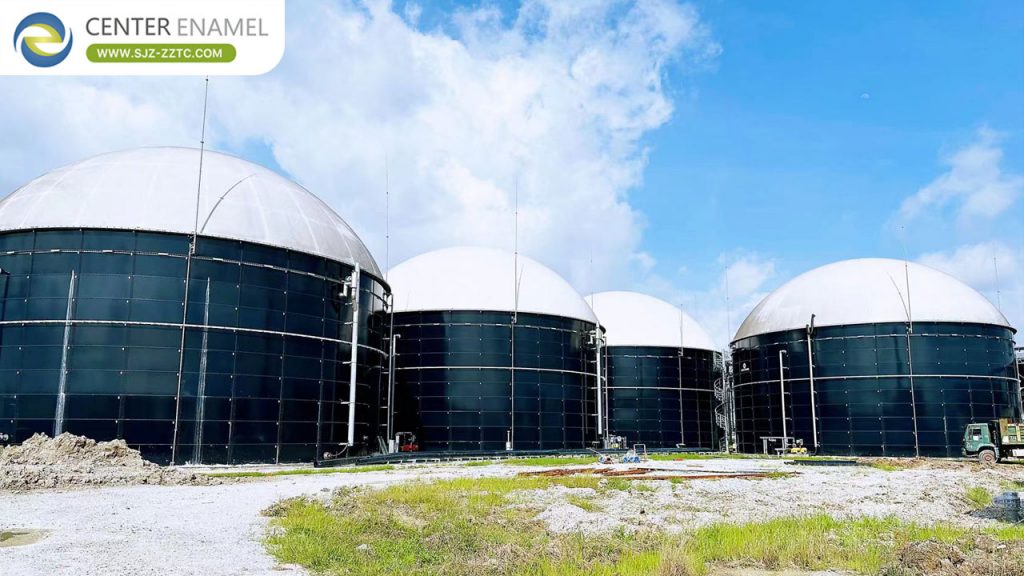
The heart of the conversion process takes place inside a sealed, oxygen-free reactor (such as a Continuous Stirred-Tank Reactor [CSTR] or bolted Glass-Fused-to-Steel tank). Specialized microbial communities drive four sequential biological stages:
- Hydrolysis: Extracellular enzymes break down complex carbohydrates, fats, and proteins into soluble monomers (simple sugars and amino acids).
- Acidogenesis: Acid-forming bacteria convert soluble monomers into volatile fatty acids (VFAs), alcohols, and carbon dioxide.
- Acetogenesis: Acetogenic bacteria transform VFAs into acetic acid (acetate), hydrogen, and carbon dioxide.
- Methanogenesis: Methanogenic archaea consume the acetate and hydrogen, synthesizing combustible methane (CH4) and carbon dioxide (CO2).
Step 4: Gas Collection, Upgrading, and Utilization
As biogas accumulates in the reactor headspace, it undergoes treatment before final use:
- Desulfurization and Dehumidification: Hydrogen sulfide (H2S) and water vapor are stripped using biological scrubbers and condensate traps to prevent equipment corrosion.
- Gas Upgrading (Optional): Membrane separation or pressure swing adsorption (PSA) removes carbon dioxide, upgrading raw biogas into high-purity biomethane (Renewable Natural Gas) suitable for natural gas grid injection or vehicle fuel (Bio-CNG).
Comparative Data Table: Food Waste Biogas Parameters
| Process Stage | Key Engineering Action | Primary Equipment Involved | Optimal Target Metric |
| 1. Pre-Treatment | Sorting, depackaging, maceration | Industrial depackagers, shredders, pumps | Homogenized slurry (< 10 mm particle size) |
| 2. Conditioning | Blending and pasteurization | Heat exchangers, mixing pits | C:N ratio of 20:1 to 30:1; temp at 70°C |
| 3. Digestion | Microbial breakdown without oxygen | Bolted GFS tanks / CSTR, mechanical agitators | Temp: 37°C (mesophilic); pH: 6.8 to 8.0 |
| 4. Gas Upgrading | Removing H2S, moisture, and CO2 | Carbon scrubbers, moisture traps, PSA units | Methane purity > 95% for grid injection |
Frequently Asked Questions (FAQ)
Q1: What types of food waste work best for biogas conversion?
A: Beverage processing waste, restaurant scraps, expired grocery produce, and high-sugar or high-fat food processing discards work exceptionally well because they have high volatile solids content and break down rapidly into methane.
Q2: How do commercial biogas plants prevent food waste digesters from turning sour?
A: Because food waste degrades quickly into volatile fatty acids (VFAs), plants prevent acidification by carefully controlling the organic loading rate, employing co-digestion with alkaline manure, and monitoring the FOS/TAC stability ratio.
Q3: Can food waste be converted into biogas at a small scale or at home?
A: Yes. Small-scale household or community biodigesters can process daily kitchen food scraps in sealed containers, producing clean biogas primarily utilized for on-site cooking or small burner heating.