
How to Create Biogas from Organic Waste? A Complete Practical Guide to Waste-to-Energy Solutions
Organic waste is an abundant, globally generated renewable resource produced every single day from farming, food processing, catering and household consumption. Billions of tons of organic scraps end up in landfills or open incineration sites annually, triggering severe methane leakage, soil contamination, odor pollution and greenhouse gas accumulation.
Thanks to mature anaerobic digestion technology, learning how to create biogas from organic waste enables businesses, farms and local governments to turn troublesome waste into valuable clean biogas fuel. This comprehensive guide clarifies core definitions of organic waste, detailed biogas production workflow, multi-layer project benefits, professional anaerobic technologies and reliable equipment solutions from leading global EPC supplier Center Enamel.
What Is Organic Waste? Main Common Feedstock for Biogas Production
Organic waste refers to biodegradable materials derived from animal, plant and food-related sources, all ideal feedstock for biogas fermentation and classified into four mainstream categories:
- Agricultural organic waste: Crop straw, corn cobs, rice husks, fruit & vegetable stalks, pomace and orchard fallen fruits left after seasonal farm harvesting across tropical and temperate planting zones.
- Livestock manure waste: Pig, cattle, chicken and sheep manure from large-scale breeding farms, rich in nitrogen and organic matters to balance carbon-nitrogen ratio for stable microbial reproduction during digestion.
- Food & agro-processing residues: Fruit peels, vegetable scraps, distillers grains, leftover pulp from juice, canned food and brewery manufacturing factories, featuring high moisture and fast biodegradation.
- Catering & household organic waste: Kitchen trimmings, expired fruits and leftover meals from urban restaurants, hotels, supermarkets and residential communities.
After impurity removal (plastic, metal, inorganic debris) and proper crushing pretreatment, these organic materials can be fed into sealed reactors and GFS Tanks to start controlled anaerobic biogas fermentation.
Step-by-Step Process: How to Create Biogas from Organic Waste
All biogas generation takes place inside airtight, oxygen-free digester tanks via four continuous microbial biochemical reactions, the core scientific principle of converting organic waste into usable biogas:
- Hydrolysis Stage: Hydrolytic microorganisms secrete specific enzymes to break down large-molecule organics like cellulose, starch and protein into small soluble sugars, amino acids and short-chain soluble substances, laying the basic substrate for subsequent acid-forming reactions. This phase is usually the rate-limiting step of full digestion.
- Acidification (Acidogenesis): Acid-forming bacteria further convert soluble small organics into volatile fatty acids (VFAs) and intermediate alcohols, creating suitable acidic environment for acetogenic microbes.
- Acetogenesis Stage: Specialized acetogenic bacteria degrade leftover fatty acids and alcohols into acetic acid, hydrogen gas and carbon dioxide, the primary raw materials for final methane synthesis.
- Methanation Stage: Strictly anaerobic methanogenic archaea convert acetic acid and H₂/CO₂ mixtures into raw biogas, which contains 55%–70% methane and roughly 30%–45% carbon dioxide.
Crude biogas needs desulfurization, dehydration and compression purification before application for on-site power generation, industrial boiler heating or compressed Bio-CNG for vehicle fuel. Meanwhile, leftover fermented digestate is processed into high-grade organic fertilizer for farmland circulation to realize zero-waste closed-loop economy.
Multi-Dimensional Benefits of Producing Biogas from Organic Waste
Investing in organic waste-to-biogas projects brings remarkable environmental, economic and social gains worldwide:
1. Environmental Benefits
It drastically cuts landfill occupation and random waste stacking volume, curbs soil, underground water and odor pollution. Capturing fugitive methane (a potent greenhouse gas 28 times more heat-trapping than CO₂ over 100 years) from natural decomposition effectively reduces regional carbon emissions and helps nations fulfill carbon neutrality commitments.
2. Economic Benefits
Agro-processing factories and farms slash expensive third-party waste disposal fees; income can be obtained from biogas electricity sales, heat supply and organic fertilizer trading, greatly improving project profitability and corporate green competitiveness.
3. Social Benefits
Biogas replaces costly imported coal, firewood and natural gas to ease rural and industrial energy shortages; new job positions in waste collection, plant operation and equipment maintenance help boost grassroots income and narrow urban-rural development gaps.
Four Mature Anaerobic Technologies from Center Enamel for Organic Waste Biogas
As a top global biogas EPC manufacturer, Center Enamel customizes four differentiated anaerobic processes fully compatible with self-produced GFS Tanks, matching different organic waste types, solid content and project scales:
1. CSTR (Continuous Stirred-Tank Reactor)
Fitted with internal mechanical stirring inside matched GFS Tanks, CSTR evenly mixes high-solid straw, livestock manure and microbial sludge to avoid raw material crusting and sediment stratification, with strong anti-shock load capacity. It is the preferred option for large centralized farm and food factory biogas plants with mixed high-solid organic waste input.
2. UASB (Upflow Anaerobic Sludge Blanket)
Depends on dense high-activity granular sludge bed; pre-treated organic wastewater and liquid leachate flow upward for full organic degradation. It features small floor space and low power consumption, ideal for liquid manure and pre-filtered food processing wastewater projects.
3. USR (Upflow Solid Reactor)
Specially designed for unprocessed high-solid organic scraps, USR owns simple structure, low initial investment and excellent anti-clogging performance without complex pre-crushing pretreatment, perfectly suited for scattered small rural household and village biogas stations.
4. IC (Internal Circulation Reactor)
High-efficiency third-generation anaerobic equipment with built-in internal gas-liquid-solid auto-circulation; treatment efficiency reaches 3–5 times of conventional reactors, designed for super-large urban centralized organic waste disposal hubs with massive daily waste volume.
Core Advantages of Center Enamel’s GFS Tanks in Biogas Plants
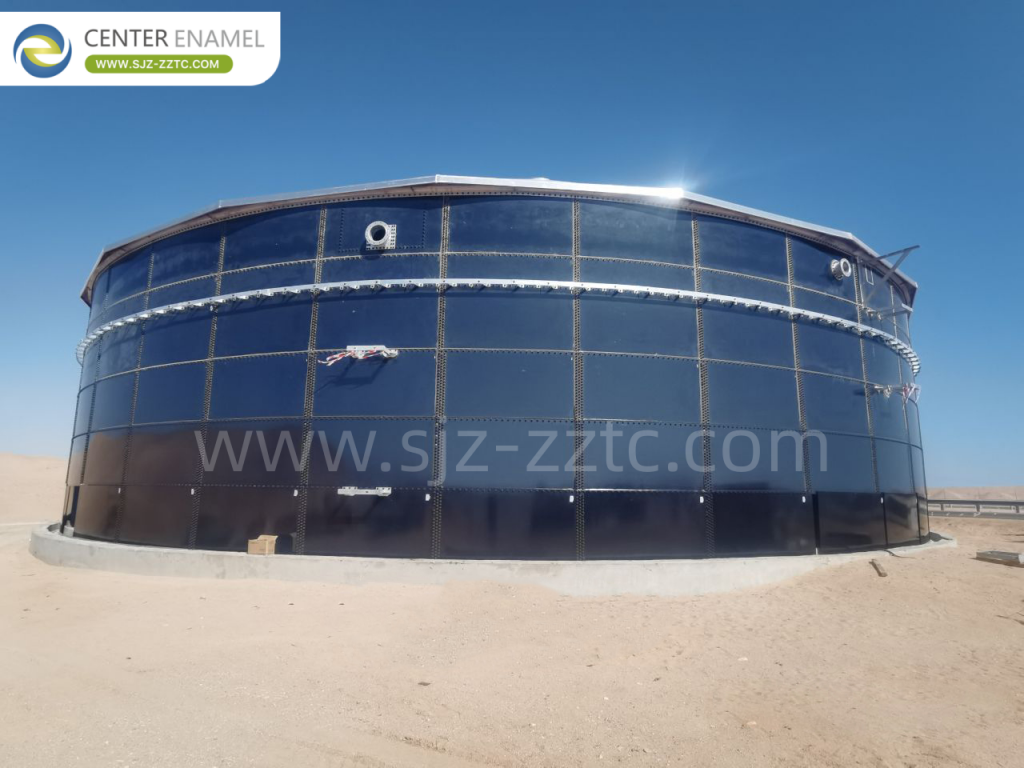
GFS Tanks (Glass-Fused-to-Steel Tanks) serve as core digestion and storage equipment for all four anaerobic technologies, with six irreplaceable merits versus concrete and ordinary carbon steel tanks:
- Outstanding Anti-Corrosion Performance: High-temperature 820–930℃ sintered enamel coating is chemically inert against acid, alkali, hydrogen sulfide and coastal salt fog, adapting to global tropical, rainy and cold climates with over 30-year stable service life.
- Superior Airtightness: Exclusive customized rubber sealing accessories block biogas leakage completely, maximizing methane recovery rate and eliminating flammable gas safety risks.
- Modular Bolted Prefabrication: All steel panels are factory pre-produced and bolt-assembled on-site without hot welding, shortening construction period and avoiding quality defects from rainy or humid construction conditions.
- Smooth Inner Wall: Non-sticky enamel lining prevents organic residue scaling, cutting regular tank cleaning and daily maintenance expenses significantly.
- Flexible Volume Expansion: Extra enamel panels can be added anytime to expand tank capacity as seasonal organic waste output rises, supporting long-term project capacity upgrade.
- Multi-Purpose Compatibility: Single tank can flexibly work as anaerobic digester, raw waste storage tank or digestate storage tank to match all four anaerobic process configurations.
Comprehensive Full-Cycle EPC Advantages of Center Enamel
Center Enamel stands out in global organic waste biogas industry with full-spectrum turnkey EPC strengths:
- Own over 200 independent enamel and anaerobic technology patents; all GFS Tanks are manufactured strictly following ISO and AWWA international quality standards for cross-border project certification.
- Provide full one-stop service covering project design, equipment production, cross-border logistics transportation, on-site installation, system commissioning, operator training and lifelong after-sales maintenance, saving clients multi-party coordination cost and construction cycle.
- Deliver localized customized design: adjust anaerobic process selection and tank specification based on local organic waste composition, ambient temperature and site terrain to maximize unit biogas yield.
- Decades of successful biogas project experience across Southeast Asia, Europe and North America, proficient in diverse local environmental laws and construction codes to guarantee smooth project delivery.
- Optimized overall system layout lowers equipment failure rate and daily running cost, securing steady long-term investment returns for project investors.
- Global after-sales service network provides timely remote technical guidance and on-site overhaul support worldwide.
Mastering how to create biogas from organic waste opens a sustainable circular economy pathway to resolve global organic waste pollution and clean energy shortage simultaneously. With Center Enamel’s diversified mature anaerobic technologies and high-durability GFS Tanks, farms and waste treatment enterprises can reliably turn useless organic scraps into profitable biogas and premium organic fertilizer. As a trusted full-cycle EPC contractor, Center Enamel’s customized turnkey biogas solutions help global clients reduce landfill burden, cut fossil fuel dependence and advance local circular agriculture and low-carbon sustainable development.