
How to Make Biogas from Kitchen Waste? Complete Process Guide for Biogas Project
Kitchen waste is one of the most abundant, accessible, and highly biodegradable organic waste types worldwide. It includes fruit and vegetable peels, leftover meals, rice, flour, cooking oil, eggshells, and other food residues. Rich in carbohydrates, proteins, and fats, kitchen waste is an ideal raw material for biogas production. Many households, communities, restaurants, canteens, and food markets are now turning kitchen waste into clean energy through biogas projects.
If you are asking How to make biogas from kitchen waste?, this article will give you a full, clear, and practical explanation. We will cover the core principles, step-by-step production process, benefits of kitchen waste biogas, four major anaerobic technologies, the advantages of GFS Tanks, and why Center Enamel is the leading EPC contractor for reliable kitchen waste biogas projects.
What Is Kitchen Waste and Why Is It Suitable for Biogas?
Kitchen waste, also called food waste, is organic waste generated during cooking, meal preparation, and eating. It has unique characteristics that make it perfect for biogas production:
- High organic content and high biogas yield
- High moisture content, easy to mix and digest
- Good biodegradability, fast decomposition by anaerobic microbes
- Abundant supply in households, restaurants, and communities
- Low lignin content, does not easily block digestion systems
Unlike plastic, metal, glass, or paper, organic kitchen waste can be efficiently broken down in an oxygen-free environment to produce methane-rich biogas.
Core Principle: Biogas Production from Kitchen Waste
Biogas from kitchen waste is produced through anaerobic digestion — a natural process where microorganisms break down organic matter without oxygen.
In a closed, airtight reactor, bacteria convert kitchen waste into biogas, which typically consists of:
- 55%–70% methane (combustible energy component)
- 30%–45% carbon dioxide
- Small amounts of hydrogen sulfide, water vapor, and other gases
This process has three key stages:
- Hydrolysis: Complex organic matter breaks into small molecules
- Acidification: Small molecules turn into organic acids
- Methanation: Methanogenic bacteria produce methane biogas
How to Make Biogas from Kitchen Waste? Step-by-Step Process
Making biogas from kitchen waste follows a standardized, repeatable process that ensures high efficiency and stable gas output.
Step 1: Waste Collection and Sorting
First, collect kitchen waste and remove non-biodegradable impurities such as plastic bags, bones, shells, metal, glass, and stones. These impurities damage equipment and reduce digestion efficiency.
Step 2: Crushing and Pulping
Crush sorted kitchen waste into small particles or slurry to increase surface area for microbial reaction. Smaller materials digest faster and more completely.
Step 3: Mixing and Condition Adjustment
Mix crushed kitchen waste with water to form a pumpable slurry. Adjust temperature, pH value, and carbon-nitrogen ratio (C/N) to create the best living environment for anaerobic bacteria.
Step 4: Anaerobic Digestion Reaction
Pump the prepared slurry into a closed, airtight digester. Under oxygen-free conditions, microbes decompose organic matter and continuously produce biogas.
Step 5: Biogas Collection and Purification
Collect biogas at the top of the digester. Remove water vapor, hydrogen sulfide, and other impurities to improve safety, calorific value, and equipment service life.
Step 6: Biogas Utilization
Purified biogas can be used directly for:
- Cooking
- Heating
- Boiler fuel
- On-site power generation
- Upgraded to biomethane for grid injection
Step 7: Digestate Treatment
The residue after digestion is nutrient-rich digestate, which can be processed into organic fertilizer for agriculture, gardens, and greening. This forms a full circular economy.
Benefits of Making Biogas from Kitchen Waste
Turning kitchen waste into biogas brings huge environmental, economic, and social benefits:
- Reduces kitchen waste volume and relieves landfill pressure
- Produces clean renewable energy and lowers energy costs
- Reduces methane emissions from landfills and supports carbon neutrality
- Eliminates odor, flies, and bacteria caused by waste accumulation
- Creates organic fertilizer and reduces chemical fertilizer use
- Supports sustainable waste management for communities and businesses
Four Advanced Anaerobic Technologies for Kitchen Waste Biogas Project
To efficiently make biogas from kitchen waste, Center Enamel provides four mature, high-performance anaerobic technologies:
1. CSTR (Continuous Stirred-Tank Reactor)
Equipped with mechanical stirring to ensure full mixing. Strong anti-impact load capacity, ideal for high-solid kitchen waste with many impurities.
2. UASB (Upflow Anaerobic Sludge Blanket)
Uses high-activity granular sludge. High organic load, high COD removal rate, low energy consumption, suitable for soluble kitchen waste slurry.
3. USR (Upflow Solid Reactor)
Simple structure, low investment, strong anti-clogging performance. Perfect for high-SS kitchen waste and small-to-medium community projects.
4. IC (Internal Circulation)
High-rate internal circulation reactor with 3–5 times higher processing capacity than traditional reactors. Small footprint, ideal for large-scale kitchen waste biogas projects.
These technologies ensure stable biogas production from kitchen waste in various project scales.
Advantages of GFS Tanks for Kitchen Waste Biogas Project
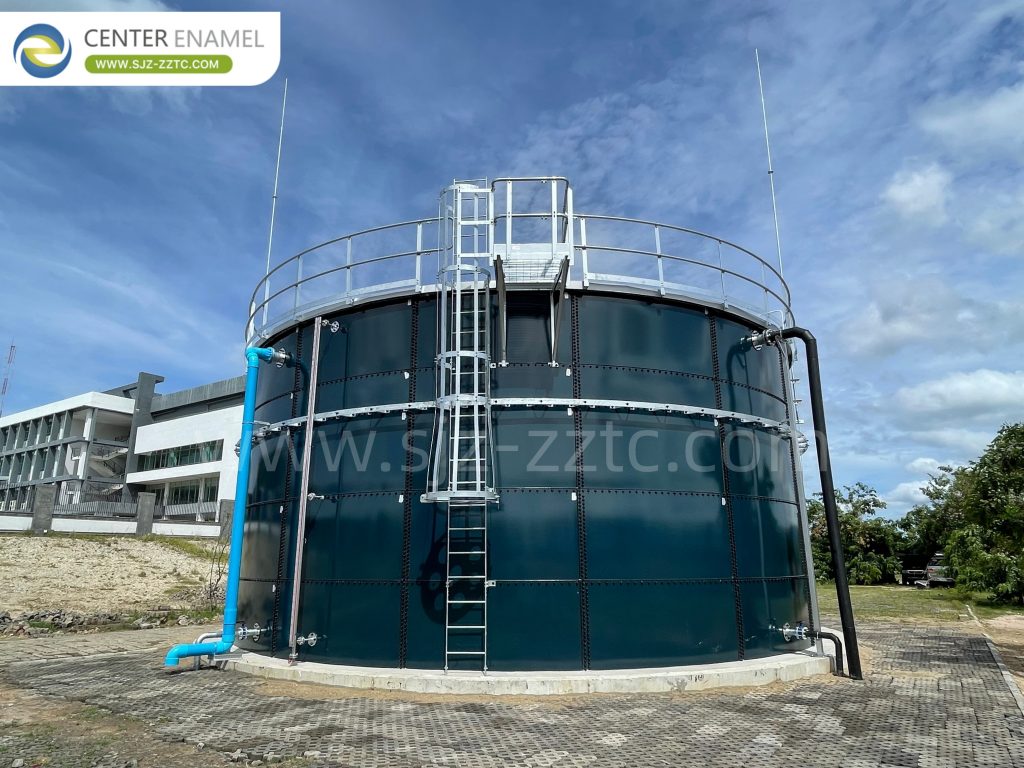
GFS (Glass-Fused-to-Steel) Tanks are the core equipment for kitchen waste biogas projects. They offer unmatched benefits:
- Super corrosion resistance: Fused at over 820°C, resistant to pH 1–14, adapts to acidic kitchen waste and humid environments
- Long service life: Over 30 years, low maintenance cost
- Fast installation: Factory prefabricated, bolted on-site, no welding or long curing time
- Compact structure: Space-saving vertical design for limited land areas
- Strong tightness: Airtight structure ensures safe biogas production and storage
- Weather resistance: Resists high temperature, UV, rain, and coastal salt spray
- Flexible expansion: Can expand capacity easily as project needs grow
GFS Tanks are the most reliable and cost-effective choice for kitchen waste biogas projects.
Why Choose Center Enamel as Your Biogas Project EPC Contractor?
Center Enamel is a global leader in biogas project EPC services, specializing in kitchen waste and organic waste treatment. Our core strengths include:
1. Customized Solutions
We design systems based on your kitchen waste composition, output, site conditions, and emission standards.
2. Advanced GFS Tanks Manufacturing
Asia’s largest GFS Tanks production base, with 200+ patented enamel formulas and strict quality control. Each tank plate passes 1500V spark test.
3. Full Turnkey EPC Service
One-stop service covering design, production, transportation, installation, commissioning, training, and after-sales support.
4. Proven Anaerobic Technologies
Stable CSTR, UASB, USR, IC systems ensure high biogas yield and stable long-term operation.
5. Rich Global Project Experience
Successful projects in Asia, Europe, Africa, and the Americas. We understand local policies, climates, and construction habits.
6. International Standard Compliance
Products meet ISO, AWWA, NSF/ANSI 61 standards for safe and reliable operation.
Center Enamel helps you efficiently make biogas from kitchen waste with stable, low-cost, long-life biogas systems.
Learning how to make biogas from kitchen waste is the first step to turning waste into valuable energy. The complete process includes sorting, crushing, mixing, anaerobic digestion, purification, utilization, and digestate recycling. With advanced CSTR, UASB, USR, IC anaerobic technologies and high-performance GFS Tanks, kitchen waste biogas projects are efficient, stable, and environmentally friendly. As a professional EPC contractor, Center Enamel provides full-process solutions to help households, communities, and businesses build safe, reliable, and high-efficiency kitchen waste biogas projects.