
How to Manage Food Waste in Restaurants?
Food waste in restaurants and catering businesses arises from inefficiencies throughout food preparation, handling, and disposal stages . Globally, the food service sector accounts for approximately 12–14% of total food waste, with restaurants in the United States alone responsible for 15–20% of all food waste generated . For individual establishments, food waste can represent up to 10% of a restaurant's food costs, directly impacting profitability . Beyond the financial implications, wasted food decomposing in landfills generates methane—58% of fugitive methane emissions at landfills come from wasted food —making effective food waste management both an economic necessity and an environmental imperative.
Prevention: Stopping Waste Before It Starts
Smart Inventory Management
Effective food waste management begins before food enters the kitchen. Implementing the First-In, First-Out (FIFO) system with clear labeling minimizes spoilage, while regular stock audits improve purchasing decisions . Bulk buying should be limited to items with long shelf life or adequate storage capacity to prevent overstocking .
AI-Powered Waste Tracking
Data-driven interventions have proven remarkably effective. Studies show that AI-based automatic waste-tracking systems using computer vision and deep learning can achieve 23–51% reductions in food waste, particularly in food preparation and overproduction . The Ghent Food Waste Monitor, a smart scale solution with AI-driven image recognition, helped pilot businesses achieve a 30% reduction in food waste on average . By automatically logging discarded food and categorizing it by type, amount, and time, kitchen staff can identify patterns and adjust procurement or menu planning accordingly .
Menu Planning and Portion Control
A well-planned menu uses ingredients efficiently across multiple dishes, preventing excess stock from going unused . Streamlining menu size reduces the variety of stock needed and minimizes preparation errors. Portion control tools like measuring cups and scales ensure serving consistency, while offering flexible portion sizes allows customers to choose what suits their appetite, cutting down on plate waste .
Recovery: Feeding People, Not Landfills
Donation and Redistribution
When surplus food is safe for consumption but cannot be sold, donation programs offer a viable solution. Platforms like Too Good To Go connect restaurants with consumers seeking discounted surplus food, while charities like FareShare redistribute surplus food to community organizations . Spain's recent food waste prevention law mandates formal donation agreements for large operators, establishing a clear hierarchy: preventing surplus, donating for human consumption, using as animal feed, and lastly, composting or energy recovery .
Creative Upcycling
Chefs are turning food scraps and surplus into culinary assets—using vegetable trimmings for stocks, stale bread for croutons, and overripe fruit for jams and smoothies . Currently, only 10–15% of food waste is repurposed, with potential to reach 30–40% through enhanced practices and technologies . The "Taste the Waste" project in North Macedonia demonstrated that implementing inventory management, portion control, and staff training can achieve an average 20% reduction in food waste within a year .
Advanced Solution: Biogas Conversion
Why Convert Food Waste to Biogas
While prevention and donation are essential first steps, they cannot address all food waste. Conversion to biogas through anaerobic digestion represents a transformative approach that captures the energy potential locked in food waste. Restaurant food waste is an ideal feedstock for anaerobic digestion due to its high moisture content and rich organic composition . Research demonstrates that anaerobic treatment with 100% restaurant waste substrate can yield significant biogas production, with methane concentrations reaching up to 60% of the biogas formed . Processing food waste into biogas reduces methane hazards while providing economic benefits—a canteen-scale biodigester processing 363.5 kg of food waste produced 40.7 m³ of methane gas, reducing greenhouse gases by 690 kg CO₂e annually .
The CSTR Process
The Continuous Stirred-Tank Reactor (CSTR) is the core technology enabling efficient biogas conversion. The CSTR reactor is a closed, insulated tank equipped with mechanical stirring that ensures complete mixing of food waste and microorganisms at a constant temperature. This continuous agitation prevents solids from settling, maintains stable fermentation, and maximizes methane production—critical for handling the diverse composition of restaurant food waste .
Equipment for Biogas Projects
GFS Tanks: The Preferred Storage Solution
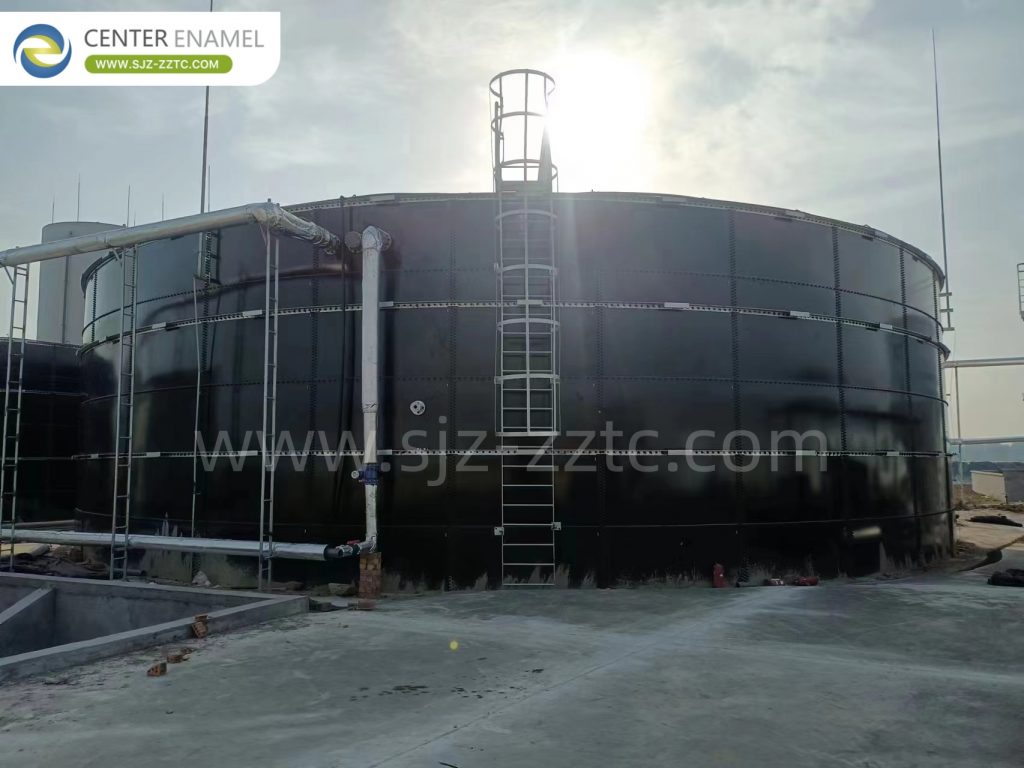
For biogas projects, reliable storage infrastructure is paramount. Glass-Fused-to-Steel (GFS) tanks are manufactured through a high-temperature firing process (820°C–930°C) that fuses glass to steel, creating an inert, inorganic bond . The advantages of GFS tanks in biogas applications are significant:
Superior Corrosion Resistance: The glass coating resists aggressive hydrogen sulfide, acidic compounds, and pH conditions ranging from 1 to 14, ensuring a service life exceeding 30 years with minimal maintenance .
Gas and Liquid Impermeability: The fused glass coating creates a gas-tight seal essential for preventing odor and greenhouse gas leakage, with zero permeability rating .
Modular, Rapid Installation: Bolted panel construction enables fast onsite assembly without large cranes or scaffolding, cutting project durations .
Low Maintenance: The non-porous, smooth enamel surface resists sludge deposits and biofilm formation, reducing cleaning frequency .
Double Membrane Roof
For biogas storage, the Double Membrane Roof integrates the gas holder directly on top of the tank, eliminating the need for separate ground-mounted gas holders and saving valuable land area . Its leak-proof design ensures safe and efficient biogas storage.
Comprehensive Biogas Project Solutions
Center Enamel: A Leader in Biogas Projects
Center Enamel has emerged as a premier EPC Contractor in sustainable energy, with over 36 years of experience, a 150,000㎡ R&D and production base, and an annual production capacity of 250,000 tank sheets . As a full-service provider, Center Enamel delivers turnkey biogas solutions covering the entire project lifecycle—from feasibility studies and process engineering to equipment manufacturing, installation, and commissioning .
Center Enamel's expertise spans across more than 100 countries, with successful projects in applications ranging from agricultural biogas plants and municipal wastewater treatment facilities to industrial organic waste processing . Their solutions are engineered to withstand diverse climates, ensuring long-term reliability . The company's GFS tanks meet rigorous international standards including ISO 9001, NSF/ANSI 61, AWWA D103-09, and EN/ISO 28765, providing assurance of quality and safety .
Conclusion
Managing food waste in restaurants requires a multi-layered approach: prevention through smart purchasing and AI monitoring, recovery through donation and upcycling, and advanced conversion through biogas technology. While prevention remains the most important strategy, biogas offers a compelling solution for waste that cannot otherwise be recovered. By harnessing the CSTR Process within durable GFS Tanks and relying on experienced EPC Contractor expertise, restaurants can transform food waste from a cost burden and environmental liability into a renewable energy asset. Center Enamel stands ready to support this transition, delivering robust, efficient, and cost-effective solutions for sustainable food waste management.
Frequently Asked Questions (FAQ)
Q1: What is the most effective method for restaurants to reduce food waste?
Source prevention through AI-based waste tracking and inventory management is most effective. Studies show data-driven interventions can achieve 23–51% reductions in food waste, primarily by addressing overproduction and improving purchasing decisions .
Q2: How does biogas conversion from restaurant food waste work?
Food waste is processed in a CSTR (Continuous Stirred-Tank Reactor) where anaerobic microorganisms break down organic matter at constant temperature, producing methane-rich biogas for electricity, heating, or cooking, while the remaining digestate serves as organic fertilizer .
Q3: What makes GFS Tanks suitable for restaurant biogas projects?
GFS Tanks provide exceptional corrosion resistance against aggressive biogas gases (hydrogen sulfide, acidic compounds), zero gas permeability, >30-year lifespan with minimal maintenance, and modular installation that reduces construction time and costs .