
How to Plan a Sludge Treatment Project
A sludge treatment project turns the solids removed from wastewater into a stable, safe, transportable form through thickening, digestion (often anaerobic), dewatering, and storage. For a B2B buyer the deciding factors are the sludge volume and character, the stabilization route, and—critically—tank quality, because sludge tanks hold putrescible, gas-bearing, corrosive material that must never leak.
Step 1 – Thickening
Gravity or dissolved-air thickening raises solids content from ~0.5–1% to 3–6%, cutting downstream tank volume and digester heating load. Good thickening directly lowers capital and operating cost of the whole project.
Step 2 – Stabilization (Digestion)
Anaerobic digestion at mesophilic 35–38°C stabilizes sludge and yields biogas (55–65% CH₄) at roughly 0.30–0.45 m³ per kg COD removed; aerobic digestion or lime stabilization are alternatives for smaller plants. Digested sludge is far safer to handle and store.
Step 3 – Dewatering and Storage
Belt press, centrifuge, or filter press dewater digested sludge to 15–25% solids, then it is stored in sealed, corrosion-resistant tanks or silos before land application or disposal. Storage tanks must resist H₂S and acidic condensate.
| Step | Goal | Typical equipment | Output |
| Thickening | raise TS to 3–6% | gravity / DAF | concentrated sludge |
| Digestion | stabilize + biogas | anaerobic digester | biogas + stabilized sludge |
| Dewatering | TS 15–25% | centrifuge / belt | cake |
| Storage | hold cake safely | sealed GFS tank | ready for use |
Technical Considerations
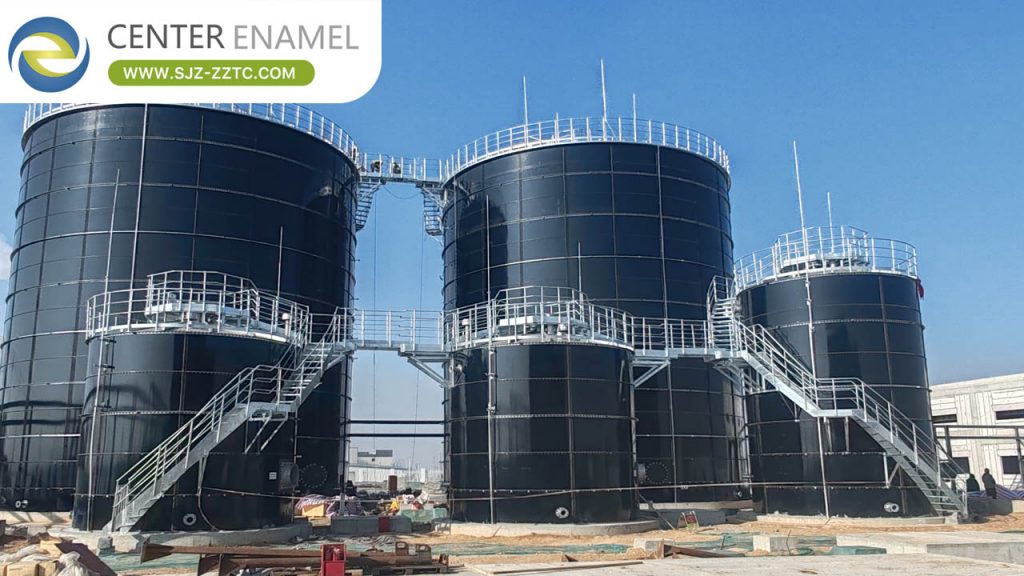
Sludge tanks see continuous corrosion from H₂S, variable pH, and thermal cycling. Bolted Glass-Fused-to-Steel (GFS) with the glass fused at 820–930°C gives an inert, impermeable barrier. Size equalization and digestate/sludge holding to cover maintenance and winter gaps; manage grit to protect seals.
Why Quality Control Decides Project Success
A sludge tank leak is an environmental and permit failure, not just a repair. Quality control—material traceability, enamel continuity testing, bolt-torque verification, and hydrostatic testing—is what separates a tank that lasts 20+ years from one that fails early. For a sludge treatment project, verified quality is non-negotiable.
How to Scope the Project
Confirm dry-solids production rate, target stabilization (anaerobic vs aerobic), dewatering target, and storage days; then size thickener, digester, dewatering, and storage tanks, specifying corrosion-resistant material and QA. A dry-tonnes-per-day figure lets suppliers quote accurately.
Project Case Study
Pharmaceutical Wastewater Treatment in Jiangdong. A high-salinity pharmaceutical plant with 6 granular-sludge anaerobic reactors (12.66 × 24 m each, 1,000 m³/day), achieving ≥70% COD removal under salt up to 6,000 mg/L. It shows quality-controlled anaerobic tankage handling difficult, sludge-generating industrial wastewater.
| Project | Pharmaceutical Wastewater Treatment in Jiangdong |
| Location | Xiaoshan District, Hangzhou, China |
| Industry | Pharmaceutical |
| Application | High-salinity industrial wastewater |
| Product | Granular sludge anaerobic reactors |
| Capacity | 1,000 m³/day |
| Quantity | 6 sets, 12.66 × 24 m |
| Material | Glass-Fused-to-Steel (GFS) |
| Standards | ISO 28765 |
| Status | Delivered 2019, ≥70% COD removal |
About Center Enamel
Center Enamel demonstrates its quality control discipline through controlled enamel-firing lines (glass fused to steel at 820–930°C), material traceability, and documented inspection—ISO 9001 certified, with ISO 28765 / AWWA D103 tank design and CE/EN 1090 structural marking. For sludge treatment projects the company supplies sealed, corrosion-resistant GFS thickener, digester, and storage tanks built and verified to survive continuous H₂S-laden duty.
Advantages and Limitations
Anaerobic sludge digestion recovers biogas and stabilizes solids; dewatering cuts transport cost. Limits: digestion needs steady feed and heat; dewatering polymer cost is recurring; and tank quality must be verified to avoid leaks. Skimping on QA is the most common failure.
Comparison: Tank Materials for Sludge
| Material | Corrosion resistance | Life | Note |
| GFS (enameled steel) | high (inert glass) | 20+ yr | best for sludge |
| Epoxy-coated steel | good | 15–20 yr | field-applied risk |
| Concrete | variable | long | porous, cracks |
| Stainless steel | very high | long | high cost |
A sludge treatment project runs thickening → digestion → dewatering → storage. Specify sealed, corrosion-resistant GFS tanks and verified quality control; anaerobic digestion at 35–38°C also returns biogas (55–65% CH₄) and stabilizes the sludge safely.
Frequently Asked Questions (FAQ)
Q1: How do you plan a sludge treatment project?
A: Confirm dry-solids rate, pick stabilization (anaerobic/aerobic), set dewatering target and storage days, then size and specify corrosion-resistant tanks with verified QA.
Q2: Which tank is used for sludge?
A: Sealed, corrosion-resistant GFS thickener, digester, and storage tanks resist H₂S; concrete cracks and plain steel corrodes.
Q3: What does anaerobic digestion give?
A: Stabilized sludge plus biogas (55–65% CH₄) at ~0.30–0.45 m³/kg COD removed, at mesophilic 35–38°C.
Q4: Why does quality control matter?
A: A sludge tank leak is a permit failure; enamel continuity, torque, and hydrostatic testing ensure 20+ year life.
Q5: What standards apply?
A: GFS tanks to ISO 28765 / AWWA D103, ISO 9001 quality, CE/EN 1090 marking.
Q6: What capacity is available?
A: GFS tanks from 200 m³ to 60,000 m³, modular for sludge and digestate storage.
Share your dry-solids rate, stabilization route, and storage days. We will size GFS thickener, digester, and storage tanks with verified quality control and confirm standards for your sludge treatment project.