
How to Recycle Animal Waste? A Complete Guide to Farm Waste Management & Biogas Solutions
For livestock farmers worldwide, animal waste is an unavoidable reality. A single dairy cow produces approximately 60–80 pounds of manure daily. A pig farm with 5,000 head generates tens of thousands of gallons of slurry each week. For decades, farmers have treated this waste as a disposal problem-storing it in lagoons, spreading it on fields, or paying for off-site removal. But these methods create odor complaints, groundwater contamination, and greenhouse gas emissions.
The better question is not “How do we get rid of animal waste?” but rather “How to recycle animal waste into valuable resources?” The answer lies in modern anaerobic digestion technology. When properly recycled, animal manure becomes renewable energy (biogas) and organic fertilizer (digestate)-turning an environmental liability into a profit center. This article provides a complete, practical guide to recycling animal waste, from basic principles to turnkey solutions from Center Enamel.
What Does It Mean to Recycle Animal Waste?
Before explaining how to recycle animal waste, it helps to define the term. Recycling animal waste means converting raw manure, urine, bedding, and wash water into useful products instead of simply discarding it. Unlike traditional disposal (which focuses on getting waste off the farm), recycling creates value:
Biogas (methane and CO₂) for electricity, heat, or vehicle fuel
Digestate (liquid and solid fractions) for organic fertilization
Separated solids for animal bedding or compost
Successful recycling captures the energy and nutrients embedded in animal waste while eliminating the environmental negatives of raw manure.
Step 1: Collection and Pretreatment of Animal Waste
The first step in how to recycle animal waste is efficient collection and preparation. Different farm systems require different approaches:
For swine and dairy farms with slurry systems: Manure and urine are flushed or scraped into collection channels, then pumped to a homogenization tank. This tank balances flow rates and solids content, ensuring a consistent feedstock for the digester.
For poultry farms with litter: Bedding material (rice hulls, wood shavings) mixed with manure is collected and may require crushing or maceration to reduce particle size before digestion.
Pretreatment equipment includes:
Screens to remove stones, plastic, rope, and other debris
Crushers to break down large organic particles
Sand settlers to extract heavy grit that would damage pumps
Homogenization tanks to mix and balance incoming waste
Without proper pretreatment, recycling animal waste becomes inefficient-pumps clog, digesters fill with sand, and biogas yields drop.
Step 2: Anaerobic Digestion – The Core Recycling Technology
The most effective method for how to recycle animal waste is anaerobic digestion (AD) . AD uses naturally occurring bacteria to break down organic matter in an oxygen-free environment. The process produces biogas and digestate.
The most reliable anaerobic digestion technology for animal waste is the CSTR Process (Continuous Stirred-Tank Reactor).
What is the CSTR Process?
CSTR stands for Continuous Stirred-Tank Reactor. In this system, pretreated animal waste is fed continuously (or semi-continuously) into a sealed, heated tank equipped with mechanical stirrers. The stirrers keep the material constantly mixed, preventing solids from settling and scum from forming on top. The temperature is maintained at 35–37°C (mesophilic range) for optimal bacterial activity.
Why the CSTR Process Excels at Recycling Animal Waste
| Challenge with Animal Waste | How CSTR Solves It |
| High solids content | Mixing keeps particles suspended |
| Sand and grit | Continuous agitation prevents accumulation |
| Variable feed composition | Homogenization + mixing handles fluctuations |
| Temperature sensitivity | Heated tank with insulation maintains stability |
| Scum layer formation | Mechanical stirrers break surface tension |
The CSTR Process achieves 50–70% volatile solids destruction, meaning most of the organic matter that would otherwise produce methane in open lagoons is converted into usable biogas.
Step 3: Biogas Collection and Storage
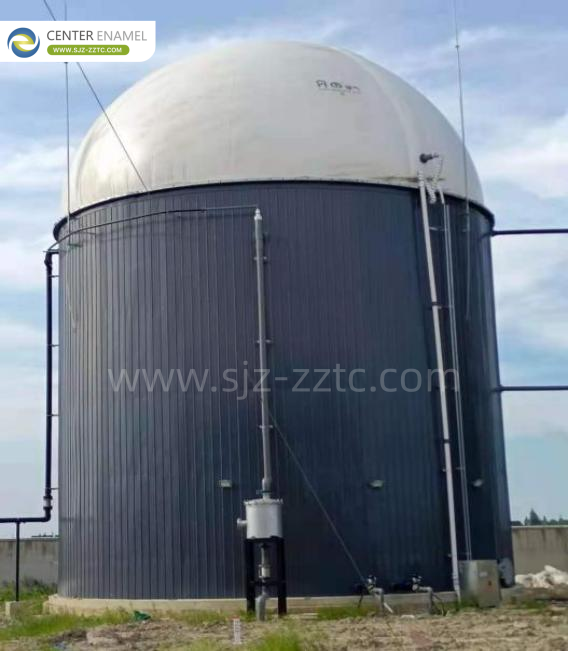
Once biogas is produced inside the digester, it must be collected and stored safely. This is where GFS Tanks and Double Membrane Roofs become essential.
GFS Tanks (Glass-Fused-to-Steel) are bolted steel panels coated with a glass layer fired at high temperature. The result is a smooth, non-porous, corrosion-resistant surface that withstands the aggressive environment inside a digester (hydrogen sulfide, organic acids, ammonia). GFS tanks do not crack, leach, or require frequent recoating-making them ideal for long-term animal waste recycling.
Double Membrane Roofs sit atop the GFS tank. The outer membrane protects against weather; the inner membrane creates a gas-tight seal. The space between them is pressurized with air, giving the roof its dome shape. This integrated design eliminates the need for a separate ground-mounted gas holder, saving land and foundation costs.
For extreme weather locations (high winds, heavy snow loads), Center Enamel also offers a GFS roof option.
Step 4: Biogas Utilization – Turning Gas into Value
Recycled biogas can be used in several ways:
Electricity generation: Biogas fuels a generator or combined heat and power (CHP) unit. Electricity powers farm operations or is sold to the grid.
Direct heat: Biogas burns in boilers to produce hot water or steam for barn heating, milk pasteurization, or equipment cleaning.
Upgraded biomethane: Purified biogas (removing CO₂ and H₂S) becomes pipeline-quality natural gas or vehicle fuel.
Most livestock farms start with electricity generation, using waste heat from the generator to maintain digester temperature.
Step 5: Digestate Management – The Second Valuable Output
After the CSTR Process completes its cycle (typically 20–30 days retention time), the remaining material is called digestate. Digestate is not raw manure-it is stabilized, low-odor, and pathogen-reduced. It contains the same nutrients (nitrogen, phosphorus, potassium) as raw manure but in a more plant-available form.
Digestate can be:
Separated into solid and liquid fractions using a solid-liquid separator
Solid fraction used as animal bedding, compost, or sold as soil conditioner
Liquid fraction applied directly to crops as fertilizer through irrigation systems
This closes the nutrient loop: animal waste becomes fertilizer that grows animal feed.
Complete Equipment for Recycling Animal Waste
A full-scale animal waste recycling system includes more than just a digester. Center Enamel supplies:
| Equipment | Function |
| Gas Holder | Stores biogas to balance supply and demand |
| Black Membrane | Lined lagoons for secondary containment or storage |
| Solid-liquid Separator | Divides digestate into solid and liquid fractions |
| Torch System | Safely burns excess biogas when not needed |
| Lifting Pump | Transfers waste between treatment stages |
| Dehydration & Desulfurization Tank | Removes moisture and H₂S to protect downstream equipment |
| Screw Sludge Dewatering Machine | Reduces sludge volume for easier handling |
Efficient Installation: From Planning to Operation
How to recycle animal waste is not just a technical question-it is also a logistical one. Farms cannot afford months of construction delays. Center Enamel’s bolted GFS Tanks are prefabricated in a 150,000 m² production facility and shipped in standardized containers. On-site assembly requires no welding-only bolting and sealing. A complete anaerobic digestion system can be erected in weeks, not months.
Center Enamel provides:
On-site or remote technical supervision
Commissioning support
Hands-on training for farm operators
After-sales support and spare parts
For remote farms or regions with limited skilled labor, this modular approach is a decisive advantage.
Center Enamel: One-Stop Biogas Solutions for Recycling Animal Waste
Center Enamel is not just a tank manufacturer-it is a one-stop solution provider for complete Biogas Solutions systems. With over 36 years of experience, Asia’s largest GFS tank production capacity (250,000 sheets/year), and exports to more than 100 countries, Center Enamel delivers turnkey EPC services.
What Center Enamel provides:
Feasibility studies and financial modeling
Process engineering and equipment design
Manufacturing of GFS tanks, roofs, and all auxiliary equipment
On-site installation and commissioning
Operator training and long-term support
Center Enamel’s certifications (CE/EN1090, ISO9001, NSF61, WARS, EN28765) and design standards (AWWA D103, OSHA, EuroCode) guarantee quality and safety.
Conclusion
The question “How to recycle animal waste?” has a clear, proven answer: anaerobic digestion using the CSTR Process, housed in durable GFS Tanks with Double Membrane Roofs, supported by a full range of auxiliary equipment. This method transforms manure from an environmental burden into renewable energy and organic fertilizer. Farms reduce electricity costs, eliminate odor complaints, comply with environmental regulations, and create new revenue streams.
Center Enamel provides complete, turnkey Biogas Solutions that make animal waste recycling practical, profitable, and sustainable. For farmers, cooperatives, and project developers worldwide, choosing Center Enamel means choosing a certified, experienced partner.
FAQ
Q1: Can all types of animal waste be recycled using the same system?
A1: Most animal waste types (cattle, pig, poultry, sheep, goat) can be recycled using the CSTR Process. However, adjustments are needed. Poultry litter requires careful ammonia management. Dairy waste with sand bedding needs additional sand removal pretreatment. Center Enamel customizes each system based on the specific waste composition, ensuring optimal biogas yield and equipment longevity.
Q2: How much space is needed to install an animal waste recycling system?
A2: Space requirements depend on farm size and waste volume. A system for 2,000 pigs typically requires approximately 300–500 m² for the digester, pretreatment area, and auxiliary equipment. The double membrane roof eliminates the need for a separate gas holder, reducing footprint by 30–40% compared to traditional designs. Center Enamel provides a site-specific layout during the feasibility study.
Q3: Is the recycled digestate safe to use on food crops?
A3: Yes, with proper processing. The CSTR Process reduces pathogen levels significantly (meeting or exceeding EPA Class A or Class B biosolids standards depending on retention time and temperature). The resulting digestate is stabilized, low-odor, and safe for use on food crops when applied according to agronomic rates. Many organic farms use digestate as a certified input for vegetable and grain production. Center Enamel can design systems to meet specific pathogen reduction requirements.