
How to Scope a Wastewater Treatment Project
A wastewater treatment project is scoped by first fixing the design flow and discharge (or reuse) limit, then selecting the process train, and finally customizing the tank package to capacity, climate, and duty. For a B2B buyer the tank package is rarely off-the-shelf: diameters, heights, roofs, linings, and accessories must match the process, site, and standard—which is where bolted-tank customization pays off.
Define Flow and Limit
Start with average and peak daily flow and the target effluent (e.g. COD ≤100 mg/L for municipal, or industry-specific limits). These two numbers size every reactor and clarifier downstream and are the basis for any supplier quote.
Pick the Process Train
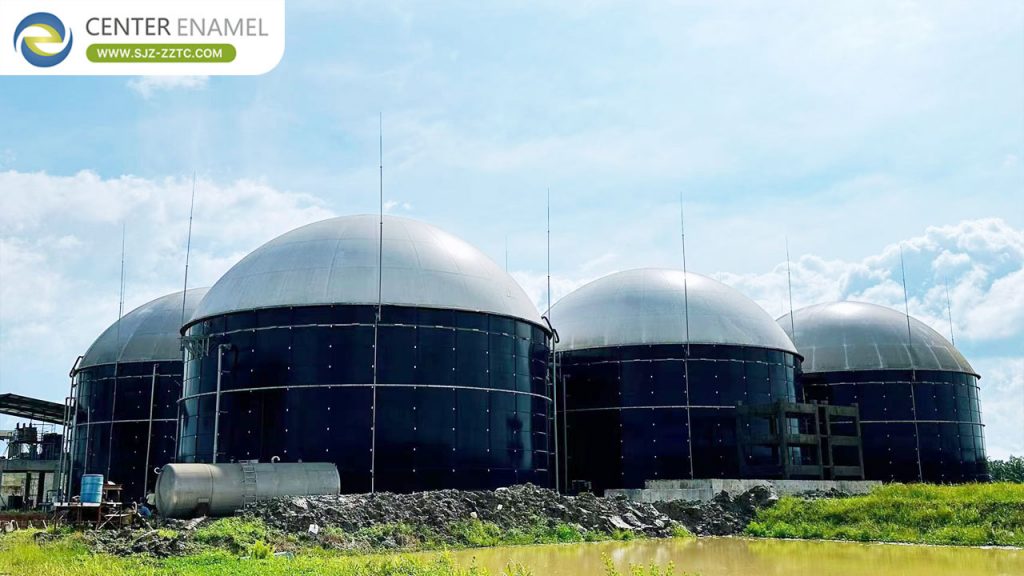
Municipal plants use activated sludge / SBR / A²/O; industrial plants add anaerobic front-ends (UASB) for high COD. A palm-oil ETP in Indonesia used 3 GFS anaerobic reactors (two sizes: Φ 17.58 × 8.4 m and Φ 16.82 × 7.2 m) for POME—showing how tank dimensions follow the process.
| Flow band | Typical process | Tank focus |
| < 500 m³/d | SBR / package | compact GFS |
| 500–5,000 m³/d | A²/O + anaerobic | modular GFS |
| > 5,000 m³/d | conventional + anaerobic | large GFS 60,000 m³ |
Customize the Tank Package
Bolted Glass-Fused-to-Steel tanks are customized by diameter and height (standard shell modules), roof type (aluminum dome, membrane, fixed), lining grade (by corrosion species), and accessories (mixers, nozzles, manways, heaters). Cold climates add insulation; high salinity needs a verified enamel grade.
Technical Considerations
Specify tank material by the most aggressive species (acid, salt, H₂S); keep GFS glass fused at 820–930°C for an inert barrier; confirm standards (ISO 28765 / AWWA D103, ISO 9001, CE/EN 1090). Plan transport and crane access for site assembly; modular bolts speed deployment.
How to Scope Efficiently
Provide a one-page brief: flow, influent/effluent, process preference, site constraints, and standards. Suppliers then return a customized tank schedule (sizes, quantities, materials, accessories) and delivery plan—no generic catalog guesswork.
Project Case Study
Indonesia Biogas Project — Anaerobic Reactors. Three GFS anaerobic reactors (two different diameters) for a palm-oil ETP, demonstrating process-driven tank customization: Φ 17.58 × 8.4 m and Φ 16.82 × 7.2 m, supplied as a coordinated package for POME digestion.
| Project | Indonesia Biogas Project — Anaerobic Reactors |
| Location | Indonesia |
| Industry | Palm Oil |
| Application | Palm oil ETP anaerobic digestion |
| Product | 3 GFS anaerobic tanks (custom sizes) |
| Capacity | Φ 17.58 × 8.4 m + Φ 16.82 × 7.2 m |
| Material | Glass-Fused-to-Steel (GFS) |
| Standards | ISO 28765 |
| Status | Delivered 2013 |
About Center Enamel
Center Enamel demonstrates its customization capability through bolted GFS tanks made from standard shell modules that are combined into site-specific diameters, heights, roof types, and lining grades. For wastewater treatment projects the company tailors digester, equalization, reactor, and storage tanks to the process flow, climate (insulation for cold sites), and corrosive duty—engineered to ISO 28765 / AWWA D103, ISO 9001, CE/EN 1090, with capacities 200–60,000 m³.
Advantages and Limitations
Custom bolted GFS packages fit the process exactly, speed installation, and resist corrosion. Limits: very large or non-standard geometries need engineering review; extreme duty may require special enamel or stainless. A clear brief removes guesswork.
Comparison: Custom Bolted vs Concrete
| Option | Lead time | Corrosion | Flexibility |
| Bolted GFS (custom) | short | high | high (modular) |
| Concrete (cast) | long | variable | low |
| Welded steel | medium | needs coating | medium |
Scope a wastewater treatment project by flow and limit, pick the process, then customize the bolted GFS tank package to capacity, climate, and duty. Standard shell modules become site-specific diameters, roofs, and linings engineered to ISO 28765 / AWWA D103, 200–60,000 m³.
Frequently Asked Questions (FAQ)
Q1: How do you scope a wastewater treatment project?
A: Fix design flow and discharge limit, select the process train, then customize tank diameters, heights, roofs, and linings to duty and site.
Q2: Can tanks be customized?
A: Yes—bolted GFS uses standard modules combined into site-specific sizes, roof types, and lining grades.
Q3: What capacity is available?
A: GFS tanks from 200 m³ to 60,000 m³, modular and relocatable.
Q4: What standards apply?
A: ISO 28765 / AWWA D103 design, ISO 9001 quality, CE/EN 1090 marking.
Q5: Which process for industrial WWTP?
A: Add an anaerobic front-end (UASB) for high COD; municipal uses A²/O / SBR.
Q6: What does a supplier need to quote?
A: Flow, influent/effluent, process preference, site constraints, and standards—a one-page brief.
Send your one-page brief (flow, limit, process, site, standards). We will return a customized GFS tank schedule with sizes, quantities, linings, and delivery for your wastewater treatment project.