
How to Treat Dairy Wastewater?
The dairy industry generates massive volumes of high-concentration organic wastewater every day, becoming one of the most typical pollution sources in the food processing sector. Many dairy factories face challenges such as excessive COD, BOD, oil content, suspended solids and nutrient compounds in wastewater. Without scientific treatment, dairy wastewater will cause river eutrophication, groundwater contamination, odor pollution and ecological damage. Therefore, learning how to treat dairy wastewater correctly is essential for dairy enterprises to meet environmental discharge standards, reduce operation costs and realize resource recycling.
Sources and Characteristics of Dairy Wastewater
Dairy wastewater mainly comes from multiple production links in milk processing plants. The primary sources include raw milk tank cleaning, production line flushing, equipment sterilization, workshop floor cleaning, cheese and yogurt processing wastewater, as well as whey wastewater produced during dairy production.
Dairy wastewater features high organic concentration, high fat and protein content, large fluctuations in water volume and water quality, and variable pH values. It has high COD and BOD levels, rich nitrogen, phosphorus and suspended solids, and is easily deteriorated and fermented to produce unpleasant odors. These characteristics make dairy wastewater difficult to treat by conventional single-process methods, requiring a combined process of pretreatment, anaerobic treatment, aerobic treatment and advanced purification.
Complete Dairy Wastewater Treatment Process
A standard dairy wastewater treatment flow adopts the classic route: Pretreatment → Equalization → Oil Separation & Air Flotation → Anaerobic Treatment → Aerobic Treatment → Sedimentation & Advanced Disinfection.
Pretreatment and Screening: Large suspended impurities such as plastic debris, plant residues and milk clot are intercepted through mechanical bar screens to protect subsequent pumps and reactor equipment from blockage and abrasion.
Water Quality and Quantity Equalization: Wastewater flows into the equalization tank to balance the fluctuation of daily water volume and organic concentration, stabilizing water quality for subsequent biological treatment and avoiding impact load on anaerobic and aerobic systems.
Oil Separation and Dissolved Air Flotation (DAF): Dairy wastewater contains a large amount of milk fat and emulsified oil. The oil separation tank and DAF system effectively remove floating oil, suspended solids and partial colloidal organic matter, greatly reducing COD load for the follow-up anaerobic unit.
Core Anaerobic Biological Treatment: As the key stage of dairy wastewater treatment, anaerobic digestion decomposes macromolecular organic matter into small molecules under oxygen-free conditions, efficiently removing most COD and BOD, and meanwhile producing renewable biogas for energy recovery. This is the most economical and energy-saving core link in the whole process.
Aerobic Biological Treatment: The effluent from the anaerobic reactor enters the aerobic system to further degrade residual organic pollutants, ammonia nitrogen and phosphorus, making the water quality preliminarily reach discharge standards.
Secondary Sedimentation and Advanced Treatment: Sludge and water are separated in the sedimentation tank. After disinfection and advanced filtration, the final effluent can be discharged up to standard or reused for factory cleaning. The excess sludge is concentrated and dehydrated for subsequent resource disposal.
Four Mainstream Anaerobic Technologies for Dairy Wastewater Treatment
Anaerobic technology is the core of how to treat dairy wastewater efficiently. Center Enamel, as a professional wastewater treatment EPC contractor, provides four mature anaerobic reactors perfectly adapted to different dairy plant scales, wastewater concentration and site conditions.
1. CSTR (Completely Stirred Tank Reactor)
CSTR is the most widely used anaerobic technology for high-solids and high-concentration dairy wastewater. Equipped with a mechanical stirring system, it realizes full mixing of wastewater and anaerobic sludge, preventing surface crusting and sedimentation. It features strong impact load resistance and stable operation, especially suitable for large dairy factories with high-fat and high-protein wastewater and whey wastewater treatment.
2. USR (Upflow Solids Reactor)
USR adopts an upflow solid retention design without mechanical stirring. It has a simple structure, low energy consumption and convenient maintenance. It is ideal for medium and small-scale dairy plants and scattered dairy processing workshops, with low construction and operation costs and stable organic matter removal effect.
3. UASB (Upflow Anaerobic Sludge Blanket)
UASB is a globally proven cost-effective anaerobic process for medium and low-concentration dairy wastewater. Wastewater flows upward through the high-density granular sludge blanket, achieving efficient degradation of organic pollutants. It has high volumetric loading, low operating cost and strong stability, widely applied in conventional dairy production wastewater treatment projects.
4. IC (Internal Circulation) Reactor
IC is an advanced high-rate anaerobic technology driven by biogas internal circulation. Its treatment load is 3–5 times that of traditional anaerobic reactors, with a compact footprint and excellent COD removal efficiency. It is the preferred choice for large-scale modern dairy industrial parks and land-scarce projects pursuing maximum treatment efficiency and biogas energy recovery.
Core Advantages of Center Enamel in Dairy Wastewater Treatment
As a leading EPC solution provider for dairy wastewater treatment, Center Enamel has irreplaceable comprehensive strengths in process design, equipment manufacturing and project implementation.
First, customized process matching. According to the actual water quality, water volume, plant scale and local discharge standards of dairy enterprises, we flexibly select and combine CSTR, UASB, USR and IC anaerobic technologies to design the most cost-effective treatment scheme.
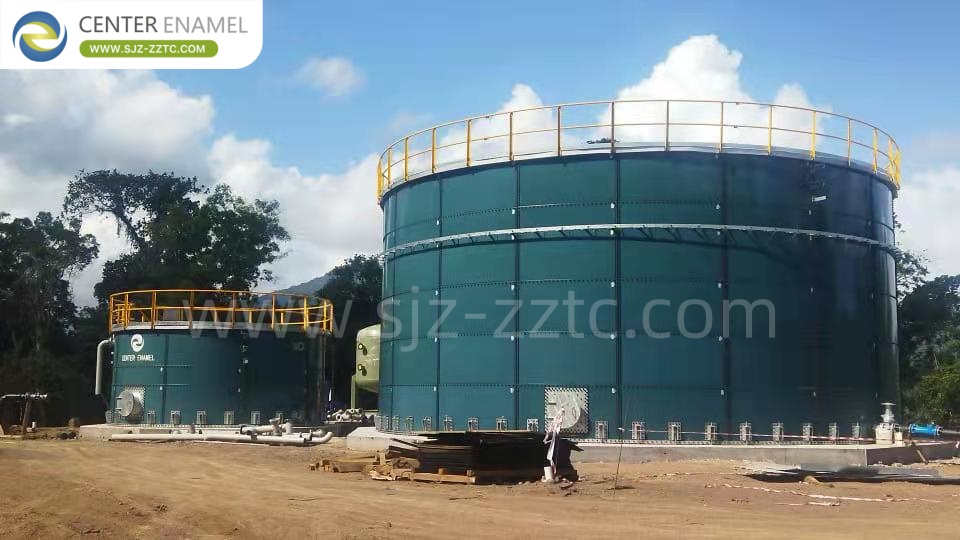
Second, high-performance anti-corrosion GFS Tanks. Dairy wastewater contains fat, protein and corrosive organic substances. Center Enamel’s Glass-Fused-to-Steel (GFS) tanks feature full pH resistance (1–14), strong anti-corrosion, UV and seismic stability, perfectly adapting to long-term corrosion of dairy wastewater. With bolted assembly, fast installation and a service life of over 30 years, GFS tanks are far superior to concrete and traditional welded tanks.
Third, full lifecycle EPC service. We provide one-stop services including process design, equipment manufacturing, civil construction, installation, commissioning and after-sales maintenance, minimizing project investment risks and operation difficulty for dairy clients.
Fourth, energy recycling and economic benefits. The anaerobic system efficiently converts organic pollutants into biogas, which can be used for power generation, heating and factory energy supply, helping dairy plants realize energy self-sufficiency and reduce production costs. The digested sludge can be made into organic fertilizer to achieve circular economic development.
Treating dairy wastewater scientifically requires a complete combined process of pretreatment, anaerobic core treatment and advanced purification. Choosing suitable anaerobic technologies including CSTR, UASB, USR and IC is the key to stable effluent and cost control. Center Enamel integrates mature dairy wastewater treatment process, high-efficiency anaerobic technologies and durable GFS tank equipment, delivering tailored turnkey EPC solutions for global dairy enterprises. It not only helps factories meet environmental discharge standards, but also realizes biogas energy recovery and waste resource utilization, achieving a win-win of environmental protection and economic benefits.