
IC Anaerobic Reactors for Pre-treatment of Alcohol Industry Wastewater | Center Enamel
The alcohol production industry-spanning breweries, distilleries, and liquor manufacturers-generates wastewater streams with exceptionally high organic loads that challenge conventional treatment systems. Chemical oxygen demand (COD) levels in alcohol wastewater can range from 5,000 to 25,000 mg/L, with high-strength spent mash and still bottoms peaking far higher . Effective pre-treatment is not optional; it is the foundation of environmental compliance, operational cost control, and resource recovery. Center Enamel’s Internal Circulation (IC) anaerobic reactors are engineered specifically for this demanding application, combining third-generation high-rate anaerobic technology with glass-fused-to-steel (GFS) containment for durability and performance.
Why Alcohol Wastewater Demands Specialized Pre-treatment
Alcohol production wastewater differs from typical industrial effluent in ways that directly dictate technology selection. The pollutants are primarily natural organics-starches, reducing sugars, proteins, and residual alcohols-with a BOD/COD ratio reaching 0.5–0.6, making the stream highly biodegradable but also highly concentrated . Suspended solids can reach up to 40,000 mg/L, and pH typically sits in the slightly acidic range of 3–5 .
The operational reality is equally challenging: production is batch-driven and seasonal, producing sharp swings in hydraulic flow, organic loading, and pH from cleaning-in-place (CIP) chemicals. Traditional aerobic treatment alone would require enormous aeration energy, generate excessive sludge, and struggle to absorb these shock loads. Anaerobic pre-treatment is the technically sound and economically rational first step.
The IC Process: How Internal Circulation Changes the Equation
The IC reactor is the third-generation evolution of high-rate anaerobic technology, building upon the UASB concept with a defining innovation: a self-regulating internal circulation loop driven by biogas, requiring no external return pumps .
In operation, wastewater enters the lower reaction zone and mixes with recirculated sludge-water. Anaerobic microorganisms degrade the organic load, producing biogas. The gas-lift effect carries the mixed liquor upward to a gas-liquid separator, where biogas is collected. The degassed mixture returns by gravity through downcomers to the reactor bottom, creating continuous internal circulation . This design delivers three critical advantages for alcohol wastewater:
Superior mass transfer and shock tolerance. The high upflow velocity maintains intimate contact between biomass and substrate, preventing dead zones and enabling the reactor to absorb organic and hydraulic shock loads that would destabilize conventional systems .
Compact footprint with high loading capacity. The IC reactor maintains high concentrations of active granular biomass, handling organic loading rates three to five times higher than standard anaerobic systems within a vertical, space-efficient vessel .
Biogas recovery as a revenue offset. Up to 80% of removed COD is converted to methane-rich biogas, which can be captured for boiler fuel or power generation, directly reducing plant energy costs .
Project Overview: Sichuan Liquor Wastewater Treatment, China
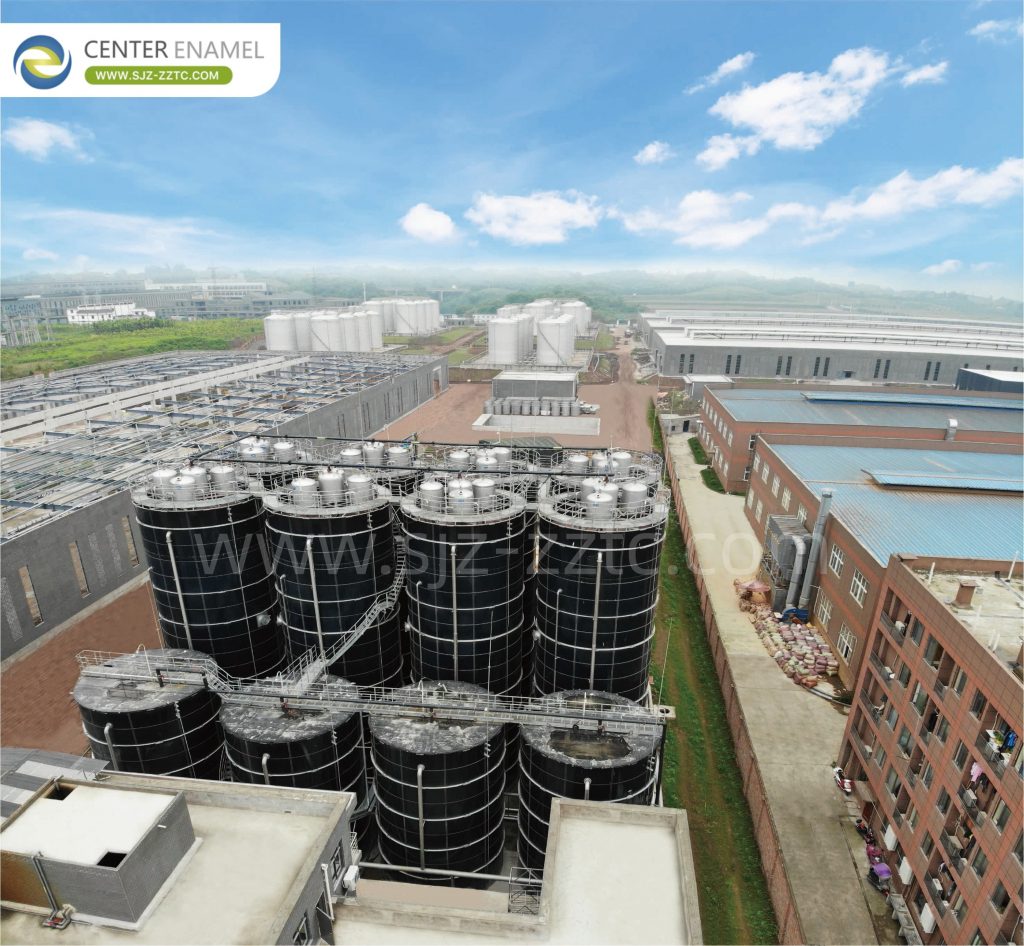
Center Enamel’s IC anaerobic reactor technology has been deployed in a high-profile project in the Chishui River Basin, a region renowned for premium Chinese liquor production. The Sichuan Brewery Wastewater Treatment Project addresses the critical need to protect the Chishui River-the “Wine River”-from the high-strength effluent generated by local distillery operations .
Scope of Work. Center Enamel served as the environmental protection EPC and anaerobic process section provider, delivering a customized treatment solution designed to accommodate the specific water quality characteristics of the facility: high influent pollutant concentrations, large COD concentration spans, significant fluctuations in water volume, and high impact loading on the treatment system . The scope encompassed anaerobic reactor design, GFS tank manufacturing, equipment integration, and commissioning support.
Technologies Used. The core anaerobic process utilizes Center Enamel’s IC reactor design housed within glass-fused-to-steel containment. The GFS panels are factory-coated with vitreous enamel fused to steel at approximately 800–850°C, creating a chemically inert, corrosion-resistant barrier that withstands the organic acids, sulfides, and humid biogas environment inherent to anaerobic digestion . The modular bolted design enables rapid field assembly in space-constrained industrial settings.
Project Results. Upon commissioning, the system meets the facility’s sewage collection and treatment requirements, ensuring effluent quality complies with mandated discharge standards. The project represents a significant contribution to protecting the ecological environment of the Chishui River Basin, demonstrating that high-strength distillery wastewater can be treated effectively within a compact industrial footprint .
Client Testimonial. (Representative of Center Enamel’s project delivery model) “The IC anaerobic solution provided by Center Enamel addressed our dual priorities: reliable compliance and operational efficiency. The compact reactor design integrated smoothly into our existing production infrastructure, and the biogas recovery has reduced our auxiliary fuel consumption.” - Project representative, Sichuan liquor production facility.
Performance Data: IC Reactor vs. Conventional Alternatives
| Performance Metric | IC Anaerobic Reactor (Center Enamel GFS) | Conventional UASB Reactor | Aerobic Activated Sludge |
| Organic Loading Capacity | Very High (handles distillery COD peaks with ease) | Moderate | Low to Moderate |
| Footprint Requirement | Compact (tall vertical design) | Moderate | Very Large (extensive aeration basins) |
| Energy Balance | Net energy producer (biogas recovery) | Low consumption | Very High (continuous mechanical aeration) |
| Shock Load Tolerance | High (internal circulation buffers pH and concentration spikes) | Moderate | Low (vulnerable to toxic or shock organic loads) |
| COD Removal Efficiency | 80–90% (pre-treatment) | 70–85% | 85–95% (but at high energy cost) |
| Sludge Production | Low (anaerobic digestion minimizes biomass yield) | Low | High (requires sludge handling and disposal) |
Operational Considerations for Alcohol Wastewater IC Reactors
Temperature control. Maintaining mesophilic (30–40°C) or thermophilic (50–60°C) conditions is essential for microbial community stability. Alcohol wastewater often arrives at elevated temperatures from distillation processes, which can be advantageous for thermophilic operation but requires careful heat management and reactor insulation.
Hydraulic retention time (HRT). The reactor must provide sufficient contact time between wastewater and biomass. IC reactors achieve effective treatment at shorter HRTs than conventional systems due to their high biomass retention, but HRT must be tuned to influent characteristics and target removal rates.
Pre-conditioning. Mechanical screening and pH equalization prior to anaerobic digestion improve biodegradability and protect the microbial consortium from extreme pH excursions caused by CIP chemicals.
Co-digestion potential. Where available, co-digesting alcohol wastewater with complementary organic streams can balance the carbon-to-nitrogen ratio and stabilize the microbial environment.
Why Center Enamel: Engineering Depth and Proven Delivery
Center Enamel (Shijiazhuang Zhengzhong Technology Co., Ltd.) brings over 30 years of specialized manufacturing experience and a track record spanning more than 100 countries . The company is uniquely positioned as a single-source provider integrating proprietary enamel frit research, in-house GFS tank manufacturing, and EPC general contracting capability . For alcohol producers, this means:
Precision-engineered containment. GFS panels undergo high-voltage holiday testing to ensure zero-discontinuity in the glass lining, critical for long-term integrity in corrosive anaerobic environments .
Customizable reactor configurations. Designs are adapted to specific wastewater characteristics, site constraints, and discharge requirements.
Full lifecycle support. From feasibility assessment through commissioning and operational guidance, Center Enamel supports the entire project arc.
Frequently Asked Questions (FAQ)
Q: What COD removal efficiency can I expect from an IC anaerobic reactor for alcohol wastewater?
A: Center Enamel IC reactors typically achieve 80–90% COD removal in pre-treatment, converting the majority of removed organic matter into biogas. Final polishing may be required depending on discharge standards .
Q: How does the IC reactor handle the seasonal and batch-driven fluctuations typical of alcohol production?
A: The internal circulation mechanism creates a buffering effect, maintaining high upflow velocity and biomass contact even during shock loads. This design tolerates the organic and hydraulic variability inherent to batch production far better than conventional UASB systems .
Q: What is the footprint advantage of an IC reactor compared to aerobic treatment?
A: IC reactors are vertical, high-rate vessels that treat high-strength wastewater in a fraction of the space required for aerobic basins. This is particularly valuable for facilities with limited plot space or expansion constraints .
Q: Can the biogas produced be used within the alcohol production facility?
A: Yes. The methane-rich biogas can be captured and used as boiler fuel or for power generation, offsetting the facility’s energy consumption and improving overall sustainability performance .
Q: What containment material does Center Enamel use for IC reactors, and why does it matter?
A: Center Enamel uses glass-fused-to-steel (GFS) tanks with vitreous enamel fused at over 800°C. The glass lining is chemically inert and highly resistant to the organic acids and sulfides present in anaerobic digestion, protecting the steel structure and ensuring decades of service life .
Q: Does Center Enamel provide EPC services or only reactor equipment?
A: Center Enamel provides integrated EPC delivery encompassing design, GFS tank manufacturing, equipment supply, and construction support, reducing coordination risk for clients .
Center Enamel’s IC anaerobic reactors represent a proven, engineered solution for the alcohol industry’s most challenging wastewater streams. For facilities seeking to reduce COD load, recover energy, and ensure compliance within a compact footprint, the combination of third-generation IC process design and GFS containment delivers measurable results. Contact Center Enamel to discuss your specific wastewater profile and treatment objectives.