
How Can the IC Process and GFS Tanks Solve the "Three Highs" of Industrial Wastewater Treatment?
Industrial wastewater treatment today is defined by a familiar triad of challenges: high difficulty, high cost, and high energy consumption. Effluent from the new energy, chemical, and pharmaceutical industries is complex in composition, carrying numerous characteristic pollutants that conventional treatment processes struggle to remove effectively. At the same time, increasingly stringent emission standards demand continuous technological upgrading, while new requirements for digitalization and low-carbon transformation place fresh pressure on operational refinement. Addressing these pressures requires more than a single piece of equipment-it requires a coherent pairing of advanced biological process design and durable containment engineering. That is precisely the role played by the IC Process and GFS Tanks in Center Enamel's industrial wastewater portfolio.
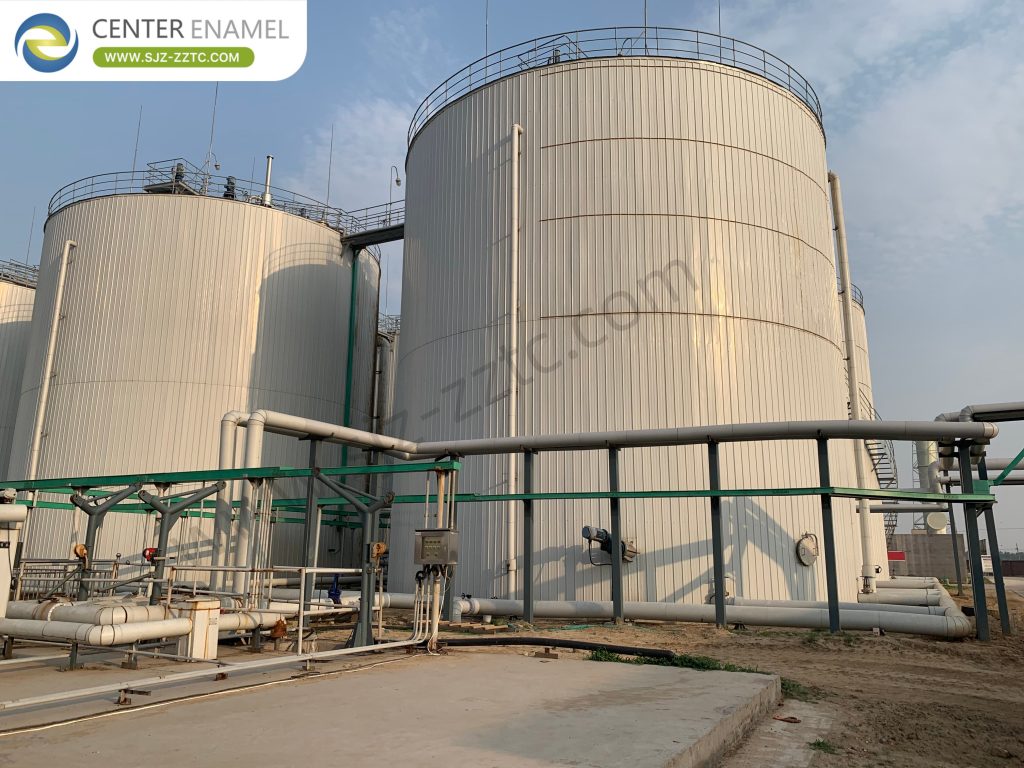
Core Industry Challenges: The Three Highs
The "three highs" framework captures why industrial wastewater is so much harder to treat than municipal sewage. High difficulty stems from complex, variable pollutant profiles. High cost reflects the energy, chemicals, and maintenance demanded by conventional processes. High energy consumption is embedded in aerobic treatment and in the auxiliary equipment that keeps older systems running. Chinese manufacturers have secured significant price advantages in the mid- to low-end equipment segment, but price alone does not resolve the underlying technical challenge. What resolves it is a process architecture that removes organics efficiently in a small footprint while recovering energy rather than consuming it-the design logic behind the IC Process.
GFS Tanks Built for Extreme Climates and Seismic Zones
Process performance means little if the containment structure fails. GFS Tanks can undergo customized wind and seismic design based on project site climate and geological conditions, giving them environmental adaptability far superior to concrete tanks. Concrete tanks are cast-in-place monolithic structures whose seismic and wind resistance depends entirely on on-site construction quality-a critical weakness in remote areas, typhoon-prone zones, and earthquake belts where quality control is difficult. Under strong earthquakes or typhoons, concrete tanks are prone to cracking and base settlement damage, and reinforcement costs can equal rebuilding.
GFS Tanks take a different approach. Before construction, local seismic intensity, maximum wind pressure, and foundation bearing capacity data are collected, and thickened steel panels, stiffening ribs, and anchored base components are factory-prefabricated to standardized specifications. The bolted panel structure distributes stress exceptionally well, making it less prone to overall fracture under seismic and typhoon impact, while minor foundation settlement will not cause through-cracking. Structural parameters can be flexibly adjusted for mountainous, coastal typhoon-zone, and high-seismic-zone projects, providing long-term protection against extreme natural climate damage.
IC Process: Third-Generation High-Efficiency Anaerobic Technology
The IC Process-Internal Circulation Anaerobic Reactor-is the third-generation high-efficiency anaerobic treatment technology built upon the UASB platform. Its core innovation is a built-in gas-lift internal circulation system that enables autonomous wastewater recirculation without external return pumps. The reactor uses a dual-zone configuration, with a lower main reaction zone and an upper polishing zone. Biogas gas-lift creates hydraulic internal circulation, significantly increasing upflow velocity and enhancing contact between sludge and wastewater. The result is extremely high compactness combined with high efficiency, energy savings, and minimal footprint-specifically designed for high-concentration, high-flow industrial organic wastewater. For plants constrained by land availability yet facing strict discharge limits, the IC Process is the core process for modern high-strength wastewater treatment.
Brewery Wastewater: Sources and Characteristics
Brewery effluent illustrates the type of stream the IC Process handles best. Brewery wastewater is high-concentration organic wastewater generated across the entire production process of beer, liquor, and wine-a high-volume wastewater type in the food industry. Key pollution stages include raw material soaking and washing, saccharification and fermentation, distillation and purification, and filling and packaging. Major streams include still bottoms, fermentation yellow water, spent mash, and raw material soaking wastewater, with auxiliary discharges from equipment and pipeline washing, floor cleaning, production line maintenance, and cooling water. Discharge is notably intermittent and seasonal-high volume during peak production and reduced during off-seasons. Large breweries typically operate unified collection systems, while small and medium-sized facilities have more dispersed collection with prominent uncontrolled discharge issues concentrated in brewing facility areas. These characteristics-high organic load, soluble pollutants, and seasonal fluctuation-align closely with IC Process strengths.
Demonstrated Project Performance
The following table summarizes representative project data underpinning Center Enamel's IC Process and GFS Tanks capabilities.
| Project | Location | Technology/Scope | Capacity/Performance | Status |
| Food Waste + Napier Grass Biogas Demonstration | Pakistan | CSTR anaerobic process with mechanical mixing; co-digestion of food waste and Napier grass | Stable daily biogas production of 100 m³ | Local official demonstration project validating gas production efficiency and long-term operational stability |
| Brewery IC Reactor Installation | Chongqing, China | IC reactor × 6 sets | 6,000 tons/day | Stable operation treating full brewery effluent |
| High-Rise IC Reactor | Xinjiang Aksu, China | IC reactor (6.88 × 21 m) | 780 m³ total capacity | COD removal exceeding 70%, operational since 2024 |
The Pakistan demonstration project confirms anaerobic process stability under mixed-feedstock conditions, and following successful pilot operation, multiple large-scale Napier grass biogas projects are planned locally to promote biomass clean energy and support regional low-carbon development. Together with the brewery references, these installations demonstrate how IC Process systems perform under real operating loads.
R&D Strength Behind Material and Process Innovation
Sustaining this performance over decades depends on materials science as much as process engineering. Center Enamel has built a full-chain professional team covering R&D, design, marketing, installation, and after-sales service. The R&D team is led by national-level materials technology experts specializing in enamel frit and tank anti-corrosion core technologies. External senior environmental engineering and mechanical structure engineers are retained to strengthen R&D capabilities, focusing on anti-corrosion coating formulations, specialty corrosion-resistant tanks, and anaerobic supporting integrated equipment-continuously breaking through industry technological barriers.
Innovative Material Technology Extending Service Life
That R&D investment translates directly into durability. Center Enamel has independently developed over 200 anti-corrosion enamel formulations, together with proprietary double-sided, double-layer enameling technology. As a result, GFS Tanks achieve an anti-corrosion service life exceeding 30 years-far surpassing concrete and ordinary equipment-and are suitable for high-corrosion wastewater and biogas fermentation conditions anywhere in the world. For clients weighing whole-life cost rather than initial purchase price, this extended service life is where GFS Tanks deliver their clearest economic advantage, reducing replacement and rehabilitation expenses across the full operational horizon.
Project Reference Summary
| Parameter | Specification |
| Anti-corrosion enamel formulations developed | 200+ |
| GFS tank anti-corrosion service life | Exceeds 30 years |
| Enameling technology | Proprietary double-sided, double-layer |
| Suitable applications | Global high-corrosion wastewater and biogas fermentation conditions |
These figures reflect a simple principle: in industrial wastewater, the cheapest system is the one that does not need to be rebuilt. Combining the IC Process for efficient organic removal with GFS Tanks for structural and corrosion resilience gives operators a configuration designed to hold performance across decades of demanding service.
Frequently Asked Questions
What is the IC Process and how does it differ from UASB?
The IC Process is a third-generation anaerobic reactor built on UASB technology. Its built-in gas-lift internal circulation recirculates wastewater without external pumps, using a dual-zone configuration to achieve higher upflow velocity, better sludge contact, and a much smaller footprint.
Why choose GFS Tanks over concrete for wastewater containment?
GFS Tanks are factory-prefabricated with customized seismic and wind design, so quality does not depend on on-site casting. Their bolted panels resist fracture and settlement cracking, and the enamel coating provides over 30 years of corrosion service life.
Which industries benefit most from this combination?
Brewery, beverage, starch, pharmaceutical, chemical, and papermaking operations with high-concentration soluble organic wastewater benefit most, particularly where land is limited and discharge standards are strict.
Ready to see how the IC Process and GFS Tanks can lower your treatment costs while meeting strict discharge standards? Send your wastewater profile to Center Enamel for a tailored technical proposal.
Our engineers are available to review your project conditions and recommend a configuration built for your climate, effluent, and budget-reach out today to start the conversation.