
How Does the IC Process Drive Successful Pharmaceutical Wastewater Treatment Projects?
Global industrial wastewater treatment policies are escalating from "compliance discharge" to mandatory "resource recovery" and "zero liquid discharge."
The EU, through its Circular Economy Action Plan, requires member states to increase industrial wastewater reuse rates and extends carbon footprint accounting to the full life cycle of wastewater treatment. China continuously updates and tightens industrial water pollutant discharge standards, with increasingly stringent limits on total nitrogen, total phosphorus, and characteristic pollutants for industries such as chemicals, pharmaceuticals, and printing and dyeing.
Some water-scarce regions and highly polluting industries are mandated to adopt zero or near-zero liquid discharge technologies. Germany has established a differentiated pretreatment technical standard system by industry, requiring industrial wastewater to meet specific quality requirements before discharge into municipal wastewater treatment plants, implementing strict source control. For any Pharmaceutical Wastewater Treatment Project, these tightening rules mean process selection is no longer optional-it is decisive.
Why the IC Process Stands Out
Top-tier treatment efficiency defines the IC Process, with footprint only one-third that of traditional anaerobic processes for the same treatment capacity-a significant compactness advantage.
Built-in gas-lift internal circulation requires no external recirculation equipment, with autonomous forced mixing of sludge and water. Strong hydraulic mixing ensures thorough micro-pollutant contact, greatly improving degradation efficiency and withstanding high water quality and hydraulic shock loads. The dual-zone configuration combines high-efficiency degradation with deep polishing for stable effluent quality.
High degree of sludge granulation, strong activity, and very low washout. High automation, stable operation, low failure rates, large biogas production, and outstanding resource recovery benefits. Long-term energy and O&M costs far lower than traditional anaerobic processes, suitable for large-flow, high-concentration industrial wastewater treatment. These advantages make the IC Process a natural fit for the most demanding Pharmaceutical Wastewater Treatment Project requirements.
The Toxicity Challenge in Pharmaceutical Wastewater
Pharmaceutical wastewater is the most toxic and highest environmental risk category among the five wastewater types, with significant biological toxicity and environmental persistence.
Residual antibiotics, bacteriostats, and chemical synthesis intermediates in the wastewater can inhibit microbial activity at microgram-level concentrations, disrupting biochemical system bacterial community structure and potentially causing system failure. Large quantities of persistent refractory organics discharged into natural waters cannot be rapidly degraded, creating long-term ecological risk.
This toxicity profile is precisely why the IC Process-with its robust biomass retention and shock resistance-outperforms conventional anaerobic systems in pharmaceutical applications.
Key Performance Comparison
Table 1: IC Process vs. Traditional Anaerobic Process
| Parameter | Traditional Anaerobic | IC Process |
| Footprint | Baseline | One-third of traditional |
| External recirculation | Required | Not required |
| Shock load resistance | Moderate | Strong |
| Sludge granulation | Moderate | High |
| Automation level | Moderate | High |
| O&M cost | Higher | Significantly lower |
Table 2: Global Certifications and R&D Strength
| Category | Achievement |
| Proprietary enamel formulations | 200+ differentiated formulas |
| Patents | Nearly 100 invention and utility patents |
| Global certifications | NSF, WRAS, ASME, BSCI, CE, ISO9001 |
| Honors | National High-Tech Enterprise, Little Giant, Provincial Green Factory |
| Global projects | 30,000+ projects across 100+ countries |
Research Strength Behind Every Project
Technology R&D is Center Enamel's core competitive advantage. The company independently masters over 200 differentiated anti-corrosion enamel formulations, with full self-control over the enamel raw material chain, holding nearly 100 invention and utility patents. Products have passed NSF, WRAS, ASME, BSCI, CE, ISO9001, and other global certifications.
Company certifications and honors include: National High-Tech Enterprise, National Specialized and Sophisticated "Little Giant," Hebei Manufacturing Single Champion, Provincial Smart Factory, Provincial Green Factory; complete environmental engineering and special equipment manufacturing compliance qualifications.
The company maintains long-term collaborative research with multiple universities through joint materials laboratories-continuously iterating anti-corrosion coatings and large bolted tank structural design technologies. The proprietary material technology barrier creates an irreplaceable competitive advantage, with product performance comparable to high-end imported European/American storage equipment. This R&D depth directly supports the durability required in every Pharmaceutical Wastewater Treatment Project.
Installation Quality You Can Verify
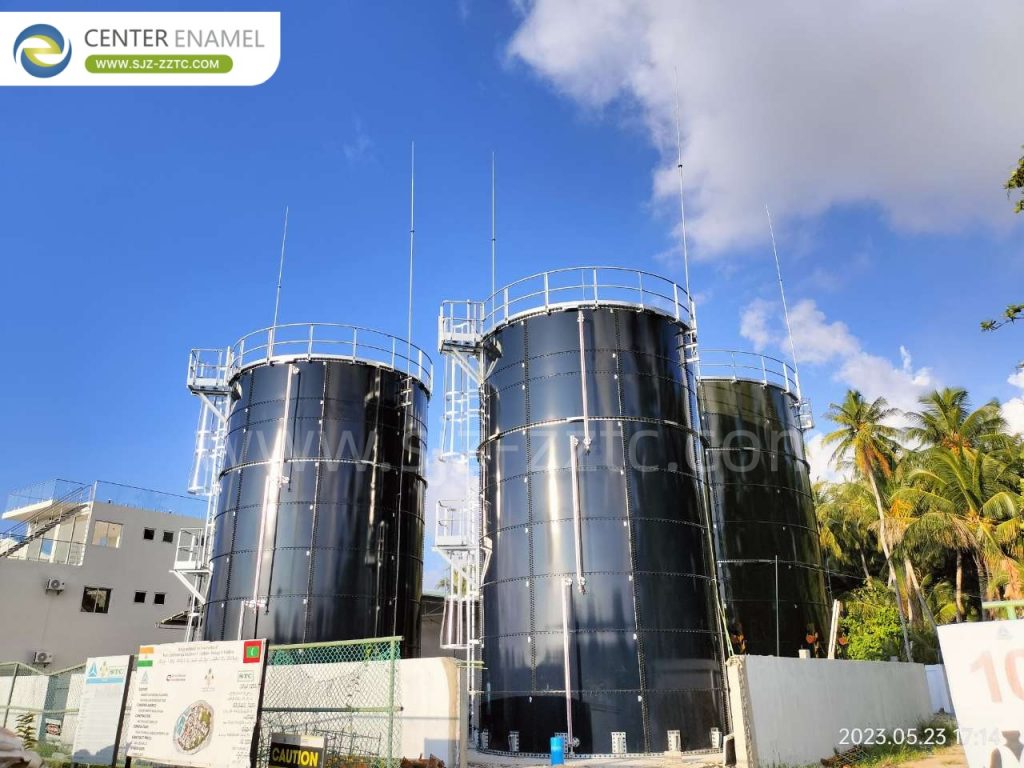
Demonstrating high-standard installation quality through long-term stable global project performance, Center Enamel has established full-chain quality control standards across four dimensions: factory protection, on-site assembly construction, completion inspection, and long-term warranty-ensuring quality control for every GFS tank.
At the factory stage, all enameled panels, seals, and structural components receive rust-proof and moisture-proof independent packaging with dedicated protective supports-preventing damage during sea and land transport and avoiding enamel coating damage. On-site construction strictly follows unified assembly process specifications-panel by panel tightening and leak testing in layers, with airtightness and verticality testing after each tank section completion-dual-membrane covers and anaerobic piping undergo simultaneous pressure testing and acceptance.
Differentiated quality acceptance standards are customized for different regions: EU/US projects follow stringent CE/NSF inspection criteria; Southeast Asian hot humid regions receive enhanced corrosion protection and sealing acceptance; remote African sites have additional foundation settlement re-inspection procedures. Upon project completion, complete construction inspection reports, pressure test records, and anti-corrosion appearance acceptance documents are issued, with full photo/video archives retained.
Over 10,000 tanks delivered globally have operated long-term without large-scale leakage or structural deformation-preventing future O&M issues at source.
Experienced Teams, Proven Delivery
The installation team has practical experience from over 10,000 GFS tank projects globally, strictly following standardized construction procedures-full control over project mobilization, civil coordination, tank assembly, piping, and commissioning schedules and quality.
The team is proficient in complete standardized installation processes for GFS tanks, dual-membrane gas storage covers, USR/CSTR/IC anaerobic reactors, and biogas desulfurization/piping systems-adaptable to large-scale farms, industrial parks, remote mountainous sites, coastal high-corrosion sites, and other complex locations-strictly implementing unified global safety construction standards.
For large overseas cross-border projects, the team can be deployed as complete units for on-site construction, technical training, and local worker practical instruction-full control over construction details, air-tightness testing, and corrosion protection-ensuring timely and stable commissioning of global environmental projects through standardized delivery capability.
Global Footprint in Numbers
Center Enamel's project portfolio covers over 100 countries across Southeast Asia, Africa, Europe, and the Americas-30,000+ mature projects-accumulating complete industry solutions across palm oil, livestock, municipal, brewing, and food waste biogas-rapidly matching customized solutions for different regional climates, water quality, and regulations.
This breadth of experience means that whether your Pharmaceutical Wastewater Treatment Project is in a humid tropical zone or a cold inland region, Center Enamel has likely delivered a comparable system before.
Frequently Asked Questions
1. Why is the IC Process preferred for pharmaceutical wastewater?
The IC Process tolerates toxic compounds, withstands shock loads, and maintains high biomass retention-critical for pharmaceutical wastewater with low biodegradability.
2. What does a Pharmaceutical Wastewater Treatment Project include?
It typically combines pretreatment, IC anaerobic digestion, aerobic treatment, and advanced polishing, with GFS tanks ensuring corrosion resistance.
3. How many projects has Center Enamel delivered globally?
Over 30,000 projects across 100+ countries, including more than 2,000 wastewater and 1,000 biogas installations.
Let's Discuss Your Treatment Goals
Planning a Pharmaceutical Wastewater Treatment Project and want a process that meets both compliance and budget targets? Contact Center Enamel for a tailored IC Process design.
Our engineers are ready to review your water quality data and recommend the right configuration-reach out today and move your project forward.