
How Do GFS Tanks and IC Process Elevate Papermaking Wastewater Treatment Performance Worldwide?
The global industrial wastewater market is shifting fast, and papermaking sits right at the center of that change. The Asia-Pacific region, particularly China, has become the world's largest industrial wastewater treatment market, with the operation and maintenance service segment's contribution continuing to rise-marking a shift from project construction to long-term operational management. North America focuses on upgrading existing facilities, while Europe emphasizes high-value-added resource recovery technologies.
Wastewater from the new energy industry chain (lithium batteries, photovoltaics, hydrogen) has become the most notable emerging growth area due to its complex composition and high treatment difficulty, generating significant demand for customized solutions. The maturity of third-party treatment models in industrial parks continues to improve, driving consolidation in the professional operation market. The Middle East has strong demand for advanced treatment and reuse due to water scarcity, while manufacturing transfer in Southeast Asia drives local facility construction demand. Within this landscape, Papermaking Wastewater Treatment stands out as one of the most demanding applications-and GFS Tanks have become the preferred containment solution for meeting those demands.
Why Are GFS Tanks Ideal for Modern Intensive Plant Layouts?
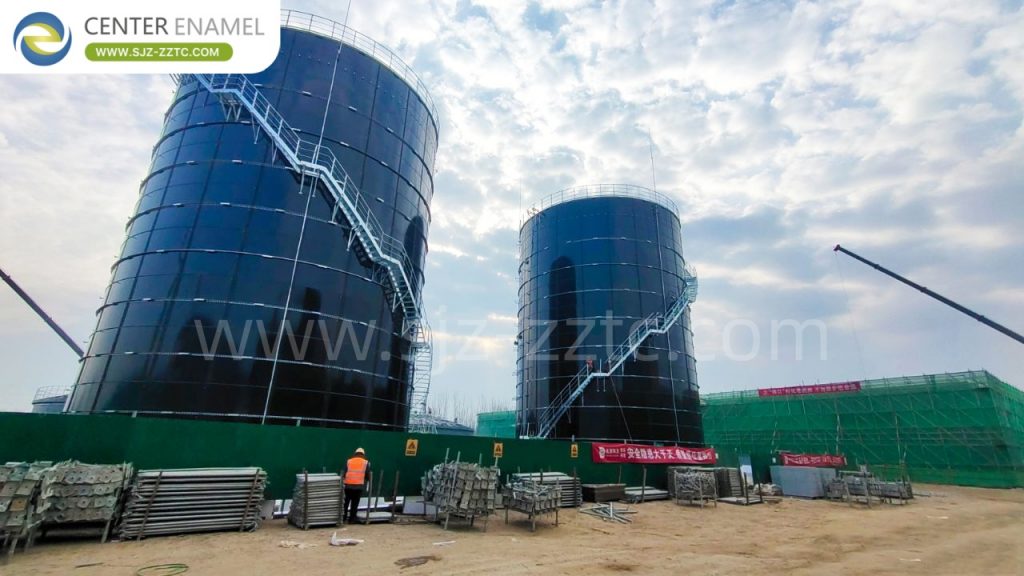
Flexibility is the first reason GFS Tanks outperform conventional alternatives. They offer flexible customization of size and appearance, with higher land utilization rates, making them ideally suited for modern compact plant layouts with significant advantages over fixed poured concrete tanks. Concrete tanks cannot alter volume or shape after pouring, with heavy bases occupying large areas, making placement difficult on narrow or irregular plots, and their rough, uniform appearance cannot match modern facility aesthetic requirements. In contrast, GFS Tanks can be precisely customized as needed, with capacities ranging from dozens of cubic meters to 50,000 cubic meters freely selectable. Tank height and diameter can be flexibly combined to fit narrow or irregularly shaped plots, effectively saving plant land occupation. Enamel color customization is also supported, achieving visual harmony with plant buildings and environmental facilities. During later plant expansion, GFS Tanks can be directly adjusted in layout and expanded; concrete tanks, being monolithic structures, must be demolished and rebuilt, offering less flexibility in land resource utilization. This aligns well with the intensive construction and aesthetic operation and maintenance needs of industrial parks.
What Equipment Makes Anaerobic Papermaking Wastewater Treatment Work?
The core equipment for anaerobic treatment is the GFS tank with a built-in gas-lift internal circulation system and upper/lower three-phase separators-key components for autonomous circulation and sludge-water separation. A bottom precision distribution system and pressure-regulating feed device ensure uniform, stable influent. Supporting equipment includes influent lift pumps, equalization tanks, and flow meters for precise influent control, along with top high-efficiency biogas collection, desulfurization, dehydration, and storage integrated equipment. High-precision online monitoring equipment provides real-time temperature, pH, COD, and level monitoring. Bottom and mid-section dedicated sludge discharge pipes and recirculation control devices complete the system-no external return pumps are needed for internal circulation. The complete system is highly integrated, with no excess external equipment, compact structure, and high automation. In short, GFS Tanks are not just storage vessels; they are the structural heart of the anaerobic process.
How Does a Standardized Papermaking Wastewater Treatment Train Deliver Results?
A proven Papermaking Wastewater Treatment solution uses a combined treatment train of "white water recirculation + physicochemical pretreatment + anaerobic digestion + aerobic treatment," with the core strategy of maximizing recycling to reduce discharge volume. White water recirculation is the core water-saving measure-paper machine white water is treated by microfiltration, DAF, and disc filters to recover fiber for repulping, reducing discharge by 60–80%. Pretreatment uses screens and fine screens to recover fiber and filler suspended solids for sale. Coagulation/sedimentation and DAF further remove colloids and fine suspended solids. Cooking black liquor is collected separately-alkali recovery boilers recover alkali and burn lignin for steam, reducing pollution at source. The main biochemical stage uses IC/UASB anaerobic plus A/O aerobic processes for dissolved organic pollutant degradation. Final advanced treatment uses chemical decolorization and membrane filtration as required by discharge standards. Throughout the train, tanks use Center Enamel GFS Tanks resistant to high alkalinity and lignin corrosion, ensuring the entire Papermaking Wastewater Treatment system stays stable over decades of service.
What Does a Proven Papermaking and Brewery Project Look Like in Practice?
Real-world performance is the best proof of concept. The South Africa Brewery High-Strength Wastewater Treatment Project focused on high-concentration organic wastewater treatment in South Africa's brewing industry, featuring both Center Enamel GFS Tanks and stainless steel tanks as core equipment. GFS tanks serve as the primary anaerobic digestion system, suited to brewery wastewater's high-COD, high-sugar, readily decomposable characteristics for efficient organic pollutant degradation. Stainless steel tanks are used for wastewater transfer and chemical storage supporting processes. The complete equipment package has excellent corrosion resistance and flexible assembly, providing long-term stable treatment of brewery production and cleaning wastewater-solving local brewing industry pollution challenges. The same engineering principles apply directly to Papermaking Wastewater Treatment, where high alkalinity and lignin corrosion place identical demands on tank durability.
Table 1: South Africa Brewery Project Snapshot
| Item | Detail |
| Industry | Brewery high-strength organic wastewater |
| Core equipment | Center Enamel GFS tanks + stainless steel tanks |
| Primary function | Anaerobic digestion (GFS); transfer and chemical storage (stainless) |
| Key performance | Excellent corrosion resistance, flexible assembly, long-term stability |
| Relevance to papermaking | Shared demand for corrosion-resistant anaerobic containment |
How Does Center Enamel's Team Support Global Papermaking Wastewater Treatment Projects?
Behind every successful Papermaking Wastewater Treatment project is a team that understands local regulations and site realities. Center Enamel's marketing team brings together environmental industry multi-skilled professionals and multilingual foreign trade specialists, with deep expertise in global biogas, wastewater treatment, and biomass new energy markets-accumulating extensive practical project experience in Southeast Asia, Africa, Europe, and the Americas. The team is proficient in various countries' wastewater discharge regulations, biogas subsidy policies, and carbon trading rules, providing one-stop preliminary site survey, solution planning, and investment return analysis consulting services. With multilingual capabilities in English, French, Spanish, and Arabic, the team effectively communicates with clients worldwide-precisely matching regional industrial resources, project budgets, and environmental requirements-customizing high-cost-performance GFS Tanks and anaerobic reactor solutions based on client production capacity, treatment targets, and gas production expectations. Leveraging extensive overseas project experience, the team proactively helps clients avoid risks in overseas approvals, equipment import, and construction implementation-building a globally adaptable integrated environmental equipment business service system.
Which Certifications Back GFS Tanks in International Papermaking Projects?
Credentials matter when tendering across borders. Center Enamel holds CE, NSF, WRAS, ISO9001, BSCI, ASME, and other global certifications-fully clearing EU, North American, Southeast Asian, and African project tendering barriers and providing critical hard credential advantages for large overseas project bidding.
Table 2: International Certifications and Market Access
| Certification | Market Access Enabled |
| CE | European Union |
| NSF | North America |
| WRAS | United Kingdom water sector |
| ISO9001 | Global quality management |
| BSCI | International supply chain compliance |
| ASME | Pressure vessel and engineering standards |
Together, these certifications ensure that GFS Tanks supplied for any Papermaking Wastewater Treatment project meet the technical and compliance expectations of regulators, owners, and EPC contractors alike.
FAQ
Q1: Why are GFS Tanks better than concrete for papermaking plants?
GFS Tanks offer flexible sizing up to 50,000 m³, fit irregular plots, resist high alkalinity and lignin corrosion, and can be expanded or relocated-concrete cannot.
Q2: How much discharge can white water recirculation reduce?
White water recirculation with microfiltration, DAF, and disc filters recovers fiber for repulping and typically reduces discharge volume by 60–80%.
Q3: Are Center Enamel GFS Tanks certified for overseas projects?
Yes. CE, NSF, WRAS, ISO9001, BSCI, and ASME certifications clear tendering barriers across the EU, North America, Southeast Asia, and Africa.
Ready to specify corrosion-resistant GFS Tanks for your next papermaking project? Send our engineers your water quality data and capacity requirements for a tailored recommendation.
Speak with Center Enamel today to plan a Papermaking Wastewater Treatment solution built around your discharge targets and site constraints.