
How GFS Tanks & IC Process Handle High-Strength Industrial Wastewater?
The competitive landscape shows divergence, with leading companies building integrated service capabilities through technical integration and capital operations, and industry concentration gradually increasing. Chinese companies continue to consolidate their advantages in mid-tier equipment exports. International giants target high-end customers and complex industrial wastewater markets, while local players occupy the mid- to low-end and industrial park centralized treatment markets with service responsiveness and cost advantages.
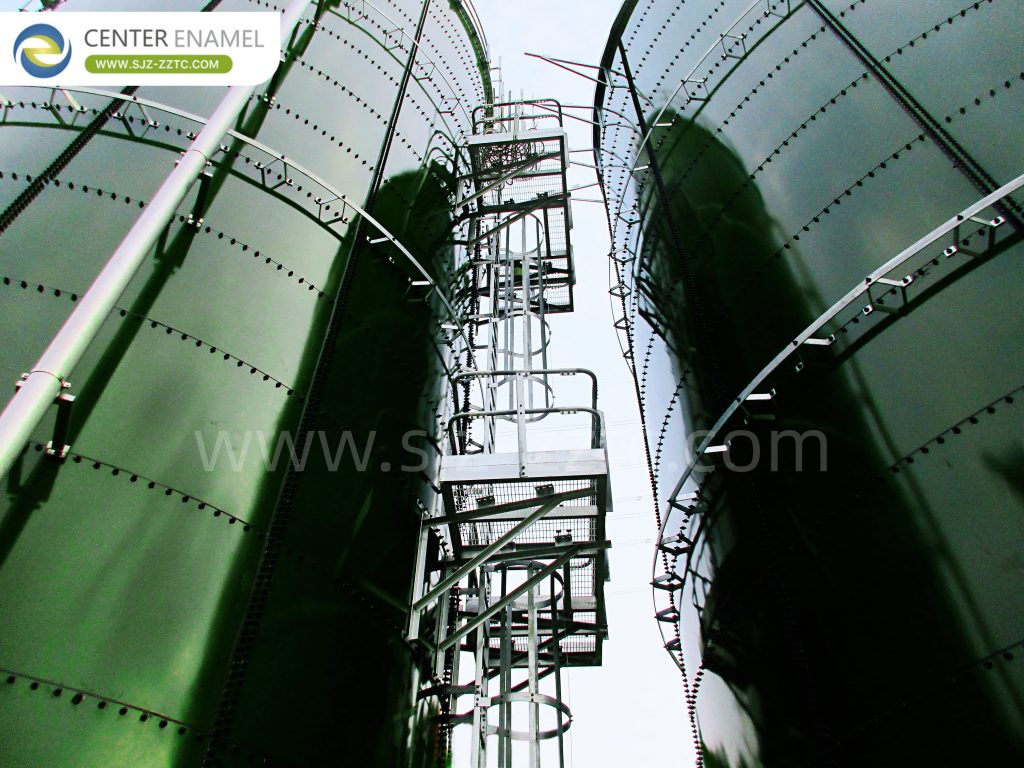
In the anaerobic process segment, UASB, EGSB, and IC anaerobic reactors, with advantages of high loading rates, small footprints, and stable operation, are widely used in high-concentration organic wastewater pretreatment in food processing, pharmaceutical fermentation, alcohol brewing, chemical, and other industries. These reactors use steel tank shells, and their corrosion resistance and gas-tightness directly determine long-term operational stability. The application value of glass-fused-to-steel tanks in such scenarios is increasingly prominent.
This trend explains why pairing the IC Process with durable GFS Tanks has become a preferred configuration for high-strength industrial wastewater treatment.
GFS Tanks: Corrosion Resistance Far Superior to Traditional Concrete Tanks
Center Enamel's independently developed double-sided double-layer enameling technology is the industry's leading coating anti-corrosion technology, with corrosion resistance completely surpassing concrete tanks. Concrete tank interiors are riddled with pores, allowing wastewater and acid/alkaline media to easily penetrate and corrode the structural layer. Long-term use leads to irreversible problems such as internal wall spalling, water seepage, and rebar corrosion, which are difficult to repair and cannot be fundamentally resolved.
GFS tanks feature high-temperature enameling on both the interior and exterior surfaces of steel panels, with a dense, non-porous enamel finish that completely blocks corrosive liquids and biogas permeation. The enamel layer has extremely strong chemical stability, resisting acids, alkalis, salts, and microbial corrosion. Concrete tanks will develop extensive corrosion and leakage after 5-8 years of use, while GFS tank anti-corrosion service life can exceed 30 years, with no need for frequent internal lining repairs throughout the service life, significantly reducing long-term anti-corrosion maintenance investment and fundamentally eliminating environmental risks of medium leakage contaminating sites and groundwater. Compared to traditional concrete and FRP tanks, GFS tank coatings have no risk of peeling or blistering, and are adaptable to highly corrosive conditions such as palm oil mill effluent, livestock manure, and chemical high-salinity wastewater, with outstanding long-term comprehensive cost advantages.
Table 1: GFS Tanks vs. Traditional Concrete Tanks
| Feature | GFS Tanks | Concrete Tanks |
| Corrosion Resistance | Excellent (30+ years) | Poor (5–8 years) |
| Porosity | Non-porous enamel | Highly porous |
| Repair Needs | No lining repairs | Frequent spalling/seepage |
| Chemical Stability | Acids, alkalis, salts, microbes | Degrades over time |
| Environmental Risk | Minimal leakage risk | Groundwater contamination risk |
IC Process Advantages
Top-tier treatment efficiency, with footprint only one-third that of traditional anaerobic processes for the same treatment capacity-significant compactness advantage. Built-in gas-lift internal circulation requires no external recirculation equipment, with autonomous forced mixing of sludge and water. Strong hydraulic mixing ensures thorough micro-pollutant contact, greatly improving degradation efficiency and withstanding high water quality and hydraulic shock loads. The dual-zone configuration combines high-efficiency degradation with deep polishing for stable effluent quality. High degree of sludge granulation, strong activity, and very low washout. High automation, stable operation, low failure rates, large biogas production, and outstanding resource recovery benefits. Long-term energy and O&M costs far lower than traditional anaerobic processes, suitable for large-flow, high-concentration industrial wastewater treatment.
Table 2: IC Process Performance Highlights
| Metric | Advantage |
| Footprint | One-third of traditional anaerobic processes |
| Circulation | Built-in gas-lift, no external pumps |
| Shock Load Tolerance | High water quality and hydraulic shock resistance |
| Sludge Retention | High granulation, low washout |
| Automation | High, with stable operation and low failure rates |
Environmental Toxicity of Pharmaceutical Pollutants
Pharmaceutical wastewater is the most toxic and highest environmental risk category among the five wastewater types, with significant biological toxicity and environmental persistence. Residual antibiotics, bacteriostats, and chemical synthesis intermediates in the wastewater can inhibit microbial activity at microgram-level concentrations, disrupting biochemical system bacterial community structure and potentially causing system failure. Large quantities of persistent refractory organics discharged into natural waters cannot be rapidly decomposed, remaining in water and soil for extended periods, inhibiting aquatic organism reproduction and disrupting aquatic ecological balance. Heavy metal ions, high salts, and toxic organics form combined synergistic pollution, causing persistent surface and groundwater contamination with long-term ecological safety risks.
These risks make robust reactor shells essential. The IC Process may deliver the biological performance, but only corrosion-resistant GFS Tanks can protect that performance over decades of exposure to aggressive pharmaceutical effluent.
Center Enamel's Core R&D Capabilities and Global Certifications
Technology R&D is Center Enamel's core competitive advantage. The company independently masters over 200 differentiated anti-corrosion enamel formulations, with full self-control over the enamel raw material chain, holding nearly 100 invention and utility patents. Products have passed NSF, WRAS, ASME, BSCI, CE, ISO9001, and other global certifications.
Company certifications and honors include: National High-Tech Enterprise, National Specialized and Sophisticated "Little Giant," Hebei Manufacturing Single Champion.
Installation and Construction Team
The installation team has practical experience from over 10,000 GFS tank projects globally, strictly following standardized construction procedures-full control over project mobilization, civil coordination, tank assembly, piping, and commissioning schedules and quality.
The team is proficient in complete standardized installation processes for GFS tanks, dual-membrane gas storage covers, USR/CSTR/IC anaerobic reactors, and biogas desulfurization/piping systems-adaptable to large-scale farms, industrial parks, remote mountainous sites, coastal high-corrosion sites, and other complex locations-strictly implementing unified global safety construction standards. For large overseas cross-border projects, the team can be deployed as complete units for on-site construction, technical training, and local worker practical instruction-full control over construction details, air-tightness testing, and corrosion protection-ensuring timely and stable commissioning of global environmental projects through standardized delivery capability.
Aluminum Geodesic Dome Roof
Aluminum Geodesic Dome Roof independently developed by Center Enamel is manufactured using high-strength aluminum alloy plates through integral stamping. It features a triangular grid spherical self-supporting structure, enabling large-span full coverage without internal support columns. Made of aluminum alloy, the roof offers excellent weather resistance and corrosion resistance, capable of long-term protection against acid rain, salt spray, and UV radiation, suitable for various extreme outdoor climate conditions. The structural design complies with international AWWA D108 standards, with aluminum plate thickness, rib cross-sections, and joint connections all verified by finite element stress analysis, ensuring wind and snow load resistance that meets building code requirements across different global regions.
The weight of the Aluminum Geodesic Dome Roof is only one-third to one-half of a steel roof with the same span, significantly reducing the load on the tank top and allowing direct installation without tank wall reinforcement. The roof provides superior overall sealing performance, with double sealing between panels using specialized sealant strips and mechanical interlocking, enabling both airtight gas storage and enclosed odor control, suitable for biogas collection and storage, wastewater tank odor control, and drinking water contamination prevention. The support-column-free design does not interfere with the installation and operation of internal equipment such as mixers and water distributors. The aluminum material does not support microbial growth, requiring no anti-corrosion maintenance over long-term use, resulting in low total life-cycle costs.
Ready to pair high-efficiency IC process reactors with durable GFS tanks? Contact Center Enamel today for a solution engineered to your wastewater profile.
Let our team support your project from reactor sizing to final commissioning-reach out now to discuss your treatment targets.
Frequently Asked Questions
Why combine GFS tanks with the IC process?
The IC process delivers compact, high-efficiency anaerobic treatment, while GFS tanks provide 30+ year corrosion resistance and gas-tightness for stable long-term operation.
What industries benefit most from IC process reactors?
Food processing, pharmaceutical fermentation, alcohol brewing, and chemical industries-especially where high-concentration organic wastewater requires compact, shock-resistant treatment.
How durable are GFS tanks in corrosive environments?
GFS tanks resist acids, alkalis, salts, and microbial corrosion for over 30 years, with no lining repairs needed-far outperforming concrete tanks that degrade in 5–8 years.