
How the IC Process Transforms Pharmaceutical Wastewater Treatment?
The global industrial wastewater treatment market is shifting from project construction to long-term operational management, and nowhere is this shift more consequential than in pharmaceuticals. The Asia-Pacific region, particularly China, has become the world's largest industrial wastewater treatment market, with the operation and maintenance service segment's contribution continuing to rise. The North American market focuses on upgrading existing facilities, while Europe emphasizes high-value-added resource recovery technologies.
Wastewater from the new energy industry chain-lithium batteries, photovoltaics, hydrogen-has become the most notable emerging growth area due to its complex composition and high treatment difficulty, generating significant demand for customized solutions. The maturity of third-party treatment models in industrial parks continues to improve, driving consolidation in the professional operation market. The Middle East has strong demand for advanced treatment and reuse of industrial wastewater due to water scarcity, while manufacturing transfer in Southeast Asia drives local industrial wastewater treatment facility construction demand.
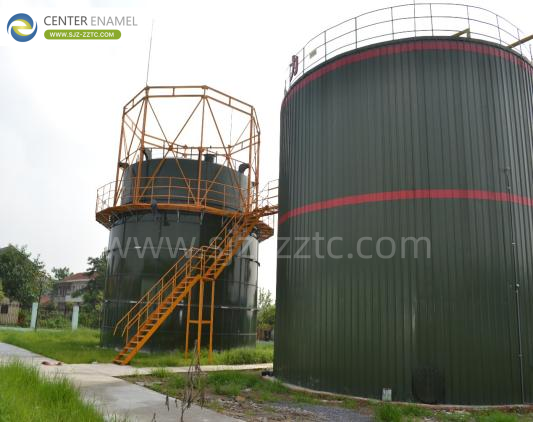
Within this evolving landscape, Pharmaceutical Wastewater Treatment stands out as one of the most technically demanding applications. Meeting it reliably requires both a robust biological process and a containment vessel engineered for corrosive, variable, and toxic conditions. The IC Process, housed in Center Enamel's GFS tanks, provides exactly this combination.
IC Process Definition: Third-Generation Anaerobic Efficiency
IC, or Internal Circulation Anaerobic Reactor, is the third-generation high-efficiency anaerobic treatment technology built upon UASB. Its core innovation is the built-in gas-lift internal circulation system, enabling autonomous wastewater recirculation without external return pumps. The reactor features a dual-zone configuration: a lower main reaction zone and an upper polishing zone. Biogas gas-lift creates hydraulic internal circulation, significantly increasing upflow velocity and enhancing sludge-wastewater contact. With extremely high compactness, it is specifically designed for high-concentration, high-flow industrial organic wastewater, combining high efficiency, energy savings, and minimal footprint-the core process for modern industrial high-strength wastewater treatment.
For pharmaceutical applications, this design offers decisive advantages. The autonomous circulation maintains stable performance despite the extreme water quality fluctuations typical of pharmaceutical production. The dual-zone configuration provides both aggressive degradation in the lower zone and polishing in the upper zone, supporting consistent effluent quality. And the compact footprint allows installation within existing plant boundaries-often the only viable option for facilities with limited available land.
Pharmaceutical Wastewater Sources and Characteristics
Understanding why pharmaceutical wastewater is so difficult begins with its origins. Pharmaceutical wastewater originates from the entire production process of chemical synthesis, fermentation antibiotics, traditional Chinese medicine, and biopharmaceuticals, representing a typical high-difficulty industrial wastewater. Key pollution-generating stages include raw material washing, reaction synthesis, fermentation culture, extraction crystallization, and filtration separation. Auxiliary wastewater includes equipment washing, workshop floor cleaning, laboratory testing, and exhaust gas scrubbing. Fermentation wastewater mainly consists of bacterial cell residues and spent culture media; chemical synthesis wastewater is rich in reaction byproducts and organic solvent residues; TCM wastewater is concentrated in herb decoction and alcohol precipitation/concentration stages.
Wastewater generation is continuous, with significant variations due to drug type and production batch changes. Small and medium-sized pharmaceutical companies lack stable production conditions, causing extreme fluctuations in water quality and quantity-the highest industry-wide pollution control difficulty. This variability is precisely what the IC Process is engineered to withstand. Its internal circulation provides hydraulic buffering, and its high sludge retention capacity prevents biomass washout during shock loads-a critical advantage over conventional anaerobic systems.
GFS Tanks Adaptable to Complex Operating Conditions
Process performance depends on containment integrity. Center Enamel has independently developed over 200 specialized enamel frit formulations and supporting patents, capable of customizing anti-corrosion enamel based on customer storage media, with adaptability comprehensively superior to concrete tanks. Concrete tanks use a single material, only suitable for neutral clean water storage. When storing corrosive materials such as livestock manure, palm oil mill effluent, chemical wastewater, food waste digestate, or high-salinity wastewater, additional anti-corrosion linings must be applied. These linings are prone to failure, preventing long-term stable operation and cannot adapt to alternating high/low concentration storage conditions.
GFS tanks solve this problem at the material level. They can be specifically formulated with specialized enamels resistant to strong acids, strong alkalis, high organic content, and high salinity. A single tank can switch between multiple wastewater and fermentation feedstock storage requirements. They are universally applicable across biogas anaerobic digestion, municipal wastewater, livestock farming, food processing, and industrial water treatment scenarios, eliminating the need to rebuild tanks for media changes and perfectly meeting the needs of diversified, multi-condition environmental protection projects.
| Parameter | Center Enamel GFS Tanks | Concrete Tanks with Linings |
| Corrosion resistance | Custom enamel formulations for strong acids, alkalis, high salinity, high organics | Single material; requires applied linings prone to failure |
| Media flexibility | Single tank can switch between multiple wastewater and feedstock types | Cannot adapt to alternating high/low concentration conditions |
| Service life | 30+ years with double-sided double-layer enameling | Lining degradation requires periodic repair and replacement |
| Applications | Biogas, municipal wastewater, livestock, food processing, industrial water treatment | Neutral clean water storage only |
Innovative Material Technology Behind GFS Tanks
Center Enamel has independently developed over 200 anti-corrosion enamel formulations, with proprietary double-sided double-layer enameling technology-GFS tank anti-corrosion service life exceeds 30 years-far surpassing concrete and ordinary equipment-suitable for global high-corrosion wastewater and biogas fermentation conditions. This material capability is what allows the IC Process to operate reliably in pharmaceutical service, where aggressive compounds and high salinity would quickly degrade lesser containment materials.
Professional Construction Team Manpower Reserve
Even the best-designed system depends on disciplined installation. Center Enamel has established its own domestic and international certified construction teams, with regular practical training on GFS tank installation and overseas construction standards for various countries. Domestically, regional construction teams cover multiple zones, capable of simultaneously deploying multiple teams for large tank farm projects. Internationally, cross-border professional installation teams are equipped to various country construction standards-sufficient manpower reserves ensure uninterrupted construction delivery for remote African sites, high-standard European/American facilities, and other projects.
For pharmaceutical clients, this means project schedules are not held hostage by labor shortages or unfamiliarity with anaerobic system installation. The same teams that install GFS tanks also handle USR/CSTR/IC anaerobic reactors and biogas piping systems-ensuring interface consistency and single-source accountability.
Aluminum Alloy Trough Deck Roof: Economical Cover Solution
Not every tank requires gas-tight sealing. The Aluminum Alloy Trough Deck Roof is a cost-effective economical tank cover solution for clean water and wastewater storage scenarios, primarily designed for drinking water, production wastewater, and firewater reserve tanks, balancing practicality and cost advantages. The main body is integrally formed from anti-corrosion aluminum alloy plates, paired with aluminum support trusses. Its lightweight design imposes less load on the tank foundation, reducing civil construction investment. A naturally formed dense oxide protective layer on the surface resists rain and mild wastewater corrosion, withstands outdoor sun and rain exposure, and effectively blocks wind, rain, insects, fallen leaves, and odor volatilization, protecting water quality by preventing dust and debris from falling in and causing secondary contamination.
The flat roof structure is neat and orderly, allowing installation of maintenance walkways, guardrails, vents, and level monitoring ports on top, facilitating daily inspection and equipment maintenance. The simple sealing structure enables straightforward installation with short construction timelines, and virtually eliminates the need for anti-corrosion painting maintenance, resulting in extremely low operational costs. It is suitable for various small, medium, and large atmospheric pressure water storage tanks, and has been widely implemented in waterworks clear water tanks, industrial circulating water tanks, park firewater tanks, and domestic wastewater temporary storage facilities. It is highly compatible with water storage applications that do not require biogas collection or high-pressure sealing.
Ready to solve your pharmaceutical wastewater challenges with the IC Process? Contact Center Enamel today for a tailored anaerobic solution designed around your effluent characteristics and site constraints.
Frequently Asked Questions
What makes the IC Process suitable for Pharmaceutical Wastewater Treatment?
Its internal circulation handles extreme water quality fluctuations, resists shock loads, retains biomass effectively, and operates in a compact footprint-ideal for complex pharmaceutical effluent.
Why use GFS tanks instead of concrete for pharmaceutical wastewater?
GFS tanks resist high salinity, strong acids/alkalis, and organic solvents, offer 30+ year service life, and allow media switching without rebuilding-concrete linings fail under these conditions.
Can the IC Process recover energy from pharmaceutical wastewater?
Yes. The process produces biogas that can be collected and used to offset facility energy costs, improving the economics of Pharmaceutical Wastewater Treatment.