
Why We Use the IC Process to Treat Complex Beverage Wastewater
Beverage plants rarely fail at treatment because they bought the wrong pump. They fail because the process architecture was fixed before anyone read the effluent, and because no single party owned the outcome from design to commissioning. The two are linked: the reactor sets the ceiling on performance, and the delivery model decides whether that ceiling is reached on site. Beverage Wastewater Treatment is not an equipment purchase but a process decision followed by an accountability decision, and this article takes them in that order.
What Makes Beverage Effluent Different
That decision starts with the water itself. COD typically runs between 3,000 and 20,000 mg/L, with cleaning-in-place (CIP) pulses peaking above 50,000 mg/L. The pollutants are soluble sugars, and BOD/COD ratios of 0.5 to 0.65 rank among the best in industrial wastewater. Suspended solids stay low, mostly fruit pulp and tea residue. Juice streams sit at pH 3 to 4, carbonated lines add phosphoric acid, and temperature holds at 20 to 40°C.
The real challenge is intermittency, not strength. Quality swings with CIP cycles and product changeovers, alternating concentrated cleaning pulses with dilute filling water. Any reactor specified here must absorb shock loading without washing out biomass, which is exactly what the IC Process is built to handle.
| Beverage Wastewater Parameter | Typical Range | Design Implication |
| COD | 3,000–20,000 mg/L; CIP peaks above 50,000 | High-rate anaerobic pretreatment |
| BOD/COD ratio | 0.5–0.65 | Excellent anaerobic degradability |
| Suspended solids | Low, mainly pulp and tea residue | Reduced clogging risk |
| pH | 3–4 for juice; phosphoric acid in carbonated lines | Corrosion-resistant containment required |
| Temperature | 20–40°C | Mesophilic operation viable |
| Variability | CIP cycles and product changeovers | Shock tolerance and equalization essential |
With that profile on paper, the question becomes which reactor holds biomass through the swings.
Sorting Out UASB, EGSB and the IC Process
Three reactor families dominate high-strength pretreatment in food, brewing and fermentation plants, and all three share high volumetric loading, a small footprint, and a steel shell whose coating decides how long stability lasts.
UASB is the reference design. Granular sludge forms a dense bed, a three-phase separator captures biogas, and clarified effluent leaves the top. It is forgiving and economical, which suits moderate loads and steady flows. The constraint is hydraulic, since upflow velocity must stay low enough to hold granules in place, so footprint grows with load.
EGSB raises that velocity with a taller vessel and a recirculation line, expanding the sludge bed and improving contact between biomass and substrate. Loading rates climb and dilution swings are better tolerated, at the cost of pumping energy and structural height.
The IC reactor is the third generation, and it changes the economics of a tight site. Two stacked reaction zones, circulation driven by biogas rather than pumps, and a top polishing stage allow loading rates well above UASB inside a footprint that fits an existing plant boundary.
Inside the IC Process: Circulation Without Pumps
Pretreated wastewater enters the lower reaction zone, mixes with recirculated liquor and rises fast. Microorganisms convert the organic load and generate large volumes of biogas, whose gas-lift effect carries mixed liquor to a top-mounted gas-liquid separator. Gas is collected and drawn off, and degassed liquor returns by gravity through downcomers, closing a loop that repeatedly passes biomass through the reaction zone.
After several cycles the flow enters the upper polishing zone, where residual organics are finished and sludge separates. Settled sludge drops back, treated effluent overflows, and aged sludge is drawn off periodically. The result is no return pumps, no external mixing energy, and an upflow regime that keeps granular sludge suspended at velocities a conventional UASB cannot sustain.
Containment and Roofing Decisions That Decide Uptime
Whichever reactor is chosen, performance rests on gas-tight, corrosion-resistant containment, and roof choice follows. FRP covers serve atmospheric storage without air-tightness needs, such as drinking water, irrigation reserve, firewater and temporary production wastewater. Molded flat or domed, they are light, resistant to mild acid and alkali attack, and will not rot in humid service. Their limit is explicit: no biogas collection, no pressurization.
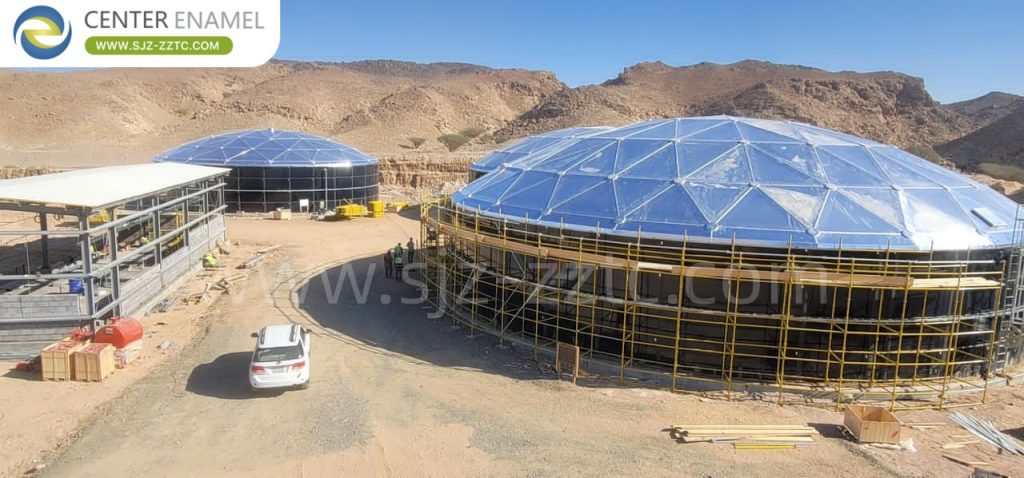
Every beverage anaerobic project captures biogas, so a sealed roof is mandatory. Center Enamel supplies gas-tight GFS roofs with the same glass-fused coating system as the shell, holding the sealing and corrosion performance that reactor biology depends on.
Field Evidence from Sweden, 2024
Those choices are easier to judge in a delivered plant than in a datasheet. A Nordic installation shows how they perform under load: organic waste digested through UASB in a Center Enamel GFS fermenter. The coating resists acid, alkali and low-temperature attack, and modular assembly kept site work short. The plant recovers biogas as energy, treats its waste harmlessly, and has been recognized as a European biomass demonstration project.
| Sweden Project Item | Specification |
| Location and year | Sweden, 2024 |
| Core process | UASB anaerobic digestion |
| Containment | Center Enamel GFS tanks |
| Single tank size | Ø 19.11 m × 19.2 m height |
| Conditions addressed | Acid and alkali corrosion; low-temperature Nordic climate |
| Outcome | Organic waste treatment plus biogas energy recovery |
Design Depth Behind the Global Record
One plant proves the concept; repeating it is harder. Selecting a partner means testing design depth, not only fabrication capacity. Center Enamel's team includes senior engineers registered in the Hebei Provincial Science and Technology Expert Database and designs to European and American high-end equipment safety standards. Integrated design covers tank structure, anti-corrosion and sealing, biogas piping and process integration for livestock biogas, palm oil mill effluent, municipal wastewater, hazardous waste storage and desalination. Pre-design work checks seismic zone, wind pressure, soil bearing capacity, water corrosivity and local discharge limits before panels, bases or sealing are upgraded.
In 2009 the company installed its first overseas GFS tank, a drinking water tank in Niger. In 2015 it delivered China's first exported GFS tank to the United States and passed US acceptance standards. Projects since then have run stably across Southeast Asia, Africa and the Americas, from mountain sites to salt-spray coasts.
| Project | Year | Scope | Significance |
| Niger | 2009 | First overseas drinking water tank | Early overseas capability |
| United States | 2015 | First Chinese GFS tank exported and installed | Passed strict US acceptance standards |
| Sweden | 2024 | UASB digestion, Ø 19.11 m × 19.2 m tank | Biomass demonstration with biogas recovery |
What to Demand from an EPC Contractor
The technical case for high-rate anaerobic pretreatment is settled; the commercial case rests on execution. When you shortlist an EPC Contractor for Beverage Wastewater Treatment, require guarantees tied to effluent limits and biogas yield rather than equipment specifications. Require reference plants on comparable effluent, single-point accountability across design, fabrication, construction and commissioning, and a partner that carries local code compliance as its own risk. UASB, EGSB and the IC Process are all mature. The differentiator is the partner who selects, engineers and delivers them.
Frequently Asked Questions
Which anaerobic technology fits beverage wastewater best?
High sugar content and BOD/COD of 0.5 to 0.65 make this effluent ideal for high-rate reactors. UASB is proven and economical for moderate loads, while EGSB and the IC Process allow higher loading in less space, and the IC Process absorbs CIP peaks better because internal circulation holds biomass in the system when flow and strength surge. Size the equalization tank on peaks rather than averages, because that is what decides whether the reactor stays stable.
Why can't an FRP roof sit on an anaerobic reactor?
FRP covers are built for atmospheric tanks with no air-tightness requirement. Digestion produces biogas that must be captured rather than vented, so the reactor needs a sealed roof, typically a gas-tight GFS or aluminum geodesic dome, to protect gas yield, odor control and site safety. Venting instead wastes methane and creates odor and exposure problems.
What should an EPC contractor guarantee?
Effluent quality against agreed discharge limits, specified biogas output, and one contract covering design, equipment supply, construction and commissioning. Ask for comparable reference plants and confirm who carries performance risk after handover, along with spare-part availability and service response times.
Send your effluent analysis and production schedule to our engineers, and you will receive a preliminary reactor selection with indicative capital and operating costs.
Talk to Center Enamel about your beverage wastewater project, and we will help you weigh reactor options and containment specifications before you commit to a design.