
Professional Industrial Wastewater Treatment Project EPC Contractor Delivering Advanced UASB Process Solutions
Global industrial wastewater treatment policies are escalating from "compliance discharge" to mandatory "resource recovery" and "zero liquid discharge." The EU, through its Circular Economy Action Plan, requires member states to increase industrial wastewater reuse rates and extends carbon footprint accounting to the full life cycle of wastewater treatment. China continuously updates and tightens industrial water pollutant discharge standards, with increasingly stringent limits on total nitrogen, total phosphorus, and characteristic pollutants for industries such as chemicals, pharmaceuticals, and printing and dyeing. Some water-scarce regions and highly polluting industries are mandated to adopt zero or near-zero liquid discharge technologies. Germany has established a differentiated pretreatment technical standard system by industry, requiring industrial wastewater to meet specific quality requirements before discharge into municipal wastewater treatment plants, implementing strict source control.
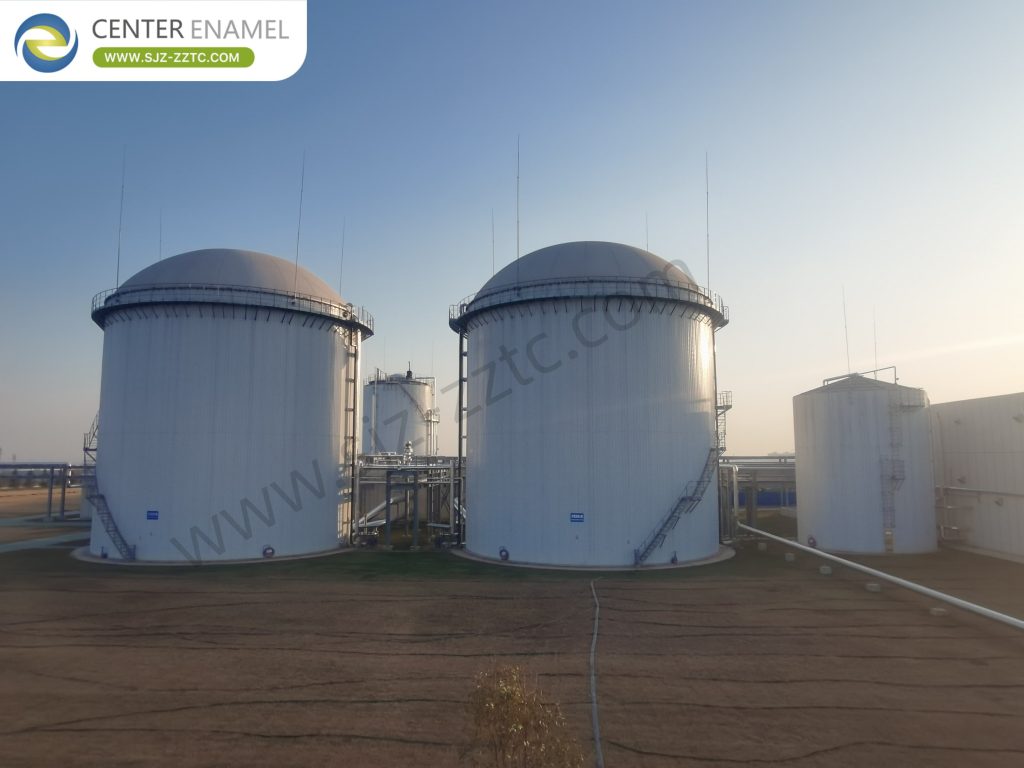
This evolving regulatory landscape demands treatment solutions that are not only effective but also adaptable and future-proof. As a leading Industrial Wastewater Treatment Project EPC Contractor, Center Enamel helps clients navigate these complex compliance requirements through innovative engineering and robust technology. This is why selecting the right EPC partner is crucial for long-term operational success and environmental stewardship.
GFS Tanks for Modern Intensive Plant Layouts
GFS tanks offer flexible customization of size and appearance, with higher land utilization rates, ideally suited for modern compact plant layouts, with significant advantages over fixed poured concrete tanks. Concrete tanks cannot alter volume or shape after pouring, with heavy bases occupying large areas, making placement difficult on narrow or irregular plots. Their rough, uniform appearance cannot match modern facility aesthetic requirements.
GFS tank volume can be precisely customized as needed, with capacities ranging from dozens of cubic meters to 50,000 cubic meters freely selectable. Tank height and diameter can be flexibly combined to fit narrow or irregularly shaped plots, effectively saving plant land occupation. Enamel color customization is also supported, achieving visual harmony with plant buildings and environmental facilities. During later plant expansion, GFS tanks can be directly adjusted in layout and expanded; concrete tanks, being monolithic structures, must be demolished and rebuilt, offering less flexibility in land resource utilization. This aligns well with the intensive construction and aesthetic operation and maintenance needs of industrial parks, making Center Enamel's GFS tanks the preferred choice for forward-thinking industrial facilities .
UASB Process Advantages for High-Strength Organic Effluent
No mechanical mixing equipment is required, with sludge suspension achieved through hydraulic action, resulting in very low overall energy consumption. High-concentration anaerobic granular sludge can be cultivated, with high sludge concentration, strong activity, excellent settleability, low sludge washout, and low sludge yield, significantly reducing sludge disposal costs. The integrated design combines reaction, sedimentation, and separation simultaneously, with small footprint and moderate capital investment. Simple structure with low failure rates and convenient maintenance. High volumetric loading rate with excellent organic pollutant degradation efficiency and good shock load resistance. Stable biogas production with high resource recovery value. The process is mature and widely adopted, with well-established construction, commissioning, and O&M systems, suitable for large-scale industrial wastewater treatment.
As a core technology offered by leading Industrial Wastewater Treatment Project EPC Contractors, the UASB Process has proven its reliability across industries ranging from beverage production to papermaking . Its ability to achieve high COD removal rates-often exceeding 85%-while generating valuable biogas makes it an indispensable component of modern wastewater treatment strategies . Center Enamel's expertise as an EPC contractor ensures that each UASB reactor is precisely engineered to match the specific wastewater characteristics of the client's facility .
Brewery Wastewater Pollutant Characteristics and Environmental Impact
No chemical toxicity-purely natural organic wastewater with very low ecotoxicological risk and easy environmental restoration. All pollutants are natural organics from grain fermentation-starches, sugars, alcohols, amino acids, proteins-containing no heavy metals, bacteriostats, or persistent toxic organics. They do not inhibit biochemical bacteria and have no acute or chronic toxicity to soil, water, or plants. The core pollution is only high-concentration oxygen-demanding organics-direct discharge rapidly depletes dissolved oxygen, causing oxygen depletion, black-odor conditions, algal blooms, and channel siltation. Pollutants have no bioaccumulation potential and are rapidly decomposed by microorganisms and natural water bodies-no long-term persistent ecological harm.
Given these characteristics, brewery wastewater is particularly well-suited for biological treatment methods such as the UASB Process. The high organic content that would otherwise cause environmental damage can be effectively converted into a valuable energy resource through anaerobic digestion, aligning perfectly with the circular economy principles now mandated by global policy frameworks.
Successful Project Implementation: Indonesia Palm Oil Biogas Upgrade
Commissioned in 2013 as the core anaerobic digestion reactor for the POME treatment station, with 3 GFS tanks in two sizes: 17.58 m dia. × 8.4 m height / 16.82 m dia. × 7.2 m height. The tanks serve as the core anaerobic reaction equipment specifically for high-organic palm oil production wastewater-anaerobic digestion degrades pollutants and recovers biogas. Tanks are adapted to local palm industry wastewater needs. GFS tank assembly is convenient with corrosion resistance for Southeast Asia's hot humid high-corrosion environment-a mature biomass energy environmental benchmark project.
This project exemplifies the comprehensive capabilities required of an Industrial Wastewater Treatment Project EPC Contractor: delivering durable infrastructure-the GFS tanks-that integrates seamlessly with advanced treatment processes like the UASB Process to achieve both environmental compliance and energy recovery. The success in Indonesia's challenging climate demonstrates Center Enamel's ability to execute complex projects in demanding conditions.
Center Enamel's Core R&D and Global Certifications
Technology R&D is Center Enamel's core competitive advantage. The company independently masters over 200 differentiated anti-corrosion enamel formulations, with full self-control over the enamel raw material chain, holding nearly 100 invention and utility patents. Products have passed NSF, WRAS, ASME, BSCI, CE, ISO9001, and other global certifications.
Company certifications and honors include: National High-Tech Enterprise, National Specialized and Sophisticated "Little Giant," Hebei Manufacturing Single Champion, Provincial Smart Factory, Provincial Green Factory; complete environmental engineering and special equipment manufacturing compliance qualifications. The company maintains long-term collaborative research with multiple universities through joint materials laboratories-continuously iterating anti-corrosion coatings and large bolted tank structural design technologies. The proprietary material technology barrier creates an irreplaceable competitive advantage, with product performance comparable to high-end imported European/American storage equipment .
Full-Process Standardized Installation Quality Control
Demonstrating high-standard installation quality through long-term stable global project performance, Center Enamel has established full-chain quality control standards across four dimensions: factory protection, on-site assembly construction, completion inspection, and long-term warranty-ensuring quality control for every GFS tank.
At the factory stage, all enameled panels, seals, and structural components receive rust-proof and moisture-proof independent packaging with dedicated protective supports-preventing damage during sea and land transport and avoiding enamel coating damage. On-site construction strictly follows unified assembly process specifications-panel by panel tightening and leak testing in layers, with air-tightness and verticality testing after each tank section completion-dual-membrane covers and anaerobic piping undergo simultaneous pressure testing and acceptance.
Differentiated quality acceptance standards are customized for different regions: EU/US projects follow stringent CE/NSF inspection criteria; Southeast Asian hot humid regions receive enhanced corrosion protection and sealing acceptance; remote African sites have additional foundation settlement re-inspection procedures. Upon project completion, complete construction inspection reports, pressure test records, and anti-corrosion appearance acceptance documents are issued, with full photo/video archives retained. Over 10,000 tanks delivered globally have operated long-term without large-scale leakage or structural deformation-preventing future O&M issues at source.
Frequently Asked Questions (FAQ)
Q1: What makes Center Enamel a leading Industrial Wastewater Treatment Project EPC Contractor?
A: Center Enamel combines over 30 years of experience with comprehensive turnkey EPC delivery-managing the entire project lifecycle from design and engineering to manufacturing, installation, and commissioning. The company holds over 200 proprietary anti-corrosion formulations and has completed more than 10,000 tank installations across 100+ countries, ensuring proven global reliability .
Q2: Why is the UASB Process preferred for high-strength industrial wastewater treatment?
A: The UASB Process offers high volumetric loading rates, excellent COD removal efficiency (often exceeding 85%), stable biogas production for energy recovery, low energy consumption, and minimal sludge production. Its simple, integrated design also results in lower capital investment and operational costs compared to alternative treatment technologies .
Q3: How long do GFS tanks last in corrosive industrial environments?
A: GFS tanks from Center Enamel offer a minimum service life of 30 years under normal operating conditions. The glass-fused-to-steel coating is created by fusing glass enamel to steel at 820°C-930°C, forming a chemically inert, non-porous barrier that resists corrosion from acidic, alkaline, and sulfide-rich effluents common in industrial wastewater treatment .